
Blog

Any Panel, Any Matrix: Flexible Offerings to Support Your Research

Any Panel, Any Matrix: Flexible Offerings to Support Your Research

Metabolomics can provide insight into the biological workings of an individual or organism, offering a real-time view of health and disease. Analyzing the metabolome reveals details related to health and disease from both intrinsic factors, like genetics, and extrinsic factors, such as the environment or diet. At Metabolon, we partner with you in your metabolomics research, no matter the source of the analyzed material.

We offer three levels of validation: exploratory, research use only (RUO), and clinically validated (to GCP/GCLP standards).

Certified Method Development Chart

Metabolon offers three levels of service, all with Metabolon’s quality and expertise. Exploratory panels can use any panel with any analyte matrix.

We offer over 30 validated panels with quantitative/semiquantitative assessments of metabolites ranging from single metabolite analysis to arrays of over 1,000 analytes. Each panel is validated to RUO or clinical standards for one or more matrices, most commonly plasma or serum.
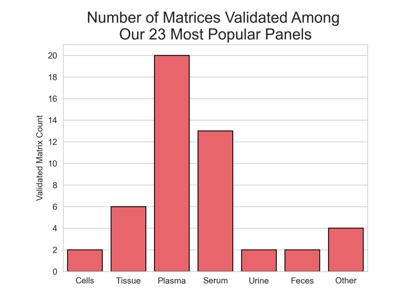
Validated Matrices Graph

Most of our panels are validated to RUO standards or higher for human plasma or serum. Exploratory panels give you the option to use any matrix for your research.

Going Beyond Validated Panels

Are you interested in using one of the targeted panels on our website but in an application that hasn’t been validated yet? Exploratory panels let you go beyond the validated panels by using these panels with any matrix. Exploratory panels are backed by our industry-leading technology to give specific, accurate results with no carryover. The only limitation is biological: are your target analytes present in the chosen matrix?

Exploratory or Validated?

The next step in preparing your experiment is to decide whether to run your experiment entirely with an exploratory panel or to have Metabolon perform validation. Validation will make your matrix and panel combination RUO-certified, with the additional stability and accuracy testing that goes with it. Validation is worth considering if you’re planning a long-term experimental pipeline with many rounds of analysis or developing a routine analysis workflow. Validation only has to happen once: on completion, the panel/matrix combination will be available at RUO level for all future experiments.

Running your analysis as an exploratory panel is a cost-effective option powered by Metabolon’s industry-leading technology. For new applications, Metabolon can help you reduce risk with an affordable range-finding service before committing to a full experimental workflow. Instead of running an entire experiment, we can run an analysis on a few samples to determine the presence of your target analytes in your chosen matrix. This offering does not return quantitative data but confirms the detection of your targets and can give you the confidence you need to submit your full-scale exploratory panel, with or without validation.

Learn more about our validated panels and contact us to discuss your research needs.

Metabolon
Our team is made up of over 45 PhDs, has been published 4,000+ times, and is committed to hard work, excellence, and success through collaboration. With over 15,000 projects, Metabolon has been a trusted partner of researchers for over 25 years.

Topics

Share this article

GET STARTED

Talk with an expert

Request a quote, get detailed information on sample types, or learn how metabolomics can accelerate your research. Find our contact details are here.

Find us on:

Talk with a Metabolomics expert

References

1. Zgoda-Pols, J.R., et al., Metabolomics analysis reveals elevation of 3-indoxyl sulfate in plasma and brain during chemically-induced acute kidney injury in mice: investigation of nicotinic acid receptor agonists. Toxicol Appl Pharmacol, 2011. 255(1): p. 48-56.

2. Bryant, J.A., et al., The impact of an oral purified microbiome therapeutic on the gastrointestinal microbiome. Nat Med, 2026. 32(1): p. 186-196

3. McGovern, B .H., et al., SER-109, an Investigational Microbiome Drugto Reduce Recurrence After Clostridioides difficile Infection: Lessons Learned From a Phase 2 Trial. Clin Infect Dis, 2021. 72(12): p. 2132-2140.

4. Feuerstadt, P., et al., SER-109, an Oral Microbiome Therapy for Recurrent Clostridioides difficile Infection. N Engl J Med, 2022. 386(3): p. 220-229.

5. Hu, Z., et al., Targeted metabolomics reveals novel diagnostic biomarkers for colorectal cancer. Mol Oncol, 2025. 19(6): p. 1737-1750.

6. Butler, F.M., et al., Vegetarian Dietary Patterns and Diet-Related Metabolites Are Associated With Kidney Function in the Adventist Health Study-2 Cohort. J Ren Nutr, 2025.

7. Stanford, J., et al., Metabolomic Profiling and Diet Quality Scoring in a Randomized Crossover Trial of Healthy and Typical Dietary Patterns. Mol Nutr Food Res, 2025 . 69(23): p. e70271.

8. O’Connor, L.E., et al., Metabolomic Profiling of an Ultraprocessed Dietary Pattern in a Domiciled Randomized Controlled Crossover Feeding Trial. J Nutr, 2023. 153(8): p. 2181-2192.

9. Fritsch, D.A., et al., Microbiome function underpins the efficacy of a fiber-supplemented dietary intervention in dogs with chronic large bowel diarrhea. BMC Vet Res, 2022. 18(1): p. 245.

10. Leal, L.N., et al., Preweaning nutrient supply improves lactation productivity and reduces the risk of culling in Holstein cows. J Dairy Sci, 2025. 108(6): p. 5875-5888.

11. Ahsin, M., et al., Soil and pasture health underlie improved beef nutrient density determined by untargeted metabolomics in Southern US grass finished beef systems. NPJ Sci Food, 2025. 9(1): p. 151.

12. Yin, W., et al., Plasma lipid profiling across species for the identification of optimal animal models of human dyslipidemia. J Lipid Res, 2012. 53(1): p. 51-65.

13. Porter, F .D., et al., Cholesterol oxidation products are sensitive and specific blood-based biomarkers for Niemann-Pick C1 disease. Sci Transl Med, 2010. 2(56): p. 56ra81.

14. Needham, B .D., et al., Plasma and Fecal Metabolite Profiles in Autism Spectrum Disorder. Biol Psychiatry, 2021. 89(5): p. 451-462

15. Li, C., et al., Estradiol and mTORC2 cooperate to enhance prostaglandin biosynthesis and tumorigenesis in TSC2-deficient LAM cells. J Exp Med, 2014. 211(1): p. 15-28.

16. Green, P.G., et al., Metabolic flexibility and reverse remodelling of the failing human heart. Eur Heart J, 2025. 46(25): p. 2422-2433.

17. Maekawa, H., et al., SGLT2 inhibition protects kidney function by SAM-dependent epigenetic repression of inflammatory genes under metabolic stress. J Clin Invest, 2025. 135(19).

18. Wu, D., et al., Integrated screens reveal that guanine nucleotide depletion, which is irreversible via targeting IMPDH2, inhibits pancreatic cancer and potentiates KRAS inhibition. Gut, 2026.

19. Schwerdtfeger, L.A., et al., Gut microbiota and metabolites are linked to disease progression in multiple sclerosis. Cell Rep Med, 2025. 6(4): p. 102055.

20. Wu, H., et al., Microbiome-metabolome dynamics associated with impaired glucose control and responses to lifestyle changes. Nat Med, 2025. 31(7): p. 2222-2231.

21. Jacobs, J.P., et al., Cognitive behavioral therapy for irritable bowel syndrome induces bidirectional alterations in the brain-gut-microbiome axis associated with gastrointestinal symptom improvement. Microbiome, 2021. 9(1): p. 236.

22. Pietzner, M., et al., Plasma metabolites to profile pathways in noncommunicable disease multimorbidity. Nat Med, 2021. 27(3): p. 471-479.

23. Faquih, T.O., et al., Robust Metabolomic Age Prediction Based on a Wide Selection of Metabolites. J Gerontol A Biol Sci Med Sci, 2025. 80(3).

24. Scherer, N., et al., Coupling metabolomics and exome sequencing reveals graded effects of rare damaging heterozygous variants on gene function and human traits. Nat Genet, 2025. 57(1): p. 193-205.

25. Holmes, Z.C., et al., Untargeted metabolomic analysis of human milk from healthy mothers reveals drivers of metabolite variability. Sci Rep, 2024. 14(1): p. 20827.

26. Titz, B., et al., Implications of Ocular Confounding Factors for Aqueous Humor Proteomic and Metabolomic Analyses in Retinal Diseases. Transl Vis Sci Technol, 2024. 13(6): p. 17.

27. Bloom, S.M., et al., Cysteine dependence of Lactobacillus iners is a potential therapeutic target for vaginal microbiota modulation. Nat Microbiol, 2022. 7(3): p. 434-450.

28. Leimer, E.M., et al., Lipid profile of human synovial fluid following intra-articular ankle fracture. J Orthop Res, 2017. 35(3): p. 657-666.