
Sample Collection | OMNImet™·GUT
OMNImet™·GUT from DNA Genotek, Validated by Metabolon
OMNImet•GUT (ME-200) is an all-in-one system for easy at-home collection, homogenization and room temperature stabilization of targeted and untargeted metabolites from fecal samples.

Sampling for Fecal Metabolomics
Fecal samples present unique practical challenges, requiring special handling during sample collection. To achieve complete stabilization and mitigate sub-sampling issues, samples should be homogenized at the point of collection. We’ve collaborated with DNA Genotek to deliver the first and only device designed for ambient-temperature storage and stabilization of human fecal samples for metabolomic analysis. For a comprehensive process of our validated process, download our whitepaper.
At-Home Collection Made Easy
We’ve collaborated with DNA Genotek to deliver the first and only device designed for ambient-temperature storage and stabilization of human fecal samples for metabolomic analysis.
Easy, private, comfortable collection
Improve patient experience and compliance with self-collection of high-quality samples, with no clinic visit or at-home sample freezing required.
Store and transport without freezing
DNA Genotek’s proprietary stabilization solution protects the integrity of the sample at ambient temperature for up to four days, eliminating cumbersome and costly cold-chain storage and shipping.
Validated for Metabolon’s global metabolomics and the Short Chain Fatty Acids Targeted Panel
Our validation studies have shown OMNImet·GUT protects and preserves the metabolomic profile of collected samples up to four days at room temperature for Metabolon’s Global Discovery Panel, which uses untargeted metabolomics, while short-chain fatty acid (SFCA) profiles are maintained for up to seven days at room temperature for our Short Chain Fatty Acids Targeted Panel.
Supports a multi-omics approach
OMNImet·GUT has the same user experience as other devices from DNA Genotek. This provides a familiar and tested method of at-home collection to reliably implement a multi-omics approach in your research.
Metabolon study success
OMNImet·GUT tubes are barcoded for sample traceability and compatibility with Metabolon’s Study Success Sample Handling Kit. These are supported as a Metabolon Preferred option for human fecal samples to achieve the fastest and most reliable results.
Metabolite Coverage in Samples Collected Using OMNImet·GUT (ME-200) Tubes
Flash freezing at -80°C is the gold standard of fecal sample collection, therefore metabolite coverage by Metabolon’s Global Discovery Panel in OMNImet•GUT samples was compared to this benchmark. The number of detected metabolites was similar between the two collection methods (Figure 1), showing that OMNImet•GUT does not introduce systematic bias or experimental artifacts and maintains a gold standard level of detection sensitivity for metabolomics analysis.

Figure 1. Preservation of metabolomic coverage. Technical replicate samples (n = 3) from each of 7 donors were collected into either a flash-frozen or an OMNImet•GUT device (ME-200), followed by immediate freezing at -80°C. The number of metabolites detected in all technical replicates (n = 3) of each donor’s samples is plotted.

Figure 2. Accurate measurement of individual metabolites and metabolic pathways. Correlation analysis across n = 7 biological replicates (after averaging each donor’s n = 3 technical replicates) in each OMNImet·GUT storage condition (baseline (T0), room temperature for 1, 4, or 7 days (T1, T4, T7), or freeze-thaw) vs. flash-frozen (FF). The median Spearman coefficient across each major class of biochemicals (metabolic superpathways) is plotted and the number of biochemicals in each super pathway (detected in flash-frozen samples) is labeled.
Stability of Metabolomics Using OMNImet·GUT (ME-200) Tubes
To measure stability, metabolites were measured at 0, 1, 4, and 7 days at room temperature and compared to flash-frozen samples (Spearman correlation). Metabolites were grouped by superpathway and Spearman coefficients were analyzed. Figure 2 shows that storage in OMNImet·GUT preserves the majority of metabolites with high fidelity for up to 7 days.
Validated for Metabolon’s Global Discovery Panel, Bile Acids Targeted Panel, and Short Chain Fatty Acids Targeted Panel
Short-chain fatty acids (SCFAs) are key mediators of gut microbial activity and play important roles in regulating the immune system, maintaining the gut epithelial barrier, and preventing disorders such as metabolic syndrome, inflammatory bowel disease and certain types of cancer.1 To test SCFAs using OMNImet·GUT, fecal samples from 7 donors were stored at room temperature for varying lengths of time in OMNImet·GUT. SCFA concentrations in raw samples at room temperature changed dramatically after 4 days, while OMNImet·GUT samples were unchanged (Figure 3). SCFAs remain stable in OMNImet·GUT at room temperature for at least 7 days. These results show that sample collection and storage in OMNImet·GUT allows for the accurate measurement of >800 metabolites per sample by Metabolon’s Global Discovery Panel, as well as the quantitative analysis of eight SCFAs.
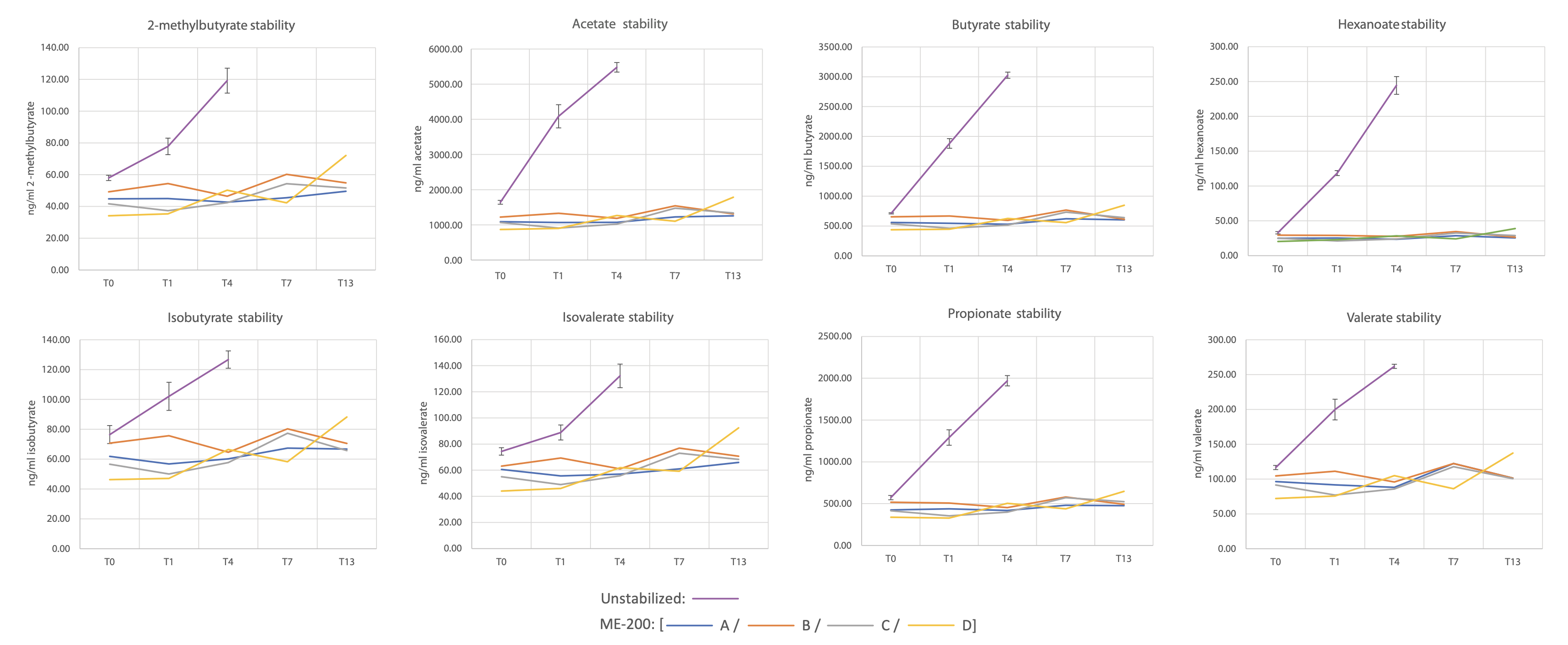
Figure 3. Stability of SCFAs in OMNImet·GUT. Aliquots of a 7-donor pooled raw fecal sample were either left unstabilized (n = 4 replicates) or stored in OMNImet·GUT (ME-200) (n = 4 replicates, A/B/C/D) at room temperature for the indicated number of days (T0 to T13), followed by quantification of eight SFCAs using targeted LC-MS/MS.
References
1.
Contact Us
Talk with an expert
Request a quote for our services, get more information on sample types and handling procedures, request a letter of support, or submit a question about how metabolomics can advance your research.
Corporate Headquarters
617 Davis Drive, Suite 100
Morrisville, NC 27560