
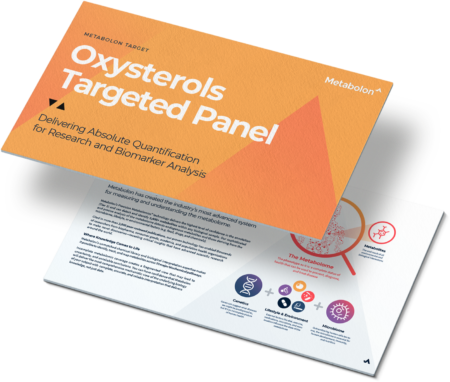
Los oxiesteroles son intermediarios en el desarrollo de ácidos biliares, hormonas esteroideas, vitamina D3 y otros marcadores bioactivos de la inflamación y otros estados patológicos. Los oxisteroles -productos oxidados de los esteroles- son intermediarios bioactivos asociados a ciertas enfermedades, y es necesario seguir investigando para comprender su papel en la patogénesis de las enfermedades. Los oxisteroles pueden influir en muchas enfermedades, desde las cardiovasculares, como la aterosclerosis, hasta la enfermedad de Alzheimer, la diabetes y el cáncer. Esto sugiere que una mayor investigación y comprensión de los oxisteroles puede ayudar a entender mejor estas afecciones.
Comprender a fondo el fenotipo de una enfermedad es crucial para un tratamiento eficaz, y la investigación metabolómica de las posibles causas de una enfermedad es el siguiente paso en la lucha por su prevención. Desafortunadamente, la detección e identificación de oxisteroles en metabolómica no dirigida puede ser un reto, y el desarrollo de ensayos personalizados es un enfoque típico para cuantificar analitos específicos como parte de una investigación más amplia. La elección de un amplio proveedor de metabolómica dirigida puede ofrecerle confianza en la cuantificación rutinaria de oxisteroles para su investigación.
The Metabolon Oxysterol Targeted Panel measures 12 oxysterols and related sterols of biological significance. Our validated method of oxysterol detection and identification in human plasma samples may enable you to gain additional insights in your research—helping you to discern whether oxysterols are a significant biomarker for a disease state or inflammatory response within your study and whether their detection can potentially be used as a precursor for medical screening.
With over 20 years’ experience helping commercial and academic studies gain insights from metabolomic analyses and with over 2,000 citations in scientific journals, Metabolon is leading the way in applied metabolomics solutions worldwide. Quality is at the core of everything we do. All methods are developed and validated according to ISO 9001:2015 standards, so you can be confident in our ability to match your quality standards.
(Scroll left/right to see full table)
| LLOQa | |
|---|---|
| Metabolito | Plasma |
| 24-Hidroxicolesterol | 10,0 ng/mL |
| 27-Hidroxicolesterol | 20,0 ng/mL |
| Desmosterol | 100 ng/mL |
| 7-Dihidrocolesterol | 100 ng/mL |
| 8-Dihidrocolesterol | 25,0 ng/mL |
| Lathosterol | 200 ng/mL |
| 5α, 6α-Epoxicolesterol | 15,0 ng/mL |
| 4β-Hidroxicolesterol | 5,00 ng/mL |
| Colesterol | 0,125 mg/mL |
| Lanosterol | 10,0 ng/mL |
| 5α, 6β-Dihidroxicolestanol | 10,0 ng/mL |
| 7α, 27-Dihidroxicolesterol | 10,0 ng/mL |
aLower Limit of Quantitation (LLOQ) varies for each sample type.
LC-MS/MS: Agilent 1290 UHPLC/Sciex QTrap 5500 and 6500+
(Scroll left/right to see full table)
| Tipo de muestra | Ejemplos de requisitos |
|---|---|
| Plasma | ≥ 250 µL |
Otros a petición
Disclaimer: This panel is for Research Use Only and is not to be used for diagnostic purposes.
Our readily available or custom developed quantitative assays help you achieve your research and biomarker validation objectives with precise and fully validated methods. Our targeted assays and panels cover more than 1,000 metabolites and lipids across a wide range of biochemical classes, metabolic pathways, and physiological processes, and they can be customized to best fit any application.
Las cardiopatías son una de las principales causas de muerte en todo el mundo, y existen numerosos factores que provocan ésta y otras enfermedades cardiovasculares (ECV). La metabolómica puede arrojar luz sobre las enfermedades cardiovasculares a múltiples niveles. En estudios preclínicos, como los realizados con cardiomiocitos o tejido cardiaco de organismos modelo, el conocimiento de la función mitocondrial, la energía y el estado redox puede aportar información esencial sobre los mecanismos de la enfermedad. En los estudios con seres humanos, la metabolómica ofrece la oportunidad de tener en cuenta factores de riesgo de ECV bien establecidos, como el colesterol y los lípidos complejos, al tiempo que se perfilan miles de otras sustancias bioquímicas de forma imparcial para permitir el descubrimiento de nuevos mecanismos y biomarcadores de la enfermedad.
La importancia de la inflamación en el desarrollo de múltiples enfermedades y trastornos relacionados con la salud, como la neurodegeneración, la diabetes, las enfermedades cardiovasculares, el cáncer y la enfermedad inflamatoria intestinal, es indiscutible. La metabolómica puede informar sobre los procesos inflamatorios al proporcionar una lectura de las pequeñas moléculas de un organismo, tejido, biofluido, etc. Esto permite un fenotipado molecular directo de la inflamación más allá de los marcadores proteínicos estándar de los ensayos típicos. Metabolon ofrece varios ensayos específicos, como oxiesteroles, ácidos grasos, cinurenina/triptófano y una serie de otros (carbono central, tolerancia a la glucosa, aminoácidos de cadena ramificada, β-hidroxibutirato) que también pueden informar sobre la salud cardiovascular general, a menudo relacionada con los procesos inflamatorios.
El metabolismo desregulado es esencial para el crecimiento y la proliferación de las células cancerosas, pero la fisiología del paciente forma parte de la ecuación tanto como el tumor. La metabolómica puede tanto identificar dianas farmacológicas específicas del cáncer como evaluar el fenotipo del paciente de forma más amplia, abordando cuestiones clave como: ¿Quién responderá a la terapia? ¿Cómo podemos ampliar el grupo de pacientes que responden? ¿Cómo predecir los efectos adversos? En general, la metabolómica informa la toma de decisiones y posiciona los programas de desarrollo para el éxito al proporcionar una lectura funcional del fenotipo molecular.
La diabetes es una enfermedad metabólica grave que afecta a más de 37 millones de estadounidenses y a 460 millones de personas en todo el mundo, según el informe más reciente de los Centros para el Control y la Prevención de Enfermedades. A pesar de ser una epidemia mundial, aún se desconoce mucho sobre los factores de riesgo individuales para el desarrollo de la diabetes, y actualmente se está investigando para identificar tratamientos nuevos y eficaces para la diabetes en todas sus fases. Al facilitar la evaluación de vías metabólicas específicas afectadas por la diabetes, la metabolómica selectiva puede ser una herramienta fundamental para identificar biomarcadores del desarrollo de la enfermedad con vistas a una intervención temprana y nuevas dianas para controlar la progresión de la enfermedad, así como para el desarrollo de nuevos fármacos con mecanismos de acción específicos.
Está bien establecido que una dieta cetogénica (DC) baja en carbohidratos y rica en grasas puede ayudar a tratar la epilepsia refractaria, que afecta a más de un tercio de los pacientes epilépticos que no responden a los fármacos anticonvulsivos existentes. Lo que los científicos no habían entendido hasta hace poco es cómo se traduce este tipo de dieta en la actividad cerebral. La respuesta a este aspecto de la epilepsia está en el microbioma intestinal. Hay muchos otros trastornos neurológicos como la enfermedad de Alzheimer, la ELA, la enfermedad de Parkinson y otros. Aunque aún queda mucho por saber sobre la ciencia del cerebro, sabemos que la metabolómica está en una posición única para entender el cerebro debido a la capacidad de los metabolitos, pequeñas moléculas, de atravesar la barrera hematoencefálica, lo que proporciona una perspectiva única.
Una vez que se comprende todo el valor de la metabolómica, la única pregunta que queda es: ¿quién lo hace mejor? Aunque muchos laboratorios cuentan con capacidades para la elaboración de perfiles de metabolitos o de química analítica, las tecnologías de metabolómica integrales son extremadamente escasas.
La identificación precisa e imparcial de los metabolitos en todo el metaboloma plantea retos en cuanto a la relación señal-ruido que muy pocos laboratorios están preparados para afrontar. Además, convertir cantidades ingentes de datos en información útil resulta lento, cuando no imposible, para la mayoría, ya que una interpretación adecuada requiere dos elementos de los que se carece: experiencia y una base de datos exhaustiva.
Gracias a nuestra sólida plataforma y a nuestras herramientas de visualización, nuestros expertos son los únicos capaces de ofrecerle más información sobre su molécula y desarrollar paneles de ensayos que le ayuden a concentrarse en los resultados que necesita.
Cobertura
Capacidad para interrogar a miles de metabolitos a través de diversos espacios bioquímicos, revelando nuevos conocimientos y oportunidades.
Comparabilidad
Capacidad para integrar los datos de diferentes estudios en el mismo conjunto de datos, en diferentes geografías, entre diferentes pacientes a lo largo del tiempo.
Competencia
Capacidad para informar sobre el diseño adecuado de los estudios, generar datos de alta calidad, obtener conocimientos biológicos y formular recomendaciones prácticas.
Capacidad
Capacidad para procesar cientos de miles de muestras de forma rápida y rentable para dar servicio a una demanda en rápido crecimiento.
Solicite un presupuesto para nuestros servicios, obtenga más información sobre tipos de muestras y procedimientos de manipulación, solicite una carta de apoyo o envíe una pregunta sobre cómo la metabolómica puede hacer avanzar su investigación.
Sede central
617 Davis Drive, Suite 100
Morrisville, NC 27560
Dirección postal
Apartado de correos 110407
Research Triangle Park, NC 27709
Teléfono
+1 (919) 572-1711
Fax
+1 (919) 572-1721
Sede central internacional
Metabolon
Zeppelinstraße 3
85399 Hallbergmoos
Alemania