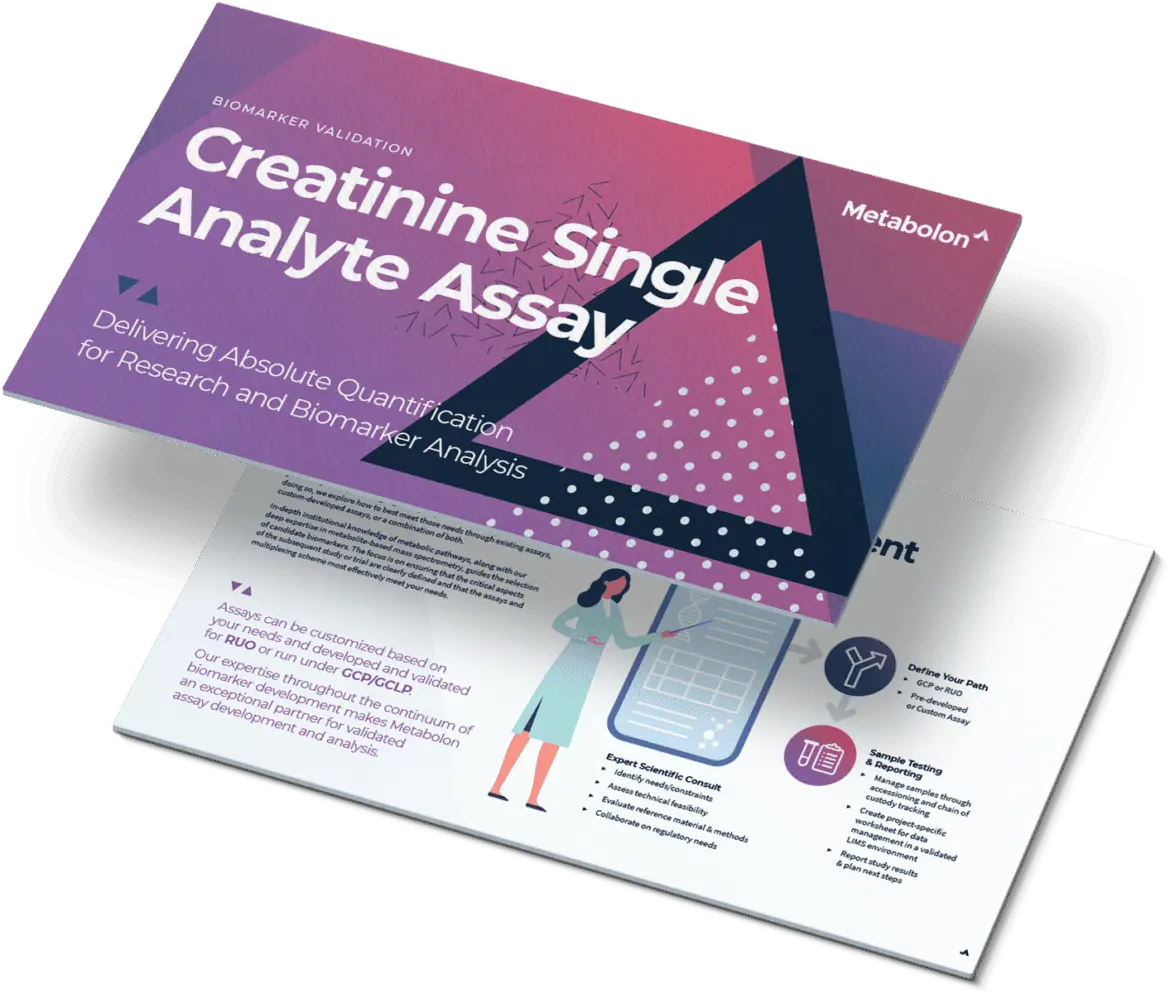
Creatinine is a breakdown product of creatine produced by muscles. Creatinine is removed from the body by the kidneys, which filter it from the blood and release it into the urine. Serum creatinine has been used as a biomarker for acute kidney injury and chronic kidney disease. Urinary creatinine is used to test sample dilution, and the biomarker-to-creatinine ratio can be used to correct the fluctuation of urine volume.
Metabolomics reveals biological insights otherwise unseen. For a successful metabolomics study, both small molecule discovery and the ability to dig deeper into specific biomarkers of interest are needed to uncover actionable insights that propel new therapeutic developments. A specific combination of liquid chromatography-mass spectrometry (LC-MS) technology and biochemical expertise is required to identify this biomarker of interest and develop an assay that is sensitive enough to explore it fully.
En Metabolon, comprendemos el papel crucial que desempeña la creatinina en las enfermedades renales, y hemos establecido la mejor experiencia en su detección. Este ensayo de creatinina se puede utilizar para rastrear la creatinina y mejorar la comprensión biológica a través de la investigación preclínica y clínica.
(Scroll left/right to see full table)
| LLOQa | |
|---|---|
| Orina | Suero/Plasma |
| 50 µg/mL | 2 µg/mL |
aLower Limit of Quantitation (LLOQ) varies for each sample type.
LC-MS/MS: Agilent 1290 UHPLC/Sciex QTrap 5500
(Scroll left/right to see full table)
| Tipo de muestra | Ejemplos de requisitos |
|---|---|
| Plasma/Suero | ≥ 150 µL |
| Orina | ≥ 150 µL |
Otros a petición
Disclaimer: This panel is for Research Use Only and is not to be used for diagnostic purposes.
Our readily available or custom developed quantitative assays help you achieve your research and biomarker validation objectives with precise and fully validated methods. Our targeted assays and panels cover more than 1,000 metabolites and lipids across a wide range of biochemical classes, metabolic pathways, and physiological processes, and they can be customized to best fit any application.
La diabetes es una enfermedad metabólica grave que afecta a más de 37 millones de estadounidenses y a 460 millones de personas en todo el mundo, según el informe más reciente de los Centros para el Control y la Prevención de Enfermedades. A pesar de ser una epidemia mundial, aún se desconoce mucho sobre los factores de riesgo individuales para el desarrollo de la diabetes, y actualmente se está investigando para identificar tratamientos nuevos y eficaces para la diabetes en todas sus fases. Al facilitar la evaluación de vías metabólicas específicas afectadas por la diabetes, la metabolómica selectiva puede ser una herramienta fundamental para identificar biomarcadores del desarrollo de la enfermedad con vistas a una intervención temprana y nuevas dianas para controlar la progresión de la enfermedad, así como para el desarrollo de nuevos fármacos con mecanismos de acción específicos.
Es necesario conocer mejor el funcionamiento normal y anormal de los tejidos renales y urológicos a nivel molecular y celular. La metabolómica no dirigida puede aplicarse a células cultivadas, tejidos de organismos modelo y biopsias de pacientes para descubrir los impulsores metabólicos de procesos como la muerte celular y la transformación maligna. Estos conocimientos pueden traducirse en biomarcadores procesables mediante paneles dirigidos de seguimiento.
Una vez que se comprende todo el valor de la metabolómica, la única pregunta que queda es: ¿quién lo hace mejor? Aunque muchos laboratorios cuentan con capacidades para la elaboración de perfiles de metabolitos o de química analítica, las tecnologías de metabolómica integrales son extremadamente escasas.
La identificación precisa e imparcial de los metabolitos en todo el metaboloma plantea retos en cuanto a la relación señal-ruido que muy pocos laboratorios están preparados para afrontar. Además, convertir cantidades ingentes de datos en información útil resulta lento, cuando no imposible, para la mayoría, ya que una interpretación adecuada requiere dos elementos de los que se carece: experiencia y una base de datos exhaustiva.
Gracias a nuestra sólida plataforma y a nuestras herramientas de visualización, nuestros expertos son los únicos capaces de ofrecerle más información sobre su molécula y desarrollar paneles de ensayos que le ayuden a concentrarse en los resultados que necesita.
Cobertura
Capacidad para interrogar a miles de metabolitos a través de diversos espacios bioquímicos, revelando nuevos conocimientos y oportunidades.
Comparabilidad
Capacidad para integrar los datos de diferentes estudios en el mismo conjunto de datos, en diferentes geografías, entre diferentes pacientes a lo largo del tiempo.
Competencia
Capacidad para informar sobre el diseño adecuado de los estudios, generar datos de alta calidad, obtener conocimientos biológicos y formular recomendaciones prácticas.
Capacidad
Capacidad para procesar cientos de miles de muestras de forma rápida y rentable para dar servicio a una demanda en rápido crecimiento.
Solicite un presupuesto para nuestros servicios, obtenga más información sobre tipos de muestras y procedimientos de manipulación, solicite una carta de apoyo o envíe una pregunta sobre cómo la metabolómica puede hacer avanzar su investigación.
Sede central
617 Davis Drive, Suite 100
Morrisville, NC 27560
Dirección postal
Apartado de correos 110407
Research Triangle Park, NC 27709
Teléfono
+1 (919) 572-1711
Fax
+1 (919) 572-1721
Sede central internacional
Metabolon
Zeppelinstraße 3
85399 Hallbergmoos
Alemania