
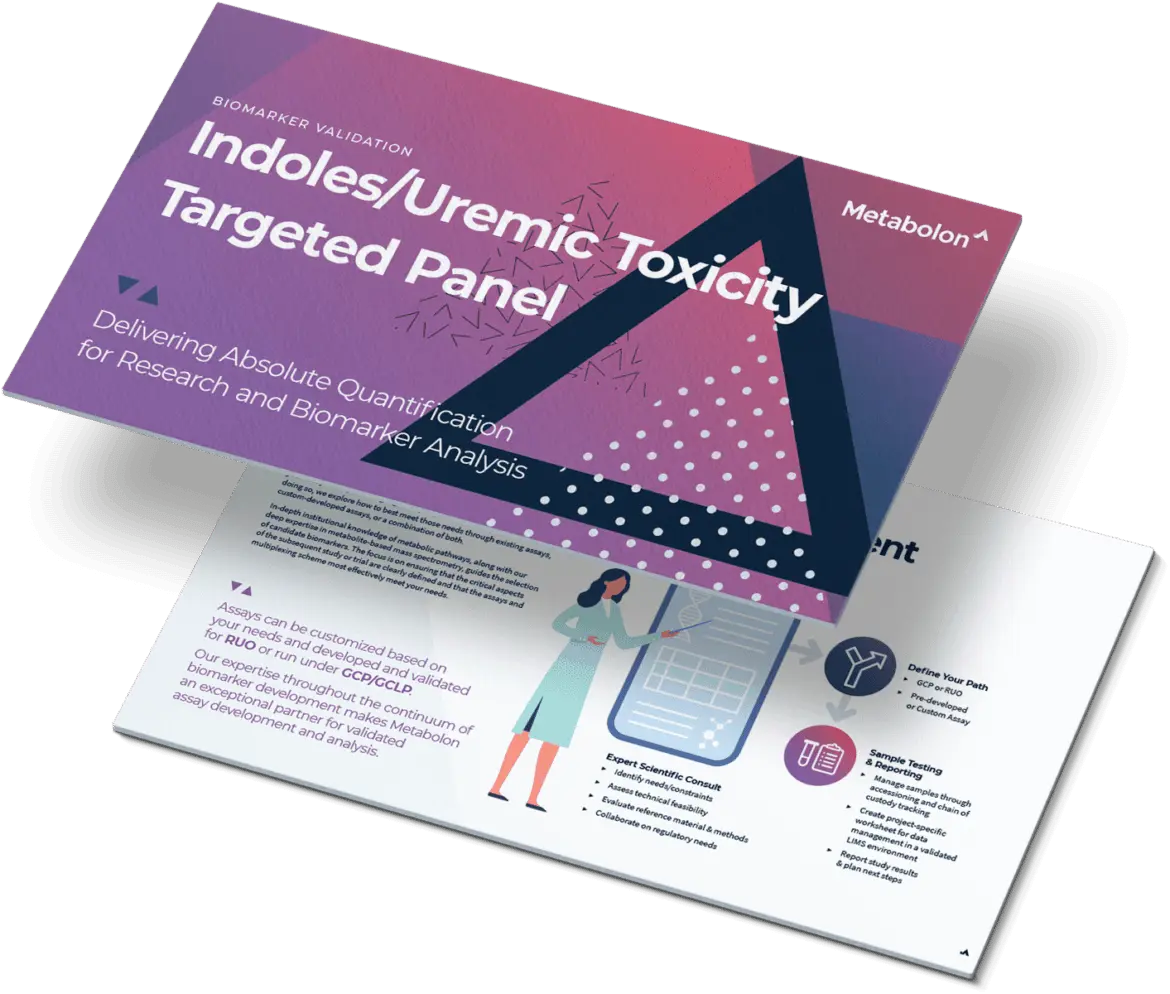
Uremic toxicity is the buildup of toxic analytes that are not able to be adequately filtered by the kidneys due to kidney injury or disease. Indole metabolites of tryptophan and the tyrosine metabolites p-cresol sulfate and 4-ethylphenyl sulfate are a key group of gut microbiota-derived uremic compounds. Their formation is the result of a complex interaction between diet, gut microbiota, and host. Increased production of these compounds by the gut microbiota and reduced clearance in kidney disease can lead to toxicity affecting nearly all systems in the body.
Metabolomics reveals biological insights otherwise unseen. For a successful metabolomics study, both small molecule discovery and the ability to dig deeper into specific biomarkers of interest are needed to uncover actionable insights that propel new therapeutic developments. A specific combination of liquid chromatography-mass spectrometry (LC-MS) technology and biochemical expertise is required to identify these biomarkers of interest and develop assays that are sensitive enough to explore them fully.
At Metabolon, we understand the crucial role indoles play in kidney disease, and we’ve established best-in-class expertise for their detection. This panel focuses on specific indoles and their metabolic pathways and can be used to track biomarkers and enhance biological understanding across preclinical and clinical research.
(Scroll left/right to see full table)
| LLOQa | |
|---|---|
| Metabolite | Plasma/Serum |
| 4-Ethylphenyl sulfate | 1.00 ng/mL |
| p-Cresol sulfate | 5.00 ng/mL |
| 3-Indoxyl sulfate | 10.0 ng/mL |
| Tryptophan | 500 ng/mL |
| 3-Indolelactic acid | 10.0 ng/mL |
| 3-Indolepropionic acid | 7.50 ng/mL |
aLower Limit of Quantitation (LLOQ) varies for each sample type.
LC-MS/MS: Agilent 1290 UHPLC/Sciex QTrap 5500
(Scroll left/right to see full table)
| Sample Type | Sample Requirements |
|---|---|
| Plasma | ≥ 150 µL |
Others on request
Disclaimer: This panel is for Research Use Only and is not to be used for diagnostic purposes.
Our readily available or custom developed quantitative assays help you achieve your research and biomarker validation objectives with precise and fully validated methods. Our targeted assays and panels cover more than 1,000 metabolites and lipids across a wide range of biochemical classes, metabolic pathways, and physiological processes, and they can be customized to best fit any application.
Recognized for our cutting-edge approach to metabolomics, Metabolon has been a valued resource for COVID-19 researchers worldwide. Our actionable metabolomic insights have fueled pivotal and high-profile studies like the National Institute of Allergy and Infectious Diseases (NIAID) IMPACC study research to improve understanding of high-risk patients and the Institute for Systems Biology research to improve understanding of high-risk patients. These and other metabolomics projects with actionable insights at Metabolon are helping get closer to the phenotype and pressing forward on COVID-19 answers.
Much about digestive diseases remains a mystery. Digestive disease includes a broad range of gastrointestinal-related health issues, ranging from chronic constipation to gastrointestinal infections to viral hepatitis. Irritable bowel syndrome (IBS) is estimated to impact between 25 and 45 million Americans and about 10 to 15 percent of the population worldwide. Although the exact cause of IBS is unknown, diet and microbiome are recurring influences. The unique ability for metabolomics to illuminate function, including those of microorganisms inhabiting the digestive tract, makes the technology a valuable tool for understanding IBS and other digestive conditions.
The kidneys are essential for the elimination of waste products, the regulation of osmolality and blood pressure, pH homeostasis, and the secretion of certain hormones. Chronic kidney disease (CKD) often occurs as a result of other diseases, such as diabetes or high blood pressure. The Targeted Panel team at Metabolon has developed multiple assays that can provide insights into the function of renal and urological tissue, such as the Creatinine Assay, Indoles/Uremic Toxicity Panel, and the Metal Cofactors and Toxic Metals Assay.
It is well-established that a low-carbohydrate, high-fat ketogenic diet (KD) can help treat refractory epilepsy, which affects more than a third of epileptic patients who don’t respond to existing anticonvulsive drugs. What scientists haven’t understood until recently is how this kind of diet translates to brain activity. The answer for this aspect of epilepsy lies in the gut microbiome. There are many other neurological disorders like Alzheimer’s disease, ALS, Parkinson’s disease, and more. While so much remains to be understood about brain science, we do know that metabolomics is uniquely poised to understand the brain because of the ability of metabolites, small molecules, to cross the blood-brain barrier providing unique insights.
Once you see the full value of metabolomics, the only remaining question is: who does it best? While many laboratories have metabolite profiling or analytical chemistry capabilities, comprehensive metabolomics technologies are extremely rare.
Accurate, unbiased metabolite identification across the entire metabolome introduces signal-to-noise challenges that very few labs are equipped to handle. Also, translating massive quantities of data into actionable information is slow, if not impossible, for most because proper interpretation takes two things that are in short supply: experience and a comprehensive database.
Using our robust platform and visualization tools, our experts are uniquely able to tell you more about your molecule and develop assay panels to help you zero in on the results you need.
Coverage
Ability to interrogate thousands of metabolites across diverse biochemical space, revealing new insights and opportunities
Comparability
Ability to integrate the data from different studies into the same dataset, in different geographies, among different patients over time
Competency
Ability to inform on proper study design, generate high‐quality data, derive biological insights, and make actionable recommendations
Capacity
Ability to process hundreds of thousands of samples quickly and cost‐efficiently to service rapidly growing demand
Request a quote for our services, get more information on sample types and handling procedures, request a letter of support, or submit a question about how metabolomics can advance your research.
Corporate Headquarters
617 Davis Drive, Suite 100
Morrisville, NC 27560
Mailing Address
P.O. Box 110407
Research Triangle Park, NC 27709
Phone
+1 (919) 572-1711
Fax
+1 (919) 572-1721
International Headquarters
Metabolon GmbH
Zeppelinstraße 3
85399 Hallbergmoos
Germany