
Isobutyric Acid

Isobutyric Acid

Linear Formula

C4H8O2

Synonyms

2-Methylpropanoic acid, isobutanoic acid

Share this metabolite

What is Isobutyric Acid?

Isobutyric acid, or 2-Methylpropanoic acid, is a branched short-chain fatty acid (BSCFA)1. Short-chain fatty acids (SCFAs) are carboxylic acids and consist of two to six carbon atoms and short aliphatic tails. BSCFAs, although similar to SCFAs, are derived during the fermentation of branched-chain amino acids (valine, leucine, and isoleucine).

Isobutyric acid is a colorless liquid and has a characteristic odor of rancid butter. As a plant metabolite, isobutyric acid can be found in certain foods such as carob and vanilla, as well as fermented beverages1.

Bacterial members of the gut microbiome can also produce SCFAs through the anaerobic fermentation of indigestible fibers2. These bacteria also produce BSCFAs like isobutyric acid but in considerably lower amounts3.

Isobutyric Acid and Gastrointestinal Health

The SCFAs produced by gut microbes are important for gastrointestinal health. Although BSCFAs like isobutyric acid are produced in lower amounts, emerging research has identified links between isobutyric acid and gut health.

In one study involving human adults, fecal levels of isobutyric acid and other BSCFAs were negatively correlated with fiber intake and BSCFA levels; however, there were no correlations with BSCFA levels and BMI4. Although associations are emerging, ongoing research continues to unravel the relationship between the gut microbiome, isobutyric acid, and gastrointestinal health.
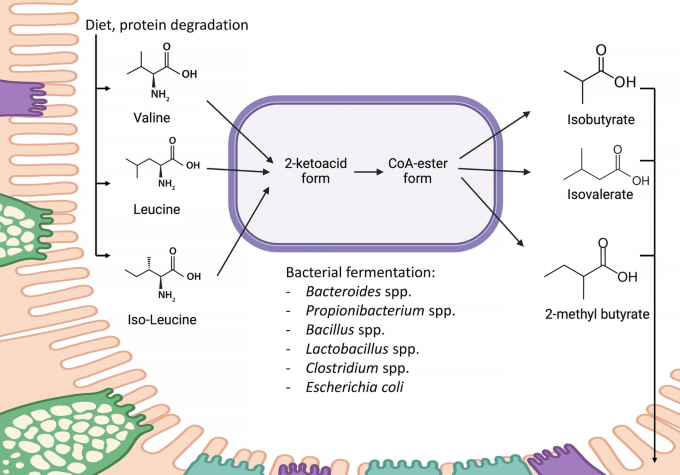
Isobutyric Acid

(Figure adapted from Salazar et al.)

Isobutyric Acid and Metabolic Health

BSCFAs have also been shown to impact metabolism and metabolic health. Similar to the effects of SCFAs on glucose and lipid metabolism, one in vitro study utilizing rat adipocytes found that administration of isobutyric acid increases insulin-stimulated glucose uptake and reduces phosphorylation of rate-limiting enzymes involved in lipolysis5. Overall, recent research is beginning to unravel the anti-obesogenic properties of BSCFAs like isobutyric acid.

Isobutyric Acid and Neuroscience

SCFAs and BSCFAs have also been implicated in modulating brain function. In experiments involving mouse models of Parkinson’s, researchers found that scheduled fasting has neuroprotective effects that are associated with changes in the gut microbiome. Interestingly, this study found that fasting in mice with characteristics of Parkinson’s reduces levels of isobutyric acid, and fecal transplants from normal, fasted mice to mouse models of Parkinson’se imparts neuroprotective effects6.

Isobutyric Acid and Cosmetics

The characteristic odor of isobutyric acid and its ester, isobutyrate, has been utilized in cosmetics and as a food additive. For example, benzyl isobutyrate has been used in shampoos and soaps for its fruity and jasmine-like odour7. Sucrose acetate isobutyrate is also commonly used as a “density-adjusting” agent in non-alcoholic carbonated and non-carbonated beverages8.

Isobutyric Acid and Drug Development

Isobutyric acid has seen considerable utility in drug development and the pharmaceutical industry. Flutamide, a nonsteroidal antiandrogen primarily used to treat prostate cancer, can be efficiently produced by acylating 4-nitro-3-trifluoromethylaniline with isobutyric acid chloride9.


References

  1. National Library of Medicine, National Center for Biotechnology Information (2023). PubChem Compound Summary, Isobutyric acid (CID 6590).
  2. Yuille, S., Reichardt, N., Panda, S., Dunbar, H., and Mulder, I.E. (2018). Human gut bacteria as potent class I histone deacetylase inhibitors in vitro through the production of butyric acid and valeric acid. PLoS One 13, e0201073.
  3. Lynch, C.J., and Adams, S.H. (2014). Branched-chain amino acids in metabolic signaling and insulin resistance. Nat Rev Endocrinol 10, 723-736.
  4. Rios-Covian, D., Gonzalez, S., Nogacka, A.M., Arboleya, S., Salazar, N., Gueimonde, M., and de Los Reyes-Gavilan, C.G. (2020). An Overview on Fecal Branched Short-Chain Fatty Acids Along Human Life and as Related With Body Mass Index: Associated Dietary and Anthropometric Factors. Front Microbiol 11, 973.
  5. Heimann, E., Nyman, M., Palbrink, A.K., Lindkvist-Petersson, K., and Degerman, E. (2016). Branched short-chain fatty acids modulate glucose and lipid metabolism in primary adipocytes. Adipocyte 5, 359-368.
  6. Zhou, Z.L., Jia, X.B., Sun, M.F., Zhu, Y.L., Qiao, C.M., Zhang, B.P., Zhao, L.P., Yang, Q., Cui, C., Chen, X., and Shen, Y.Q. (2019). Neuroprotection of Fasting Mimicking Diet on MPTP-Induced Parkinson’s Disease Mice via Gut Microbiota and Metabolites. Neurotherapeutics 16, 741-760.
  7. McGinty, D., Letizia, C.S., and Api, A.M. (2012). Fragrance material review on benzyl isobutyrate. Food Chem Toxicol 50 Suppl 2, S420-424.
  8. Reynolds, R.C., and Chappel, C.I. (1998). Sucrose acetate isobutyrate (SAIB): historical aspects of its use in beverages and a review of toxicity studies prior to 1988. Food Chem Toxicol 36, 81-93.
  9. Mohammad Ghaffarzadeh, S.R. (2014). A novel method for synthesis of flutamide on the bench-scale. Journal of Chemical Research 38.

References

1. Zgoda-Pols, J.R., et al., Metabolomics analysis reveals elevation of 3-indoxyl sulfate in plasma and brain during chemically-induced acute kidney injury in mice: investigation of nicotinic acid receptor agonists. Toxicol Appl Pharmacol, 2011. 255(1): p. 48-56.

2. Bryant, J.A., et al., The impact of an oral purified microbiome therapeutic on the gastrointestinal microbiome. Nat Med, 2026. 32(1): p. 186-196

3. McGovern, B .H., et al., SER-109, an Investigational Microbiome Drugto Reduce Recurrence After Clostridioides difficile Infection: Lessons Learned From a Phase 2 Trial. Clin Infect Dis, 2021. 72(12): p. 2132-2140.

4. Feuerstadt, P., et al., SER-109, an Oral Microbiome Therapy for Recurrent Clostridioides difficile Infection. N Engl J Med, 2022. 386(3): p. 220-229.

5. Hu, Z., et al., Targeted metabolomics reveals novel diagnostic biomarkers for colorectal cancer. Mol Oncol, 2025. 19(6): p. 1737-1750.

6. Butler, F.M., et al., Vegetarian Dietary Patterns and Diet-Related Metabolites Are Associated With Kidney Function in the Adventist Health Study-2 Cohort. J Ren Nutr, 2025.

7. Stanford, J., et al., Metabolomic Profiling and Diet Quality Scoring in a Randomized Crossover Trial of Healthy and Typical Dietary Patterns. Mol Nutr Food Res, 2025 . 69(23): p. e70271.

8. O’Connor, L.E., et al., Metabolomic Profiling of an Ultraprocessed Dietary Pattern in a Domiciled Randomized Controlled Crossover Feeding Trial. J Nutr, 2023. 153(8): p. 2181-2192.

9. Fritsch, D.A., et al., Microbiome function underpins the efficacy of a fiber-supplemented dietary intervention in dogs with chronic large bowel diarrhea. BMC Vet Res, 2022. 18(1): p. 245.

10. Leal, L.N., et al., Preweaning nutrient supply improves lactation productivity and reduces the risk of culling in Holstein cows. J Dairy Sci, 2025. 108(6): p. 5875-5888.

11. Ahsin, M., et al., Soil and pasture health underlie improved beef nutrient density determined by untargeted metabolomics in Southern US grass finished beef systems. NPJ Sci Food, 2025. 9(1): p. 151.

12. Yin, W., et al., Plasma lipid profiling across species for the identification of optimal animal models of human dyslipidemia. J Lipid Res, 2012. 53(1): p. 51-65.

13. Porter, F .D., et al., Cholesterol oxidation products are sensitive and specific blood-based biomarkers for Niemann-Pick C1 disease. Sci Transl Med, 2010. 2(56): p. 56ra81.

14. Needham, B .D., et al., Plasma and Fecal Metabolite Profiles in Autism Spectrum Disorder. Biol Psychiatry, 2021. 89(5): p. 451-462

15. Li, C., et al., Estradiol and mTORC2 cooperate to enhance prostaglandin biosynthesis and tumorigenesis in TSC2-deficient LAM cells. J Exp Med, 2014. 211(1): p. 15-28.

16. Green, P.G., et al., Metabolic flexibility and reverse remodelling of the failing human heart. Eur Heart J, 2025. 46(25): p. 2422-2433.

17. Maekawa, H., et al., SGLT2 inhibition protects kidney function by SAM-dependent epigenetic repression of inflammatory genes under metabolic stress. J Clin Invest, 2025. 135(19).

18. Wu, D., et al., Integrated screens reveal that guanine nucleotide depletion, which is irreversible via targeting IMPDH2, inhibits pancreatic cancer and potentiates KRAS inhibition. Gut, 2026.

19. Schwerdtfeger, L.A., et al., Gut microbiota and metabolites are linked to disease progression in multiple sclerosis. Cell Rep Med, 2025. 6(4): p. 102055.

20. Wu, H., et al., Microbiome-metabolome dynamics associated with impaired glucose control and responses to lifestyle changes. Nat Med, 2025. 31(7): p. 2222-2231.

21. Jacobs, J.P., et al., Cognitive behavioral therapy for irritable bowel syndrome induces bidirectional alterations in the brain-gut-microbiome axis associated with gastrointestinal symptom improvement. Microbiome, 2021. 9(1): p. 236.

22. Pietzner, M., et al., Plasma metabolites to profile pathways in noncommunicable disease multimorbidity. Nat Med, 2021. 27(3): p. 471-479.

23. Faquih, T.O., et al., Robust Metabolomic Age Prediction Based on a Wide Selection of Metabolites. J Gerontol A Biol Sci Med Sci, 2025. 80(3).

24. Scherer, N., et al., Coupling metabolomics and exome sequencing reveals graded effects of rare damaging heterozygous variants on gene function and human traits. Nat Genet, 2025. 57(1): p. 193-205.

25. Holmes, Z.C., et al., Untargeted metabolomic analysis of human milk from healthy mothers reveals drivers of metabolite variability. Sci Rep, 2024. 14(1): p. 20827.

26. Titz, B., et al., Implications of Ocular Confounding Factors for Aqueous Humor Proteomic and Metabolomic Analyses in Retinal Diseases. Transl Vis Sci Technol, 2024. 13(6): p. 17.

27. Bloom, S.M., et al., Cysteine dependence of Lactobacillus iners is a potential therapeutic target for vaginal microbiota modulation. Nat Microbiol, 2022. 7(3): p. 434-450.

28. Leimer, E.M., et al., Lipid profile of human synovial fluid following intra-articular ankle fracture. J Orthop Res, 2017. 35(3): p. 657-666.