Blog

Presented at ASBMB Deuel Conference on Lipids 2023: Lipidomics Indicates COVID-19 Severity

Richard Deuel

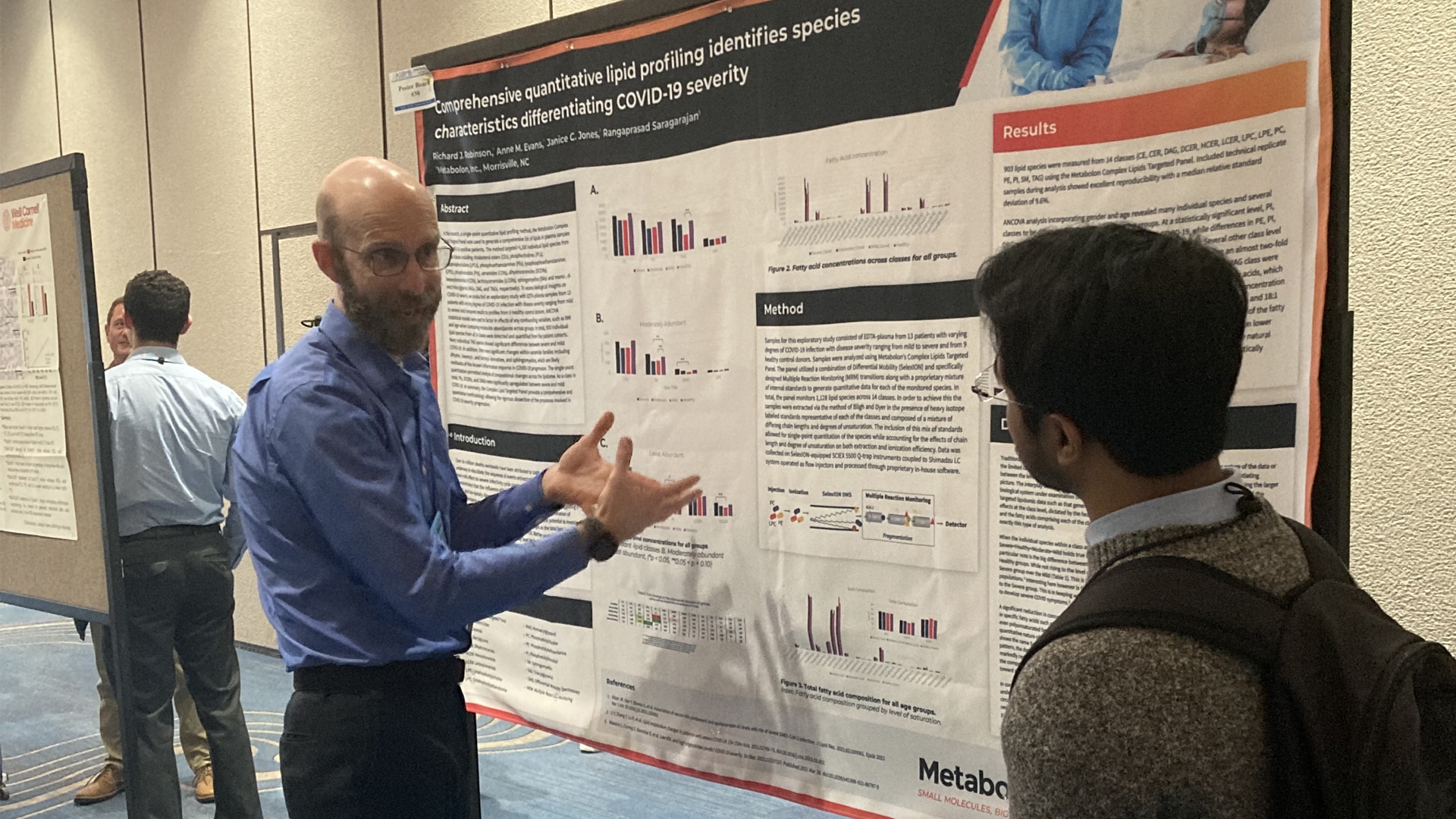
COVID-19, the disease caused by the SARS-CoV-2 virus, is responsible for about 15 million deaths globally since the pandemic began. Metabolon scientists, including Director of Research and Development, Dr. Annie Evans, have recently elucidated lipid profiles that stratify patients based on COVID-19 disease severity. Dr. Evans and her team presented their work at the American Society for Biochemistry and Molecular Biology (ASBMB) Deuel Conference on Lipids this March. This conference draws leading lipid investigators from around the world to discuss novel lipids research findings.

Unraveling COVID-19 Severity with Lipidomics

COVID-19 manifests in a variety of ways—not everyone suffers from all symptoms or from any symptoms at all. Still, others wind up in the hospital with severe disease manifestations that often cause death. Understanding the factors that impact disease severity progression can provide an opportunity to develop novel diagnostics to monitor disease progression and inform clinical management strategies to better control the disease and prevent death. 

Recent research suggests that lipid plasma levels, including high and low-density lipoproteins (HDLs and LDLs) correlate with infection severity. To further characterize this connection, Dr. Evans and colleagues leveraged Metabolon’s Complex Lipids Targeted Panel to identify lipids that differentiate infected individuals from healthy controls and also lipids that stratify infected individuals based on disease severity.

Lipids are notoriously difficult to study due to their diverse chemical structure. The Complex Lipids Targeted Panel is the only available panel that overcomes this challenge by providing both quantitative compositional analysis and complete speciation data. Dr. Evans played a key role in developing the panel, which covers 1,100 lipid species across 14 lipid classes, yielding unparalleled insight into the lipidome.

Elucidating the Lipid Profile of COVID-19

To determine whether unique lipid profiles are associated with COVID-19 disease severity, Dr. Evans and colleagues collected plasma samples from 13 patients with varying degrees of COVID-19 infection and from 9 healthy controls. A combination of Differential Mobility Spectroscopy (DMS) and Multiple Reaction Monitoring (MRM) identified 903 individual lipid species across all 14 lipid classes. There were significant differences in individual triacylglycerol (TAG) and ceramide family lipids between individuals with severe and mild COVID. Differences in ceramide lipids likely reflect the characteristic inflammatory response associated with COVID-19 progression and particularly with severe disease.

Lipidome-wide compositional changes were also observed, permitted by the Complex Lipids Targeted Panel’s single-point quantitation. Specifically, phosphatidylinositols, dihydroceramides, and diacylglycerols, as classes in total, were significantly upregulated between severe and mild COVID-19. Altogether, the comprehensive and quantitative methodology of the panel allowed a rigorous dissection of lipid changes involved in COVID-19 disease severity progression. 

The results that Dr. Evans presented at the ASBMB Deuel Conference are a significant addition to the existing body of knowledge regarding  the role of plasma lipids in COVID-19 severity. This work is a powerful example of how Metabolon’s best-in-class Complex Lipids Targeted Panel can further our understanding of disease etiology and progression to inform the development of improved diagnostics and treatment regimens.

Click here to learn more about Metabolon’s Complex Lipid Panel.

Click here to download the poster.

Richard Robinson
Richard Robinson serves as a Director in the Core R&D group at Metabolon. In his 10+ years with Metabolon, he has helped lead the development of the Global Discovery Panel, Complex Lipids Targeted Panel, Sphingolipids Targeted Panel, and Metal Analysis Targeted Panel. With over 20 years of analytical chemistry experience, he and his team remain focused on the usage of cutting-edge technology to deliver meaningful insights.

Topics

Share this article

GET STARTED

Talk with an expert

Request a quote, get detailed information on sample types, or learn how metabolomics can accelerate your research. Find our contact details are here.

Find us on:

Talk with a Metabolomics expert

References

1. Zgoda-Pols, J.R., et al., Metabolomics analysis reveals elevation of 3-indoxyl sulfate in plasma and brain during chemically-induced acute kidney injury in mice: investigation of nicotinic acid receptor agonists. Toxicol Appl Pharmacol, 2011. 255(1): p. 48-56.

2. Bryant, J.A., et al., The impact of an oral purified microbiome therapeutic on the gastrointestinal microbiome. Nat Med, 2026. 32(1): p. 186-196

3. McGovern, B .H., et al., SER-109, an Investigational Microbiome Drugto Reduce Recurrence After Clostridioides difficile Infection: Lessons Learned From a Phase 2 Trial. Clin Infect Dis, 2021. 72(12): p. 2132-2140.

4. Feuerstadt, P., et al., SER-109, an Oral Microbiome Therapy for Recurrent Clostridioides difficile Infection. N Engl J Med, 2022. 386(3): p. 220-229.

5. Hu, Z., et al., Targeted metabolomics reveals novel diagnostic biomarkers for colorectal cancer. Mol Oncol, 2025. 19(6): p. 1737-1750.

6. Butler, F.M., et al., Vegetarian Dietary Patterns and Diet-Related Metabolites Are Associated With Kidney Function in the Adventist Health Study-2 Cohort. J Ren Nutr, 2025.

7. Stanford, J., et al., Metabolomic Profiling and Diet Quality Scoring in a Randomized Crossover Trial of Healthy and Typical Dietary Patterns. Mol Nutr Food Res, 2025 . 69(23): p. e70271.

8. O’Connor, L.E., et al., Metabolomic Profiling of an Ultraprocessed Dietary Pattern in a Domiciled Randomized Controlled Crossover Feeding Trial. J Nutr, 2023. 153(8): p. 2181-2192.

9. Fritsch, D.A., et al., Microbiome function underpins the efficacy of a fiber-supplemented dietary intervention in dogs with chronic large bowel diarrhea. BMC Vet Res, 2022. 18(1): p. 245.

10. Leal, L.N., et al., Preweaning nutrient supply improves lactation productivity and reduces the risk of culling in Holstein cows. J Dairy Sci, 2025. 108(6): p. 5875-5888.

11. Ahsin, M., et al., Soil and pasture health underlie improved beef nutrient density determined by untargeted metabolomics in Southern US grass finished beef systems. NPJ Sci Food, 2025. 9(1): p. 151.

12. Yin, W., et al., Plasma lipid profiling across species for the identification of optimal animal models of human dyslipidemia. J Lipid Res, 2012. 53(1): p. 51-65.

13. Porter, F .D., et al., Cholesterol oxidation products are sensitive and specific blood-based biomarkers for Niemann-Pick C1 disease. Sci Transl Med, 2010. 2(56): p. 56ra81.

14. Needham, B .D., et al., Plasma and Fecal Metabolite Profiles in Autism Spectrum Disorder. Biol Psychiatry, 2021. 89(5): p. 451-462

15. Li, C., et al., Estradiol and mTORC2 cooperate to enhance prostaglandin biosynthesis and tumorigenesis in TSC2-deficient LAM cells. J Exp Med, 2014. 211(1): p. 15-28.

16. Green, P.G., et al., Metabolic flexibility and reverse remodelling of the failing human heart. Eur Heart J, 2025. 46(25): p. 2422-2433.

17. Maekawa, H., et al., SGLT2 inhibition protects kidney function by SAM-dependent epigenetic repression of inflammatory genes under metabolic stress. J Clin Invest, 2025. 135(19).

18. Wu, D., et al., Integrated screens reveal that guanine nucleotide depletion, which is irreversible via targeting IMPDH2, inhibits pancreatic cancer and potentiates KRAS inhibition. Gut, 2026.

19. Schwerdtfeger, L.A., et al., Gut microbiota and metabolites are linked to disease progression in multiple sclerosis. Cell Rep Med, 2025. 6(4): p. 102055.

20. Wu, H., et al., Microbiome-metabolome dynamics associated with impaired glucose control and responses to lifestyle changes. Nat Med, 2025. 31(7): p. 2222-2231.

21. Jacobs, J.P., et al., Cognitive behavioral therapy for irritable bowel syndrome induces bidirectional alterations in the brain-gut-microbiome axis associated with gastrointestinal symptom improvement. Microbiome, 2021. 9(1): p. 236.

22. Pietzner, M., et al., Plasma metabolites to profile pathways in noncommunicable disease multimorbidity. Nat Med, 2021. 27(3): p. 471-479.

23. Faquih, T.O., et al., Robust Metabolomic Age Prediction Based on a Wide Selection of Metabolites. J Gerontol A Biol Sci Med Sci, 2025. 80(3).

24. Scherer, N., et al., Coupling metabolomics and exome sequencing reveals graded effects of rare damaging heterozygous variants on gene function and human traits. Nat Genet, 2025. 57(1): p. 193-205.

25. Holmes, Z.C., et al., Untargeted metabolomic analysis of human milk from healthy mothers reveals drivers of metabolite variability. Sci Rep, 2024. 14(1): p. 20827.

26. Titz, B., et al., Implications of Ocular Confounding Factors for Aqueous Humor Proteomic and Metabolomic Analyses in Retinal Diseases. Transl Vis Sci Technol, 2024. 13(6): p. 17.

27. Bloom, S.M., et al., Cysteine dependence of Lactobacillus iners is a potential therapeutic target for vaginal microbiota modulation. Nat Microbiol, 2022. 7(3): p. 434-450.

28. Leimer, E.M., et al., Lipid profile of human synovial fluid following intra-articular ankle fracture. J Orthop Res, 2017. 35(3): p. 657-666.