

As the life sciences enter a new frontier in multiomics research, metabolomics has emerged as the connective tissue of systems biology, serving as the layer where genotype, environment, microbiome, and phenotype converge into measurable biological function. It is the closest molecular proxy to physiology itself and is increasingly recognized as the integrative axis around which meaningful multiomics interpretation is built [1], [2]
The metabolome is chemically unlike any other omic layer. It encompasses thousands of structurally distinct compound classes, many with concentrations that span more than ten orders of magnitude [3]. With this complexity, capturing it comprehensively, accurately and reproducibly is, in practice, an unsolved problem. The field has worked hard to push the boundaries of what can be detected, identified, and annotated, but that progress has come at a cost. Broader chemical coverage has historically required manipulating the analytical variables that govern detection: instrument run times and types, solvent gradients, ionization conditions, and column chemistry [4].
These choices rarely transfer cleanly between sites and the downstream consequence is a reproducibility problem that genomics and proteomics, operating on more standardized platforms, have largely solved [5] [6]. For investigators and consortia considering incorporating metabolomics into their research programs, that variability has been a legitimate reason for caution, slowing adoption in large-scale drug development and population research programs where metabolomics could contribute most. Thus, despite its immense potential, metabolomics has yet to achieve its full impact.
The scientific case for multiomics integration is well established. When molecular signals converge across independent biological layers, confidence in their biological relevance increases and the likelihood of translational success improves [7], [8]. However, the integration challenge is more acute for metabolomics than for any other omics. Metabolic pathways contain many molecules that remain difficult to detect experimentally. Incomplete coverage of metabolic networks can severely limit interpretation [9]. Therefore, researchers face a decision between integrating ‘features’ or small number of identified metabolites that encompass only a small percentage of the chemical space [10]. The most prevalent approaches in the field rely on machine learning and spectral feature matching against large reference databases for metabolite identification. However, these methods lack the method-specific tailoring and validation required to deliver accurate, reproducible data across laboratories.
On a practical level, researchers face challenges integrating these diverse and complex datasets. Each “omic” study is often conducted independently, managed by different vendors or teams, each with its own platforms, formats, and timelines. For CROs and sponsors, they must reconcile this data fragmentation, manage multiple contracts, and navigate mismatched outputs. For core mass spectrometry facilities, key hubs for metabolomics data generation, they grapple with the staffing and economics needed to support high-quality data processing. The effects are slower progress, increased risk, and missed opportunities. For multiomic programs seeking a functional biochemical readout of phenotype, metabolomics has held that potential, yet the field’s analytical heterogeneity has prevented it from delivering consistently.
Metabolon Verus™ Metabolomics Profiling Kit
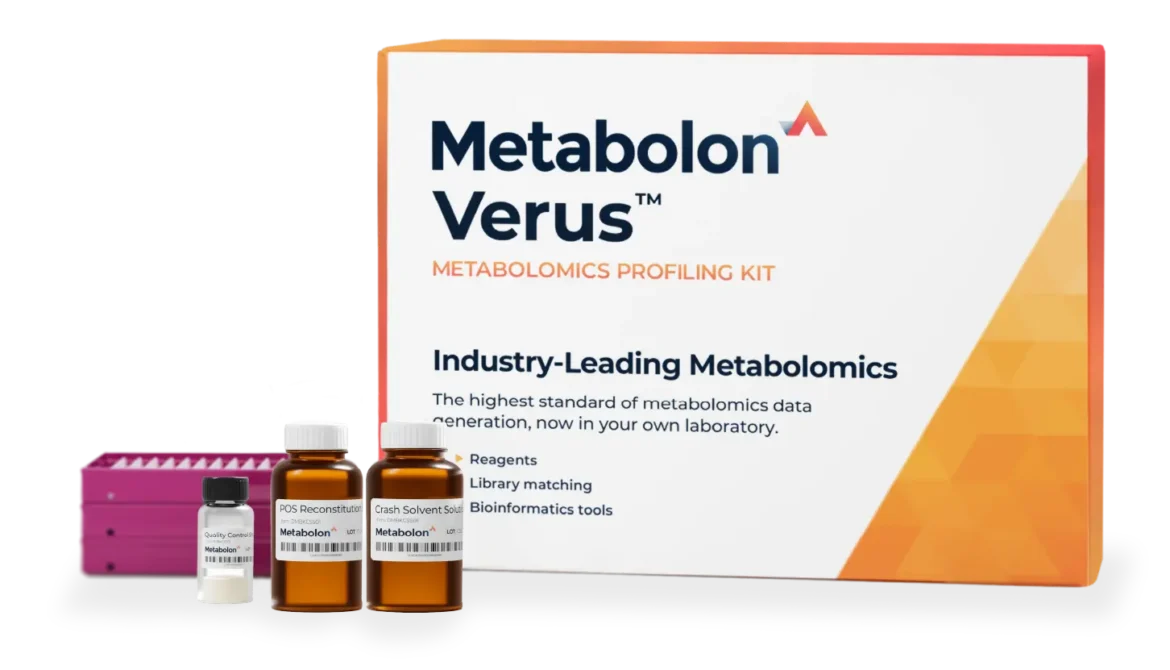
All of these challenges, both intrinsic to metabolomics and extrinsic to the growing demand for multiomics, have led us to create the Metabolon Verus Metabolomics Profiling Kit. The Metabolon kit encapsulates our experience over the last 25 years of delivering for diverse clients and biological applications. This enables us to deliver high biological coverage in each sample, matrix-specific libraries, and automated data processing and accurate annotation. All steps across the workflow are underpinned by harmonized methods, robust QA/QC, and rigorous testing and validation to ensure reproducibility from study to study and lab to lab. Our vision for the Metabolon Verus is for metabolomics to be routinely integrated into multiomics pipelines across any biological application.
The metabolite coverage in the Metabolon Verus kit provides breadth and depth across core metabolism, the exposome, and the microbiome, enabling you to relate metabolites to CVD, cancer, dementia, and many other applications. This coverage is grounded in the highest evidence burden for identifications for 80% of the reported metabolites, giving researchers confidence to infer outcomes [11]. By delivering broad metabolite coverage every time, researchers can interrogate more implicated pathways and disease mechanisms, including the TCA cycle, bile acid metabolism, obesity, and CVD.

A further differentiator of the Metabolon Verus Kit is its automated data processing and annotation, which cuts processing time from weeks to just 24 hours for one plate of 84 client samples. This approach is highly desirable for large-cohort studies and commercial labs, where high throughput and quality are paramount. In addition, the reduced processing time aligns with Genomics and Proteomics workflows, enabling better alignment of timelines and delivery for clients. To deploy this feature, Metabolon has leveraged its vast historical knowledge to create matrix-specific models, validated for accurate performance and tailored specifically to the Metabolon Verus Kit workflow, removing the need for manual optimization. The output achieves higher accuracy in metabolite identification than manual reviews and popular tools like Compound Discoverer and open-source tools like MzMine, enabling increased throughput without sacrificing quality.
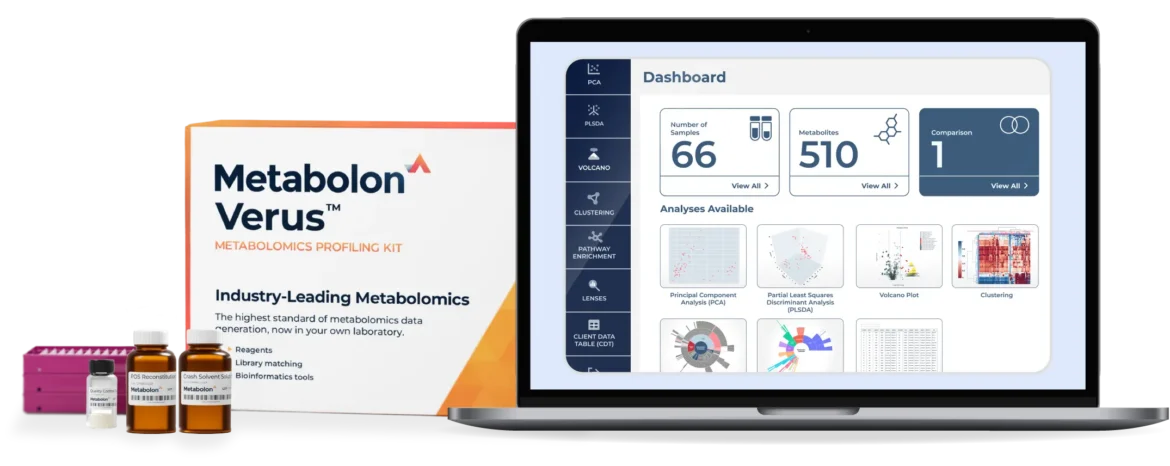
Lastly, to empower our scientists to manage the rapidly increasing volume of data and to reduce the complexity of data analysis and interpretation, we built our Integrated Bioinformatics Platform (IBP). All studies, regardless of size, are uploaded to the IBP. The IBP is designed to leverage data that can be meaningfully linked to other omics and clinical data. By examining these molecular layers together, researchers can uncover the complex interactions and regulatory mechanisms that drive biological processes. Data generated with the Metabolon Verus Kit are fully processed and annotated metabolites are delivered in the IBP within hours of raw data upload, where users can set up analyses and visualizations that include PCA plots, volcano plots, heat maps and pathway analysis, along with many other tools.
A key challenge in translational research is moving multiomics biomarker findings from exploratory readouts into embedded decision-making tools that inform trial design and drug development. Currently, one of the highest-impact applications of multiomics is in early-phase clinical development, where the primary objectives are effective patient stratification, mechanistic insights, and biomarker hypothesis generation [7], [12]. These settings offer the flexibility to explore multiple omics modalities while building the evidence base needed to justify larger investments in later-phase programs.
The Metabolon Verus Kit is well-positioned for early-phase settings, developing cross-functional alignment between translational research and clinical development teams, enabling faster time to insight, scaling seamlessly as programs grow, and fostering the collaboration and flexibility to pursue or abandon directions as the data dictates.
On a personal note, as the Product Manager for the Metabolon Verus kit, it has been a huge privilege to work alongside so many talented colleagues across teams including sales, marketing, software development, bioinformatics, analytical development, and corporate development. The release of this kit, Metabolon’s first decentralized product, is a testament to everyone’s hard work in getting to this point.
References
[1] H. Chen et al., “Functional metabolomics: unlocking the role of small molecular metabolites,” Front. Mol. Biosci., vol. 12, Jul. 2025, doi: 10.3389/fmolb.2025.1542100.
[2] Z. Wang et al., “Progress of metabolomics-centric multi-omics research in medicine,” iMetaOmics, vol. n/a, no. n/a, p. e70096, doi: 10.1002/imo2.70096.
[3] A. C. Schrimpe-Rutledge, S. G. Codreanu, S. D. Sherrod, and J. A. McLean, “Untargeted Metabolomics Strategies-Challenges and Emerging Directions,” J. Am. Soc. Mass Spectrom., vol. 27, no. 12, pp. 1897–1905, Dec. 2016, doi: 10.1007/s13361-016-1469-y.
[4] W. B. Dunn et al., “Procedures for large-scale metabolic profiling of serum and plasma using gas chromatography and liquid chromatography coupled to mass spectrometry,” Nat. Protoc., vol. 6, no. 7, pp. 1060–1083, Jun. 2011, doi: 10.1038/nprot.2011.335.
[5] D. Broadhurst et al., “Guidelines and considerations for the use of system suitability and quality control samples in mass spectrometry assays applied in untargeted clinical metabolomic studies,” Metabolomics Off. J. Metabolomic Soc., vol. 14, no. 6, p. 72, 2018, doi: 10.1007/s11306-018-1367-3.
[6] E. Defossez, J. Bourquin, S. von Reuss, S. Rasmann, and G. Glauser, “Eight key rules for successful data-dependent acquisition in mass spectrometry-based metabolomics,” Mass Spectrom. Rev., vol. 42, no. 1, pp. 131–143, 2023, doi: 10.1002/mas.21715.
[7] Z. Jiang, H. Zhang, Y. Gao, and Y. Sun, “Multi-omics strategies for biomarker discovery and application in personalized oncology,” Mol. Biomed., vol. 6, no. 1, p. 115, Nov. 2025, doi: 10.1186/s43556-025-00340-0.
[8] C. H. Wong, K. W. Siah, and A. W. Lo, “Estimation of clinical trial success rates and related parameters,” Biostatistics, vol. 20, no. 2, pp. 273–286, Apr. 2019, doi: 10.1093/biostatistics/kxx069.
[9] U. W. Liebal, A. N. T. Phan, M. Sudhakar, K. Raman, and L. M. Blank, “Machine Learning Applications for Mass Spectrometry-Based Metabolomics,” Metabolites, vol. 10, no. 6, p. 243, Jun. 2020, doi: 10.3390/metabo10060243.
[10] A. Amara et al., “Networks and Graphs Discovery in Metabolomics Data Analysis and Interpretation,” Front. Mol. Biosci., vol. 9, Mar. 2022, doi: 10.3389/fmolb.2022.841373.
[11] L. W. Sumner et al., “Proposed minimum reporting standards for chemical analysis,” Metabolomics, vol. 3, no. 3, pp. 211–221, Sep. 2007, doi: 10.1007/s11306-007-0082-2.
[12] E. Elayeh, S. M. Aleidi, O. Aboud, M. H. Semreen, Y. K. Bustanji, and L. A. Dahabiyeh, “Integrated Multi-Omics Approaches for Predicting Immune Checkpoint Inhibitor Response in NSCLC – Insights From Genomics, Proteomics, and Metabolomics,” Lung Cancer Targets Ther., vol. 16, pp. 167–198, Dec. 2025, doi: 10.2147/LCTT.S539777.