
3-Hydroxy Glutaric Acid

3-Hydroxy Glutaric Acid

Linear Formula

C5H8O5

Synonyms

beta-Hydroxyglutaric acid

Share this metabolite

What is 3-hydroxy glutaric acid?

3-hydroxy glutaric acid1 is a linear, five-carbon dicarboxylic acid that is formed as an intermediate in amino acid catabolism. As a metabolite in mammals, the regulation of 3-hydroxy glutaric acid is mediated by the enzyme glutaryl-CoA dehydrogenase (GCDH). GCDH is involved in the catabolism of lysine and tryptophan—amino acids sourced exclusively from food.

Although the mechanisms and signaling cascades involved with 3-hydroxy in mammals remain largely unknown, it serves as a critical biomarker for a rare genetic disorder called glutaric aciduria type 1 (GA1). Elevated levels of 3-hydroxy glutaric acid found in urine, blood, or cerebrospinal fluid (CSF) indicate GA1, and the symptoms are severe.
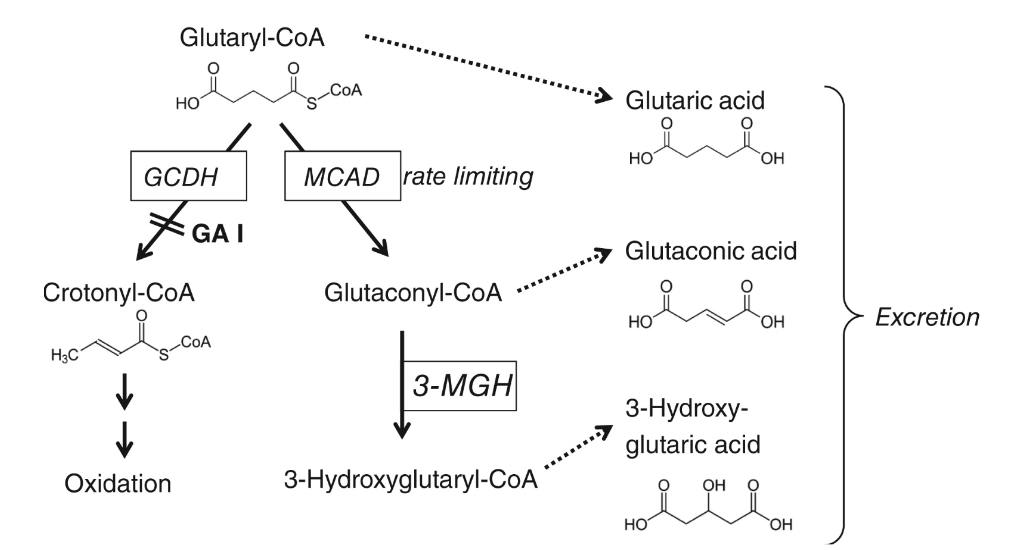
3-Hydroxy Glutaric Acid

(Figure from Peters et al., 2019)

3-hydroxyglutaric acid and glutaric aciduria type 1

GA1 is a disorder that begins a few months after birth and is estimated to affect 1 in 100,000 newborns2. The disorder disrupts amino acid degradation, a crucial process for survival, and is caused by mutations encoding GCDH. Decreases in GCDH initiate a corresponding increase in 3-hydroxyglutaric acid in biofluids like blood, urine, and CSF. Patients with GA1 have a 100-fold increase in 3-hydroxyglutaric acid levels in these biofluids, as well as elevated levels in the brain and liver compared to healthy controls3. Symptoms are life-threatening and include brain damage driven by infectious diseases or fever that can severely impact motor movements and limit life expectancy, cause cognitive dysfunction, and induce chronic kidney failure.

While increases in 3-hydroxy glutaric acid are indicative of GA1, elevated 3-hydroxy glutaric acid can also be a marker for a number of other diseases, including macrocephaly, hepatic and uremic encephalopathies, metabolic stroke, urea cycle defects, and mitochondrial disorders, infantile cerebral palsy, or child abuse.

Current treatments include dietary interventions; however, the long-term impact remains unknown and does not alleviate motor impairments.

3-hydroxy glutaric acid and Neuroscience

Since the relationship between 3-hydroxy glutaric acid and GA1 primarily involves significant damage to the central nervous system, this dicarboxylic acid has been referred to as a neurotoxin. Previous studies have demonstrated that 3-hydroxy glutaric acid can moderately impair oxygen consumption in the mitochondria of the cerebral cortex and striatum (important brain regions for coordinating motor movement). This suggests that 3-hydroxy glutaric acid could be orchestrating other processes that result in metabolic failures in GA14.

Other studies have demonstrated that once derived from lysine, 3-hydroxy glutaric acid cannot leave the nervous system. The accumulated 3-hydroxy glutaric acid elicits neurotoxic effects that include excitotoxicity (due to its similarity with glutamate, the primary excitatory neurotransmitter), redox homeostasis, impairs bioenergetics, promotes reactive astrogliosis, and damage to the blood-brain barrier4.

In an effort to understand what types of compounds might exert neuroprotective effects against 3-hydroxy glutaric acid, researchers examined the effects of a number of hormones and growth factors that might limit 3-hydroxy glutaric acid-induced toxicity in vitro. Interestingly, basic fibroblast growth factor and insulin-like growth factor, but not glutamate receptor antagonists, were effective in decreasing striatal cell death associated with 3-hydroxy glutaric acid exposure5.

Metabolon’s Custom Targeted Panels

Metabolon’s Custom Targeted Panels provide precise and accurate measurements of metabolites of your choice, such as 3-hydroxy glutaric acid. Metabolon has developed a suite of tools built from thousands of metabolomics studies to help you maximize the discovery potential of your metabolite research projects. Contact us today to learn more about our Custom Targeted Panels.

References

  1. National Library of Medicine, National Center for Biotechnology Information. PubChem Compound Summary, Glutaric acid (CID 743).
  2. Kolker S, Christensen E, Leonard JV et al. Diagnosis and management of glutaric aciduria type I–revised recommendations. J Inherit Metab Dis 2011;34(3): 677–694.
  3. Boy N, Muhlhausen C, Maier EM et al. Recommendations for diagnosing and managing individuals with glutaric aciduria type 1: Third revision. J Inherit Metab Dis 2023;46(3):482–519.
  4. Latini A, Rodriguez M, Borba Rosa R et al. 3-Hydroxyglutaric acid moderately impairs energy metabolism in brain of young rats. Neuroscience 2005;135(1):111–120.
  5. Bjugstad KB, Zawada WM, Goodman S et al. IGF-1 and bFGF reduce glutaric acid and 3-hydroxyglutaric acid toxicity in striatal cultures. J Inherit Metab Dis 2001;24(6):631–647.

References

1. Zgoda-Pols, J.R., et al., Metabolomics analysis reveals elevation of 3-indoxyl sulfate in plasma and brain during chemically-induced acute kidney injury in mice: investigation of nicotinic acid receptor agonists. Toxicol Appl Pharmacol, 2011. 255(1): p. 48-56.

2. Bryant, J.A., et al., The impact of an oral purified microbiome therapeutic on the gastrointestinal microbiome. Nat Med, 2026. 32(1): p. 186-196

3. McGovern, B .H., et al., SER-109, an Investigational Microbiome Drugto Reduce Recurrence After Clostridioides difficile Infection: Lessons Learned From a Phase 2 Trial. Clin Infect Dis, 2021. 72(12): p. 2132-2140.

4. Feuerstadt, P., et al., SER-109, an Oral Microbiome Therapy for Recurrent Clostridioides difficile Infection. N Engl J Med, 2022. 386(3): p. 220-229.

5. Hu, Z., et al., Targeted metabolomics reveals novel diagnostic biomarkers for colorectal cancer. Mol Oncol, 2025. 19(6): p. 1737-1750.

6. Butler, F.M., et al., Vegetarian Dietary Patterns and Diet-Related Metabolites Are Associated With Kidney Function in the Adventist Health Study-2 Cohort. J Ren Nutr, 2025.

7. Stanford, J., et al., Metabolomic Profiling and Diet Quality Scoring in a Randomized Crossover Trial of Healthy and Typical Dietary Patterns. Mol Nutr Food Res, 2025 . 69(23): p. e70271.

8. O’Connor, L.E., et al., Metabolomic Profiling of an Ultraprocessed Dietary Pattern in a Domiciled Randomized Controlled Crossover Feeding Trial. J Nutr, 2023. 153(8): p. 2181-2192.

9. Fritsch, D.A., et al., Microbiome function underpins the efficacy of a fiber-supplemented dietary intervention in dogs with chronic large bowel diarrhea. BMC Vet Res, 2022. 18(1): p. 245.

10. Leal, L.N., et al., Preweaning nutrient supply improves lactation productivity and reduces the risk of culling in Holstein cows. J Dairy Sci, 2025. 108(6): p. 5875-5888.

11. Ahsin, M., et al., Soil and pasture health underlie improved beef nutrient density determined by untargeted metabolomics in Southern US grass finished beef systems. NPJ Sci Food, 2025. 9(1): p. 151.

12. Yin, W., et al., Plasma lipid profiling across species for the identification of optimal animal models of human dyslipidemia. J Lipid Res, 2012. 53(1): p. 51-65.

13. Porter, F .D., et al., Cholesterol oxidation products are sensitive and specific blood-based biomarkers for Niemann-Pick C1 disease. Sci Transl Med, 2010. 2(56): p. 56ra81.

14. Needham, B .D., et al., Plasma and Fecal Metabolite Profiles in Autism Spectrum Disorder. Biol Psychiatry, 2021. 89(5): p. 451-462

15. Li, C., et al., Estradiol and mTORC2 cooperate to enhance prostaglandin biosynthesis and tumorigenesis in TSC2-deficient LAM cells. J Exp Med, 2014. 211(1): p. 15-28.

16. Green, P.G., et al., Metabolic flexibility and reverse remodelling of the failing human heart. Eur Heart J, 2025. 46(25): p. 2422-2433.

17. Maekawa, H., et al., SGLT2 inhibition protects kidney function by SAM-dependent epigenetic repression of inflammatory genes under metabolic stress. J Clin Invest, 2025. 135(19).

18. Wu, D., et al., Integrated screens reveal that guanine nucleotide depletion, which is irreversible via targeting IMPDH2, inhibits pancreatic cancer and potentiates KRAS inhibition. Gut, 2026.

19. Schwerdtfeger, L.A., et al., Gut microbiota and metabolites are linked to disease progression in multiple sclerosis. Cell Rep Med, 2025. 6(4): p. 102055.

20. Wu, H., et al., Microbiome-metabolome dynamics associated with impaired glucose control and responses to lifestyle changes. Nat Med, 2025. 31(7): p. 2222-2231.

21. Jacobs, J.P., et al., Cognitive behavioral therapy for irritable bowel syndrome induces bidirectional alterations in the brain-gut-microbiome axis associated with gastrointestinal symptom improvement. Microbiome, 2021. 9(1): p. 236.

22. Pietzner, M., et al., Plasma metabolites to profile pathways in noncommunicable disease multimorbidity. Nat Med, 2021. 27(3): p. 471-479.

23. Faquih, T.O., et al., Robust Metabolomic Age Prediction Based on a Wide Selection of Metabolites. J Gerontol A Biol Sci Med Sci, 2025. 80(3).

24. Scherer, N., et al., Coupling metabolomics and exome sequencing reveals graded effects of rare damaging heterozygous variants on gene function and human traits. Nat Genet, 2025. 57(1): p. 193-205.

25. Holmes, Z.C., et al., Untargeted metabolomic analysis of human milk from healthy mothers reveals drivers of metabolite variability. Sci Rep, 2024. 14(1): p. 20827.

26. Titz, B., et al., Implications of Ocular Confounding Factors for Aqueous Humor Proteomic and Metabolomic Analyses in Retinal Diseases. Transl Vis Sci Technol, 2024. 13(6): p. 17.

27. Bloom, S.M., et al., Cysteine dependence of Lactobacillus iners is a potential therapeutic target for vaginal microbiota modulation. Nat Microbiol, 2022. 7(3): p. 434-450.

28. Leimer, E.M., et al., Lipid profile of human synovial fluid following intra-articular ankle fracture. J Orthop Res, 2017. 35(3): p. 657-666.