
Learn More
About the Metabolon Verus™ Metabolomics Profiling Kit
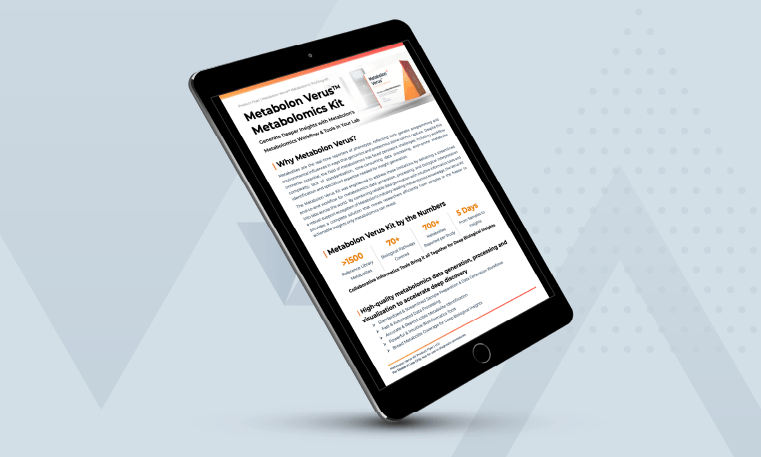
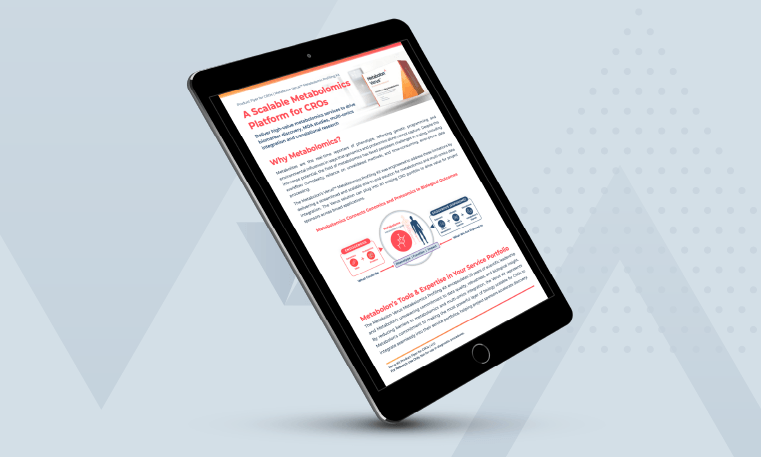
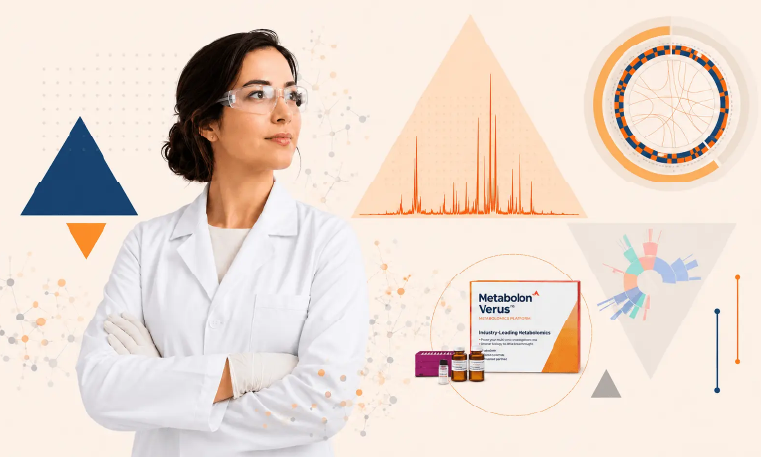
Watch now
Watch the announcement of the Metabolon Verus™ Metabolomics Profiling Kit at ASMS 2026
Learn more about the Metabolon Verus™ Metabolomics Profiling Kit
Watch the announcement of the Metabolon Verus™ Metabolomics Profiling Kit at ASMS 2026
Frequently Asked Questions
About the Metabolon Verus™ Metabolomics Profiling Kit
What Is the Metabolon Verus Kit?
What is the Kit, and who is it for?
The Metabolon Verus Metabolomics Profiling Kit brings the global standard for metabolomics directly into your laboratory. It enables labs with LC-MS instruments to leverage Metabolon’s expertise to generate data that are not only high quality but also standardized, comparable, and reproducible across studies and sites.
With broad metabolite and pathway coverage and an embedded QA/QC framework, researchers move beyond peak lists into a collaborative Integrated Bioinformatics Platform (IBP) environment underpinned by biological insight. Scientists can confidently compare study groups, prioritize biomarker candidates, and generate mechanistic hypotheses using statistically robust models and intuitive pathway visualization tools.
Beyond metabolomics alone, the Integrated Bioinformatics Platform enables seamless multiomics integration. Researchers can upload proteomics, microbiome, transcriptomics, and clinical datasets to perform integrated analyses, build predictive models, and uncover systems-level biology, accelerating discovery and insight all within a single secure platform.
The Kit is built for core facilities, biotech and pharmaceutical teams, CROs, and academic researchers who want to scale metabolomics with confidence, reproducibility, and interpretive depth. It strengthens collaboration across teams and institutions, shortens time to insight, and empowers scientists to translate complex metabolic data into decisive biological understanding that drives publications, partnerships, and innovation.
Our in-house pipeline is already optimized. Why should we switch?
The value of the Kit isn’t to replace your methods but rather to provide a validated and scalable method that can be used to compare across labs and studies.
Data Quality: The QC framework ensures reproducibility, allowing your clients to compare results directly with other labs without inter-lab variability or bias. That addresses the major bottlenecks in metabolomics. Independent of operator or site, the Kit delivers high accuracy and precision for all reported metabolites. This accuracy is comparable to or exceeds typical in-house pipelines for major metabolic pathways (lipids, acylcarnitines, amino acid derivatives, bile acids, TCA organic acids).
Throughput: You can easily implement this in your lab without extra stress, thanks to automated processing/annotation that eliminates manual curation. This allows for better allocation of scarce resources, taking on more projects and delivering to clients faster. A lot of our early adopters have used us to scale capacity and reduce bottlenecks, not to replace existing in-house methods.
Data Insights: Our Integrated Bioinformatics Platform enables your clients to analyze their data faster, gain insights sooner, publish faster and even come back to you with more projects!
How long can the Kit be stored for?
The Kit can be stored for 10 months after shipping date. Kits should be stored at 4°C.
What if I want to use a matrix that is not currently validated, such as CSF or saliva?
The Metabolon Verus™ Metabolomics Profiling Kit is currently validated for plasma/serum and urine. If your research requires a matrix outside of these, we recommend speaking with your Field Application Scientist before proceeding. They can discuss your project needs, assess feasibility, and advise on the best path forward. Please do not attempt to run unvalidated matrices through the kit workflow without this consultation.
Compatibility and Setup
What instruments (LC and MS) are compatible?
MS: Thermo Orbitrap family
- QExactive, QExactive HF
- Orbitrap Exploris 120, 240 and 480
- Tribrid (IQX, IDX)
LC:
- Waters Acquity I-class UPLC
- Thermo Vanquish Flex or Horizon.
Column:
- A Waters BEH C18 (2.1 × 100 mm, 1.7 µm) column is required for the Kit (not included).
Who can use the Kit to generate quality data?
The Kit can support data generation for a typical mass spectrometry expert with appropriate instrumentation and basic experience in biological sample preparation and analysis. It is highly recommended that any new user who wants to use the Kit be accompanied by an experienced mass-spec user.
We don’t have our own LC-MS instruments. Can we still use the Kit?
Most institutions have a mass spectrometry core or regional core facility. The Kit is designed for rapid adoption in core labs. If your lab doesn’t own LC-MS instruments, book time at your institutional core and request the Metabolon Verus™ Kit workflow.
Sample Preparation and Study Design
Which sample types are supported?
Currently, the following matrices are supported: plasma/serum (50 µL) and urine (25 µL), available across all modalities. More matrices will be available in the future.
Can I run different matrices on a plate?
Yes, one of the unique features of the Metabolon Verus Metabolomics Profiling Kit is its design for both multi-project and multi-matrix use within the same 96-well plate, helping labs maximize instrument utilization and throughput. A single plate can include multiple matrices (e.g., plasma, urine, cells, tissue), but each individual project must use a single matrix to ensure consistent processing, QC evaluation, and biologically meaningful comparability.
The Metabolon Verus Metabolomics Profiling Kit supports studies from 15 samples for pilot work through to 1,512 samples across 18 plates, using the same standardized workflow at every scale.
After acquisition, Metabolon’s automated data processing and annotation pipeline can run multiple projects in parallel, each mapped to its appropriate matrix library and performance expectations. This delivers faster, more consistent, and more reproducible outputs than manual curation, and returns results into the Integrated Bioinformatics Platform (IBP) where teams can interpret findings, collaborate, and extend analyses through multiomics integration with proteomics, microbiome, transcriptomics, and clinical data.
Do you have sample type-specific QCs included?
The kit includes KQC plasma, a technical replicate sample that is run throughout the plate to assess analytical performance and consistency across the run. Investigators can also optionally include their own technical replicate samples. A pooled sample matrix can be generated by combining a small amount of each experimental sample into a single pooled sample and generating technical replicate aliquots from it. The total number of pooled experimental QCs will depend on the size of the study. For the 84-sample project study, we recommend 8 Pooled QCs injected at regular intervals throughout the run.
Workflow, Data and Results
What are the deliverables?
The kit workflow produces three key deliverables, each designed to ensure data quality and guide you through to biological interpretation:
1. System Suitability Test (SST) Report: Performed before each ionization run, the SST confirms that instruments have been calibrated correctly, solvents have been prepared properly, and the correct method files have been selected. A pass/fail report is generated for the user to review before proceeding to sample extraction.
2. Plate QC (PQC) Report: Once a plate has been completed in each ionization mode, a PQC check is performed to verify that there is no retention deviation or instrument sensitivity loss. A pass/fail report is generated for the user to review before submitting data for processing.
A QC Guide is provided to help you evaluate both SST and PQC reports. If either stage returns a fail, the Troubleshooting Guide should be consulted before proceeding.
3. Final Curated Data Table (CDT) in the IBP: Following all QA/QC checks, your processed and annotated data is returned in the Integrated Bioinformatics Platform (IBP), where you can immediately begin statistical analysis, pathway exploration, and biological interpretation using the platform’s full suite of tools.
How long does the entire workflow take for a Kit?
The time required to complete sample analysis depends on the number of samples processed and varies slightly based on the user’s experience. In general, each plate requires 2-4 hours of sample extraction and 4 hours of instrument setup. The runtime for each ionization mode is 24 hours and 48 hours per plate. It is intended that the analysis of 84 samples in a single kit be accomplished within a 5-day workweek.
We highly recommend that new users spend time familiarizing themselves with the documentation, including the user guide, QC guide, and troubleshooting guide, as well as the User Interface and Integrated Bioinformatics Platform, before starting sample extraction. This will ensure a smoother experience when using the Kit.
Training and Support
Is training available for laboratories running the Verus Metabolomics Profiling Kit?
Yes. Metabolon provides comprehensive training for laboratories running the Metabolon Verus™ Metabolomics Profiling Kit through the Verus™ Academy platform:
https://verus.academy.metabolon.com/plus/
Training covers laboratory workflows, workflow management, project publication to researcher collaborators, and downstream data analysis within the Integrated Bioinformatics Platform (IBP).
What onboarding support is available for new laboratories?
New laboratories receive a comprehensive onboarding program delivered by a dedicated Field Applications Specialist. This onboarding is designed to help labs successfully implement workflows, operate the kit efficiently, and confidently manage data and projects in the IBP.
Is training available for researchers?
Yes. Researchers and collaborators have access to dedicated training through the Metabolon Verus™ Researcher Academy:
https://verus-researcher.academy.metabolon.com/plus/
This training includes an overview of how Metabolon Verus Kit data is generated, with a primary focus on downstream data analysis and interpretation within the Integrated Bioinformatics Platform (IBP).
What support resources are available for labs and researchers?
Metabolon will provide dedicated support resources for both laboratories running the Metabolon Verus Kit and researcher collaborators. More information to come at Launch.
Security, Privacy & Data Protection
Where is Verus data processed and stored?
Data generated through the Metabolon Verus™ Metabolomics Profiling Kit is processed within Metabolon’s secure cloud environment hosted in the United States. Client data is securely transferred to and managed within this protected infrastructure.
How does Metabolon protect client data in transit and at rest?
Metabolon uses industry-standard encryption technologies to protect client data. Data transmitted over public networks is secured using TLS 1.2 or higher, and stored data is protected using AES-256 encryption.
How are user accounts stored?
User accounts are protected using Multi-Factor Authentication (MFA), which adds an additional layer of security beyond passwords and helps prevent unauthorized access and account sharing. Access to systems is also managed through role-based permissions and approval workflows.
Is activity within the platform monitored and traceable?
Yes. Metabolon maintains internal audit and activity tracking capabilities to support security oversight, accountability, and investigation of operational or security events. These audit logs are part of Metabolon’s internal security and compliance processes and are not accessible to platform users. Logs are maintained for a minimum of three years, are accessible only by authorized Metabolon team members, and are protected from modification or deletion.
Does Metabolon follow recognized security and privacy standards?
Yes. Metabolon maintains a comprehensive Information Security and Data Governance Program aligned with industry best practices and global privacy expectations, including GDPR, HIPAA, and CCPA requirements. Security and privacy oversight includes dedicated Information Security and Data Protection leadership and is in alignment with ISO 27001.
How does Metabolon manage security incidents?
Metabolon maintains documented incident response procedures with 24/7 monitoring and response capabilities. Security readiness is regularly tested through simulation and tabletop exercises to ensure rapid detection, containment, and remediation of incidents.
How does Metabolon ensure platform reliability and business continuity?
Metabolon maintains formal business continuity and disaster recovery procedures, including controlled backups, recovery testing, and defined recovery objectives to support operational resilience and data integrity.
How does Metabolon manage vulnerabilities?
Metabolon maintains a formal vulnerability management program to identify, assess, prioritize, remediate, and verify security vulnerabilities across enterprise systems, applications, endpoints, network devices, cloud environments, and relevant third-party platforms. Vulnerability scanning is performed routinely, including recurring scans and remediation is prioritized based on severity, exploitability, and business risk. Metabolon also conducts penetration testing and application security assessments, and identified findings are tracked through remediation, validation, and closure. Patch deployment and remediation activities are supported by tools such as Automox, with oversight by Information Security and responsible system owners.
Frequently Asked Questions about the Metabolon Verus™ Metabolomics Profiling Kit
What Is the Metabolon Verus Kit?
What is the Kit, and who is it for?
The Metabolon Verus Metabolomics Profiling Kit brings the global standard for metabolomics directly into your laboratory. It enables labs with LC-MS instruments to leverage Metabolon’s expertise to generate data that are not only high quality but also standardized, comparable, and reproducible across studies and sites.
With broad metabolite and pathway coverage and an embedded QA/QC framework, researchers move beyond peak lists into a collaborative Integrated Bioinformatics Platform (IBP) environment underpinned by biological insight. Scientists can confidently compare study groups, prioritize biomarker candidates, and generate mechanistic hypotheses using statistically robust models and intuitive pathway visualization tools.
Beyond metabolomics alone, the Integrated Bioinformatics Platform enables seamless multiomics integration. Researchers can upload proteomics, microbiome, transcriptomics, and clinical datasets to perform integrated analyses, build predictive models, and uncover systems-level biology, accelerating discovery and insight all within a single secure platform.
The Kit is built for core facilities, biotech and pharmaceutical teams, CROs, and academic researchers who want to scale metabolomics with confidence, reproducibility, and interpretive depth. It strengthens collaboration across teams and institutions, shortens time to insight, and empowers scientists to translate complex metabolic data into decisive biological understanding that drives publications, partnerships, and innovation.
Our in-house pipeline is already optimized. Why should we switch?
The value of the Kit isn’t to replace your methods but rather to provide a validated and scalable method that can be used to compare across labs and studies.
Data Quality: The QC framework ensures reproducibility, allowing your clients to compare results directly with other labs without inter-lab variability or bias. That addresses the major bottlenecks in metabolomics. Independent of operator or site, the Kit delivers high accuracy and precision for all reported metabolites. This accuracy is comparable to or exceeds typical in-house pipelines for major metabolic pathways (lipids, acylcarnitines, amino acid derivatives, bile acids, TCA organic acids).
Throughput: You can easily implement this in your lab without extra stress, thanks to automated processing/annotation that eliminates manual curation. This allows for better allocation of scarce resources, taking on more projects and delivering to clients faster. A lot of our early adopters have used us to scale capacity and reduce bottlenecks, not to replace existing in-house methods.
Data Insights: Our Integrated Bioinformatics Platform enables your clients to analyze their data faster, gain insights sooner, publish faster and even come back to you with more projects!
How long can the Kit be stored for?
The Kit can be stored for 10 months after shipping date. Kits should be stored at 4°C.
What if I want to use a matrix that is not currently validated, such as CSF or saliva?
The Metabolon Verus™ Metabolomics Profiling Kit is currently validated for plasma/serum and urine. If your research requires a matrix outside of these, we recommend speaking with your Field Application Scientist before proceeding. They can discuss your project needs, assess feasibility, and advise on the best path forward. Please do not attempt to run unvalidated matrices through the kit workflow without this consultation.
Compatibility and Setup
What instruments (LC and MS) are compatible?
MS: Thermo Orbitrap family
- QExactive, QExactive HF
- Orbitrap Exploris 120, 240 and 480
- Tribrid (IQX, IDX)
LC:
- Waters Acquity I-class UPLC
- Thermo Vanquish Flex or Horizon.
Column:
- A Waters BEH C18 (2.1 × 100 mm, 1.7 µm) column is required for the Kit (not included).
Who can use the Kit to generate quality data?
The Kit can support data generation for a typical mass spectrometry expert with appropriate instrumentation and basic experience in biological sample preparation and analysis. It is highly recommended that any new user who wants to use the Kit be accompanied by an experienced mass-spec user.
We don’t have our own LC-MS instruments. Can we still use the Kit?
Most institutions have a mass spectrometry core or regional core facility. The Kit is designed for rapid adoption in core labs. If your lab doesn’t own LC-MS instruments, book time at your institutional core and request the Verus™ Kit workflow.
Sample Preparation and Study Design
Which sample types are supported?
Currently, the following matrices are supported: plasma/serum (50 µL) and urine (25 µL), available across all modalities. More matrices will be available in the future.
Can I run different matrices on a plate?
Yes, one of the unique features of the Metabolon Verus Metabolomics Profiling Kit is its design for both multi-project and multi-matrix use within the same 96-well plate, helping labs maximize instrument utilization and throughput. A single plate can include multiple matrices (e.g., plasma, urine, cells, tissue), but each individual project must use a single matrix to ensure consistent processing, QC evaluation, and biologically meaningful comparability.
The Metabolon Verus Metabolomics Profiling Kit supports studies from 15 samples for pilot work through to 1,512 samples across 18 plates, using the same standardized workflow at every scale.
After acquisition, Metabolon’s automated data processing and annotation pipeline can run multiple projects in parallel, each mapped to its appropriate matrix library and performance expectations. This delivers faster, more consistent, and more reproducible outputs than manual curation, and returns results into the Integrated Bioinformatics Platform (IBP) where teams can interpret findings, collaborate, and extend analyses through multiomics integration with proteomics, microbiome, transcriptomics, and clinical data.
Do you have sample type-specific QCs included?
The kit includes KQC plasma, a technical replicate sample that is run throughout the plate to assess analytical performance and consistency across the run. Investigators can also optionally include their own technical replicate samples. A pooled sample matrix can be generated by combining a small amount of each experimental sample into a single pooled sample and generating technical replicate aliquots from it. The total number of pooled experimental QCs will depend on the size of the study. For the 84-sample project study, we recommend 8 Pooled QCs injected at regular intervals throughout the run.
Workflow, Data and Results
What are the deliverables?
The kit workflow produces three key deliverables, each designed to ensure data quality and guide you through to biological interpretation:
1. System Suitability Test (SST) Report: Performed before each ionization run, the SST confirms that instruments have been calibrated correctly, solvents have been prepared properly, and the correct method files have been selected. A pass/fail report is generated for the user to review before proceeding to sample extraction.
2. Plate QC (PQC) Report: Once a plate has been completed in each ionization mode, a PQC check is performed to verify that there is no retention deviation or instrument sensitivity loss. A pass/fail report is generated for the user to review before submitting data for processing.
A QC Guide is provided to help you evaluate both SST and PQC reports. If either stage returns a fail, the Troubleshooting Guide should be consulted before proceeding.
3. Final Curated Data Table (CDT) in the IBP: Following all QA/QC checks, your processed and annotated data is returned in the Integrated Bioinformatics Platform (IBP), where you can immediately begin statistical analysis, pathway exploration, and biological interpretation using the platform’s full suite of tools.
How long does the entire workflow take for a Kit?
The time required to complete sample analysis depends on the number of samples processed and varies slightly based on the user’s experience. In general, each plate requires 2-4 hours of sample extraction and 4 hours of instrument setup. The runtime for each ionization mode is 24 hours and 48 hours per plate. It is intended that the analysis of 84 samples in a single kit be accomplished within a 5-day workweek.
We highly recommend that new users spend time familiarizing themselves with the documentation, including the user guide, QC guide, and troubleshooting guide, as well as the User Interface and Integrated Bioinformatics Platform, before starting sample extraction. This will ensure a smoother experience when using the Kit.
Training and Support
Is training available for laboratories running the Verus Metabolomics Profiling Kit?
Yes. Metabolon provides comprehensive training for laboratories running the Metabolon Verus™ Metabolomics Profiling Kit through the Verus Academy platform:
https://verus.academy.metabolon.com/plus/
Training covers laboratory workflows, workflow management, project publication to researcher collaborators, and downstream data analysis within the Integrated Bioinformatics Platform (IBP).
What onboarding support is available for new laboratories?
New laboratories receive a comprehensive onboarding program delivered by a dedicated Field Applications Specialist. This onboarding is designed to help labs successfully implement workflows, operate the kit efficiently, and confidently manage data and projects in the IBP.
Is training available for researchers?
Yes. Researchers and collaborators have access to dedicated training through the Verus Researcher Academy:
https://verus-researcher.academy.metabolon.com/plus/
This training includes an overview of how Metabolon Verus Kit data is generated, with a primary focus on downstream data analysis and interpretation within the Integrated Bioinformatics Platform (IBP).
What support resources are available for labs and researchers?
Metabolon provides dedicated email support for both laboratories running the Verus Kit and researcher collaborators. Support is available at:
Security, Privacy & Data Protection
Where is Verus data processed and stored?
Data generated through the Verus Metabolomics Profiling Kit is processed within Metabolon’s secure cloud environment hosted in the United States. Client data is securely transferred to and managed within this protected infrastructure.
How does Metabolon protect client data in transit and at rest?
Metabolon uses industry-standard encryption technologies to protect client data. Data transmitted over public networks is secured using TLS 1.2 or higher, and stored data is protected using AES-256 encryption.
How are user accounts stored?
User accounts are protected using Multi-Factor Authentication (MFA), which adds an additional layer of security beyond passwords and helps prevent unauthorized access and account sharing. Access to systems is also managed through role-based permissions and approval workflows.
Is activity within the platform monitored and traceable?
Yes. Metabolon maintains internal audit and activity tracking capabilities to support security oversight, accountability, and investigation of operational or security events. These audit logs are part of Metabolon’s internal security and compliance processes and are not accessible to platform users. Logs are maintained for a minimum of three years, are accessible only by authorized Metabolon team members, and are protected from modification or deletion.
Does Metabolon follow recognized security and privacy standards?
Yes. Metabolon maintains a comprehensive Information Security and Data Governance Program aligned with industry best practices and global privacy expectations, including GDPR, HIPAA, and CCPA requirements. Security and privacy oversight includes dedicated Information Security and Data Protection leadership and is in alignment with ISO 27001.
How does Metabolon manage security incidents?
Metabolon maintains documented incident response procedures with 24/7 monitoring and response capabilities. Security readiness is regularly tested through simulation and tabletop exercises to ensure rapid detection, containment, and remediation of incidents.
How does Metabolon ensure platform reliability and business continuity?
Metabolon maintains formal business continuity and disaster recovery procedures, including controlled backups, recovery testing, and defined recovery objectives to support operational resilience and data integrity.
How does Metabolon manage vulnerabilities?
Metabolon maintains a formal vulnerability management program to identify, assess, prioritize, remediate, and verify security vulnerabilities across enterprise systems, applications, endpoints, network devices, cloud environments, and relevant third-party platforms. Vulnerability scanning is performed routinely, including recurring scans and remediation is prioritized based on severity, exploitability, and business risk. Metabolon also conducts penetration testing and application security assessments, and identified findings are tracked through remediation, validation, and closure. Patch deployment and remediation activities are supported by tools such as Automox, with oversight by Information Security and responsible system owners.
