Chapter 2
In this chapter, you'll learn about some common challenges associated with metabolomics studies, the technical solutions Metabolon has developed and how they improve metabolomics data, and what a chemical-centric (chemo-centric) approach is and how it elevates data quality.
LC-MS is a favored method for conducting metabolomics studies due to its high sensitivity and wide biochemical coverage, and metabolomics is recognized for its ability to provide deep phenotypic insight beyond traditional omics sciences. However, there are challenges associated with metabolomics and traditional LC-MS approaches that can limit the insight gained from the data. These challenges include insufficient pathway coverage, a lack of reliable metabolite identification, and a shortage of context-specific data interpretability.
Metabolon’s LC-MS platform incorporates strategic innovations into the conventional analytical approach, which overcomes key limitations to deliver broader, deeper, and more precise coverage than traditional LC-MS technologies. These innovations are:
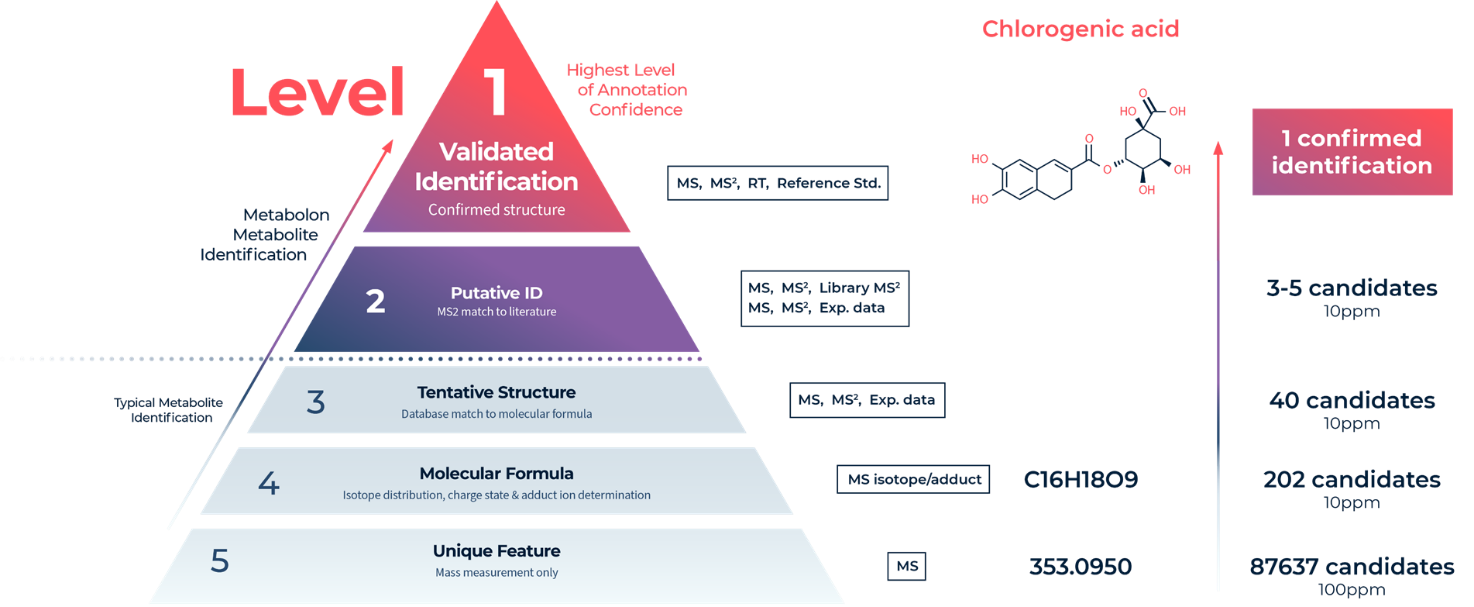
Figure 3. A summary of each level of metabolite identification. The confidence in a metabolite’s identity is defined by 5 levels that are categorized according to the analytical evidence of that identity. Level 1 denotes the highest confidence in identity, and the majority of biochemical entries in Metabolon’s library have achieved this level of identification.
In global metabolomics studies that use mass spectrometry, 10s to 100s of thousands of mass spectrometry signals, often referred to as ion features, are detected in a single sample. In the traditional ion-centric or feature centric approach to data analysis, only the statistically significant ion features are determined from the full dataset of 100,000+ features (Figure 4, bottom panel). This can introduce errors into data analysis because in a dataset this size many of the detected ion features are redundant and irrelevant to the study hypothesis. Keeping redundant features in the dataset can skew the statistical analysis, and irrelevant features only muddy the interpretation of the data, limiting insight. Moreover, distinguishing meaningful ion features from the rest in such a large dataset is tedious and time-consuming, and often done incorrectly. This forces the unchanging ion features (those compounds that are not affected by the study design) to be overlooked due to lack of time and leads to incorrect classification of important ion features, limiting insight further and introducing confounding data.
To address this challenge, Metabolon pioneered the chemo-centric approach, which brings the compound or biochemical to the forefront by using Metabolon’s robust biochemical reference library to appropriately account for extraneous and redundant ion features from the dataset before statistical analyses are performed (Figure 4, top panel). The chemo-centric workflow deconvolutes the ion feature data, which allows accurate identification of the statistically significant compounds (not features) as well as identification of compounds that did not change over the course of the study, extracting maximum insight from the dataset. Additionally, all entries in Metabolon’s biochemical reference library are identified by unique ChemID numbers, which enable Metabolon data to be compared across studies. The use of open-source biochemical reference libraries leads to rampant non-concordance of reported metabolite calls, which constrains the comparison of data generated by independent parties.
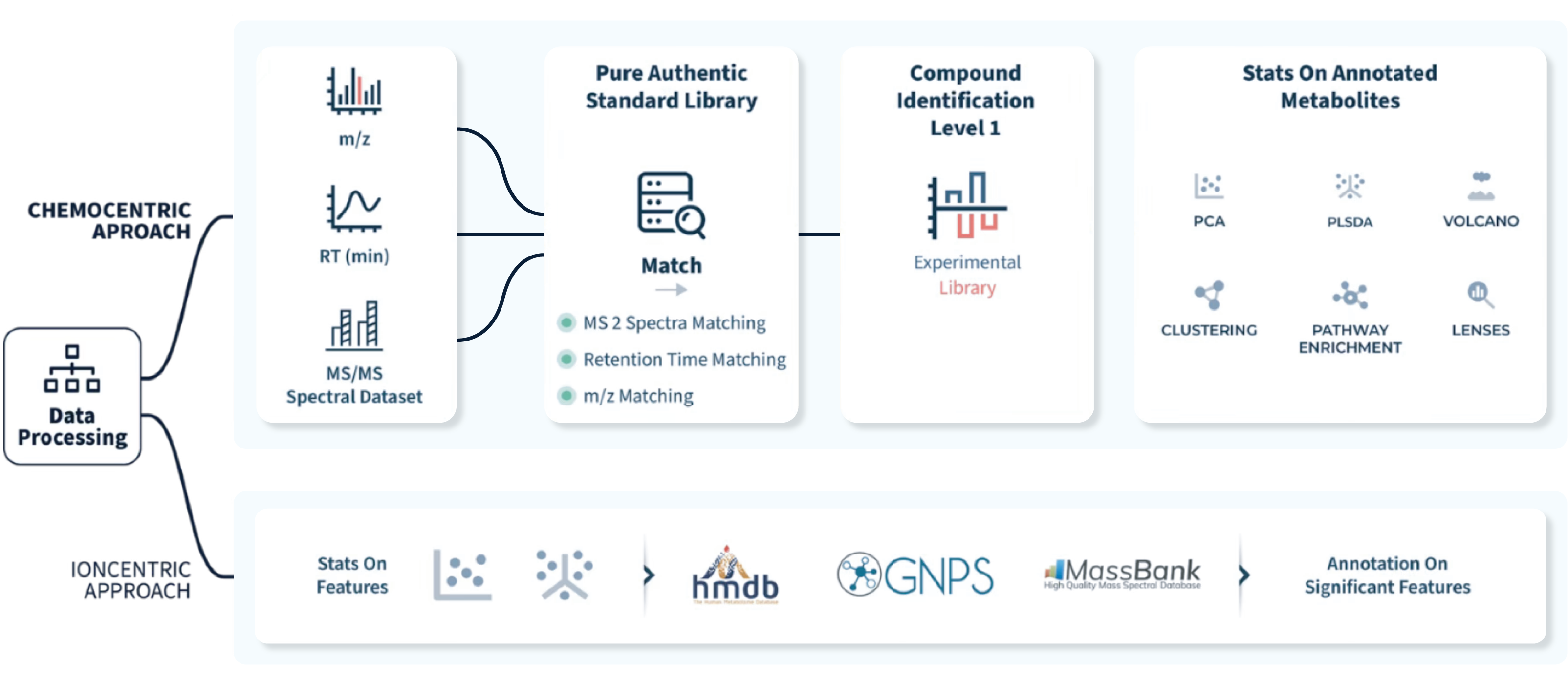
Figure 4. Summary of Metabolon’s chemo-centric approach. Global metabolomics typically identifies 10s to 100s of thousands of ion features per sample. Metabolon pioneered the approach of identifying compounds and accounting for redundant features using an in-house authentic standard reference library (Top). Unlike the traditional ion centric approach (Bottom) the library enables accurate compound identification based on multiple criteria including retention time, mass, and fragmentation spectra. Metabolon’s vast library contains information on the ionization products of numerous compounds, which facilitates their efficient removal from the data stream.
The innovations discussed above, coupled with Metabolon’s chemo-centric
approach set Metabolon data apart from that of other metabolomics
providers.
Armed with Metabolon’s tools, numerous investigators, clinicians, and industry professionals have made discoveries that were vital to advancing their projects to the next step. Over the next three chapters we will discuss quintessential studies that show how this was done. We hope that seeing metabolomics in action across diverse scientific disciplines and sectors inspires your own research endeavors.
Download this comprehensive guide developed to teach you the ins and outs of one of the most powerful -omics tools in any scientist’s toolbox: metabolomics.
Once you see the full value of metabolomics, the only remaining question is: who does it best? While many laboratories have metabolite profiling or analytical chemistry capabilities, comprehensive metabolomics technologies are extremely rare.
Accurate, unbiased metabolite identification across the entire metabolome introduces signal-to-noise challenges that very few labs are equipped to handle. Also, translating massive quantities of data into actionable information is slow, if not impossible, for most because proper interpretation takes two things that are in short supply: experience and a comprehensive database.
Using our robust platform and visualization tools, our experts are uniquely able to tell you more about your molecule and develop assay panels to help you zero in on the results you need.
Coverage
Ability to interrogate thousands of metabolites across diverse biochemical space, revealing new insights and opportunities
Comparability
Ability to integrate the data from different studies into the same dataset, in different geographies, among different patients over time
Competency
Ability to inform on proper study design, generate high‐quality data, derive biological insights, and make actionable recommendations
Capacity
Ability to process hundreds of thousands of samples quickly and cost‐efficiently to service rapidly growing demand
Request a quote for our services, get more information on sample types and handling procedures, request a letter of support, or submit a question about how metabolomics can advance your research.
Corporate Headquarters
617 Davis Drive, Suite 100
Morrisville, NC 27560
Mailing Address
P.O. Box 110407
Research Triangle Park, NC 27709
Phone
+1 (919) 572-1711
Fax
+1 (919) 572-1721
International Headquarters
Metabolon GmbH
Zeppelinstraße 3
85399 Hallbergmoos
Germany