Metabolon recently attended the American Society of Human Genetics (ASHG) Annual Conference in Los Angeles, CA, from October 25 to 29, 2022. With over 7,000 registrants and 1,400 exhibitors, the conference was the place to be to discover current trends in human genetics and genomics research. The Metabolon team was excited to meet with visitors in person for the first time in three years.
Metabolomics Reveals the Phenotype
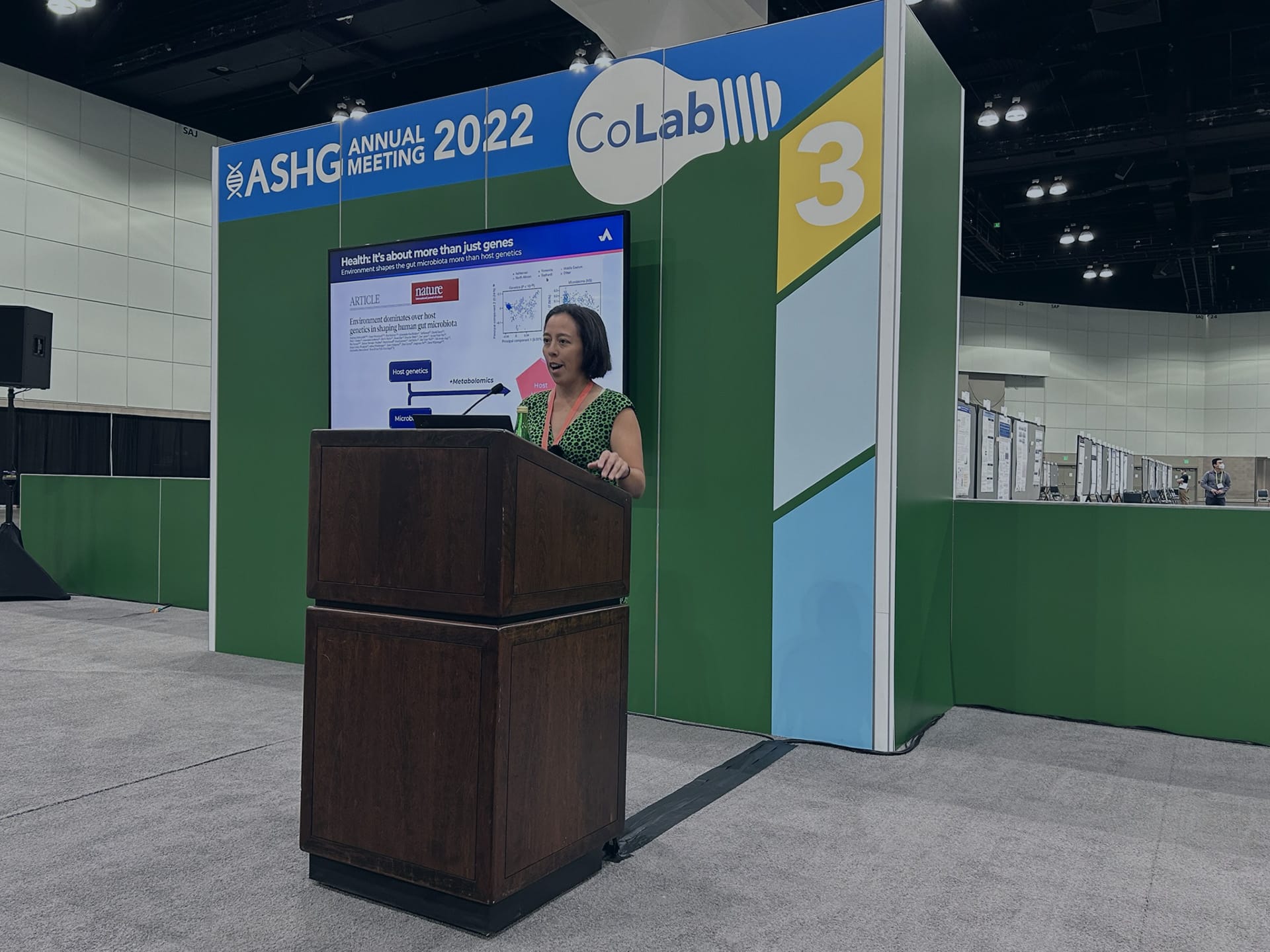
In addition to exhibiting, Metabolon hosted a CoLaboratory session (CoLab), an opportunity for the industry to share product and educational information. For the CoLab, Dr. Kari Wong, Associate Director of Scientific Strategy at Metabolon, Inc., presented “Metabolomics as a tool for phenotyping.”1 Dr. Wong’s presentation detailed how metabolomics is a vital complementary tool to genomics for providing a more comprehensive view of one’s health. Dr. Wong also highlighted how metabolomics detects the parts of the genome that are actively shaping the phenotype and then informs the function of those identified parts and provided several study examples.
Metabolomics and Genomics
Metabolomics continues to play a vital and integral role in genomics studies and research. As a core molecular phenotyping technology, it is fundamental for genomic discovery. Regardless of the amount of genomic data, the full potential of precision medicine cannot be reached using genomics alone because the genome is not a perfect representation to map human health. One of the challenges of genomic data is the large number of variants that can be found in every individual, which makes it difficult to decipher which variants are significant. In essence, metabolomics detects the parts of the genome that are actively shaping the phenotype and then informs the function of those identified parts.
Metabolomics and Rare Diseases
ASHG had strong metabolomics themes that emphasized the utility of metabolomics for investigating rare diseases. Two posters were presented that incorporated Metabolon’s Global Discovery Panel in multi-omics studies.
“Exome sequencing reanalysis complemented with combined multi-omics approach reached to 60% diagnostic yield in previously undiagnosed rare disease cohort”2 studied rare diseases in Estonian families through exome sequencing (protein-coding genes) and RNA sequencing (RNA-Seq) and compared the sequencing data to metabolomics results. While the sequencing data improved diagnostic yield, the metabolomics data was critical for identifying two cases of rare diseases that were impacted by two novel genes.
“Untargeted metabolomics profiling in patients with and without epilepsy”3 also studied Estonian participants with a combination of exome sequencing and metabolomics. The study revealed significantly altered metabolic pathways previously unrecognized for epilepsy and pointed to novel biomarkers that may be used for epilepsy diagnosis.
Metabolomics and Multi-omics
Additional posters were also presented that used a multi-omic approach with Metabolon’s Global Discovery Panel.
“Stability of genetic regulation of gene expression over time”4 explored genetic expression over time to identify contributors to age-related diseases. RNA-Seq and metabolomics identified genes that maintain consistent expression levels over time.
“Tobacco smoke-derived metabolites in plasma are associated with cardiometabolic traits, are genetically regulated, and may modulate adipose tissue DNA-methylation in African Americans,”5 was based on the idea that environmental exposure significantly affects longitudinal phenotypic changes, and the poster evaluated one such exposure: tobacco smoke. This poster presented how DNA-methylation (genetic regulatory mechanisms) impacts metabolic output (the metabolome), directly influencing gluco-cardio-metabolic outcomes like obesity and insulin sensitivity.
“Large-scale multi-omic analyses in CSF identified multiple causal and druggable targets for Alzheimer’s disease,”6 on the ASHG platform, “Averting Alzheimer’s as soon as possible,” sought to change phenotypic outcomes by identifying actionable biomarkers of disease. This study used a large-scale analysis of proteomics and metabolomics to identify quantitative trait loci (QTLs), genetic regions that influence complex trait phenotypes. These QTLs point to druggable proteins and metabolites for Alzheimer’s disease, making progress toward prevention and treatment development.
References:
- Wong K., et al. Metabolomics as a tool for phenotyping. Presented at: American Society of Human Genetics; October 25-29, 2022; Los Angeles, CA, USA.
- Ounap K., et al. Exome sequencing reanalysis complemented with combined multi-omics approach reached to 60% diagnostic yield in previously undiagnosed rare disease cohort. Poster presented at: American Society of Human Genetics; October 25-29, 2022; Los Angeles, CA, USA.
- Oja K. Untargeted metabolomics profiling in patients with and without epilepsy. Poster presented at: American Society of Human Genetics; October 25-29, 2022; Los Angeles, CA, USA.
- Raza Y., et al. Stability of genetic regulation of gene expression over time. Poster presented at: American Society of Human Genetics; October 25-29, 2022; Los Angeles, CA, USA.
- Das S., et al. Tobacco smoke-derived metabolites in plasma are associated with cardiometabolic traits, are genetically regulated, and may modulate adipose tissue DNA-methylation in African Americans. Poster presented at: American Society of Human Genetics; October 25-29, 2022; Los Angeles, CA, USA.
- Cruchaga C., et al. Large-scale multi-omic analyses in CSF identified multiple causal and druggable targets for Alzheimer’s disease. Presented at: American Society of Human Genetics; October 25-29, 2022; Los Angeles, CA, USA.