
Key Features
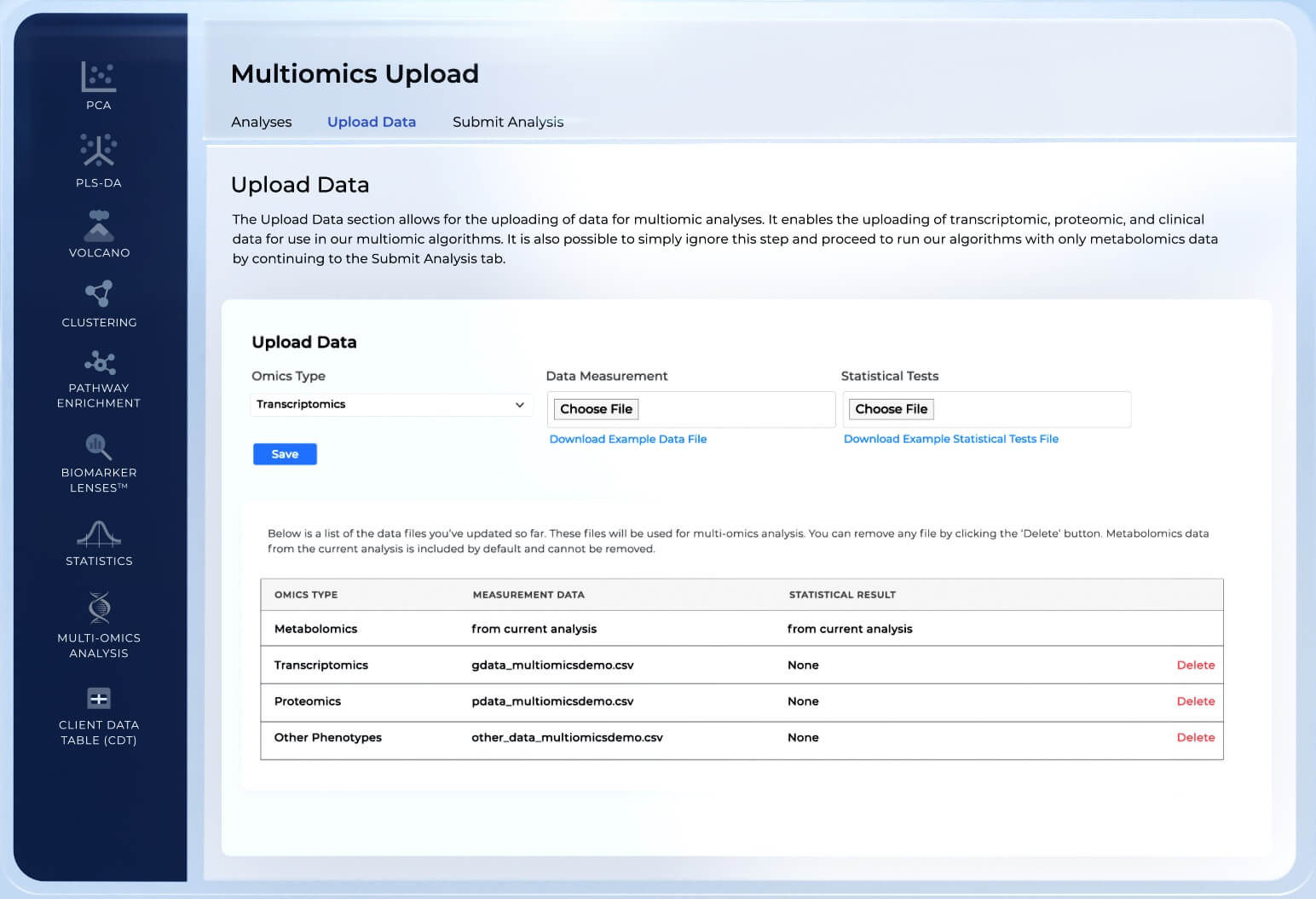
To effectively perform multiomics analysis, you must first integrate different datasets. The Multiomics Tool allows users to upload and integrate multiple omics data types into a single project, ensuring compatibility for downstream analysis.
- Support for Genomics, Proteomics, Transcriptomics, and Phenotypic Data
Upload CSV files containing data from different omics types. - Define Experimental Designs
Select groups for analysis, configure pairwise or control-based comparisons, validate input files, and apply data harmonization techniques automatically. - Feature Selection
Remove uninformative or redundant molecular features to improve predictive model building. This structured approach to data upload enables faster and more accurate multiomics research by eliminating inconsistencies and automating preprocessing steps.
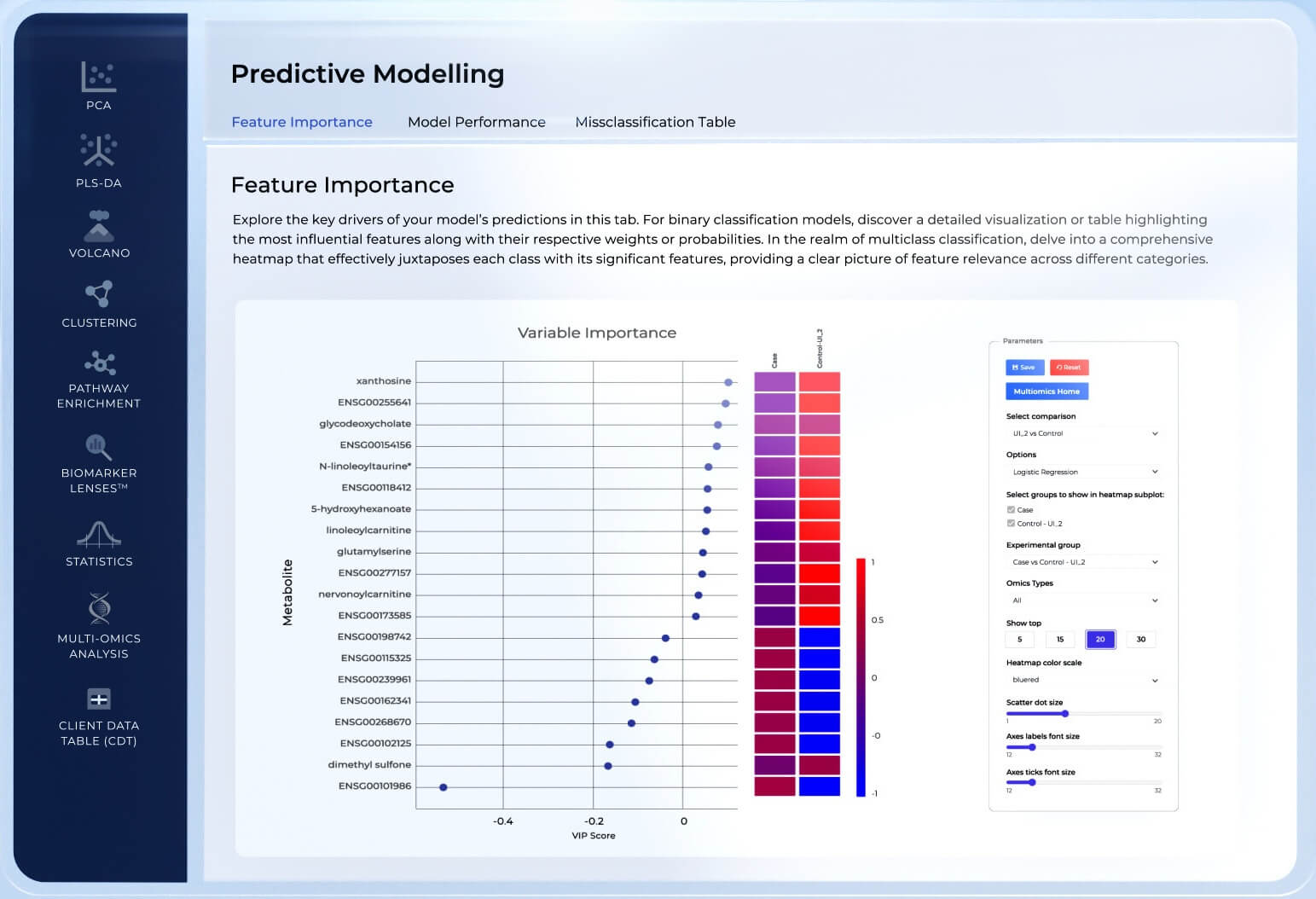
Predictive modelling is a powerful approach that enables researchers to identify and prioritize molecular features that are most relevant to biological processes and experimental outcomes. The Multiomics Tool includes Logistic Regression and Random Forest algorithms to build and organize data into predictive models from integrated omics datasets.
- Explore Model Performance: Evaluate classification accuracy with metrics like F1-score, Area Under the Curve (AUC), and Balanced Accuracy.
- Assess Multiomic Feature Contributions: Identify biologically relevant biomarkers by ranking features based on model influence.
- Compare Model Types: Use multiple approaches to understand different underlying signals in multiomic data.
Biological variation can be better understood when observing the different relationships between different omics layers, from genes and transcripts to proteins and metabolites – following the ‘cental dogma’ of molecular biology. The Multiomics Tool includes Latent Factor Analysis using DIABLO (Data Integration Analysis for Biomarker Discovery using Latent Components) to uncover possible relationships.
- Integrate multiple omics data sets to identify and select features that best differentiate outcome groups
- Reveal how various data types (e.g., transcriptomics, proteomics) correlate with each other, allowing you to discover shared or distinct biological signatures.
- Jointly model these data sets with DIABLO to answer questions about which features drive group separations and provides insights into the combined predictive power of multiple omics platforms.
- Using latent factor analysis, researchers can identify high-impact features across omics layers, allowing for a more complete understanding of biological pathways.
Multiomic data is most valuable when linked to biological function. The Multiomics Tool provides statistical pathway enrichment analysis using a curated version of REACTOME as the reference of biological pathways to maximise coverage.
- Over-Representation Analysis (ORA): Identify Enriched Pathways
- Map Molecular Features to Pathways: Connect metabolites, genes, and proteins to biological pathways using REACTOME’s structured knowledge base.
- Rank Pathway Significance: Use hypergeometric tests to identify statistically overrepresented pathways in different experimental conditions.
- Visualize Pathway-Level Patterns: Use interactive plots to explore how experimental groups differ at the pathway level.
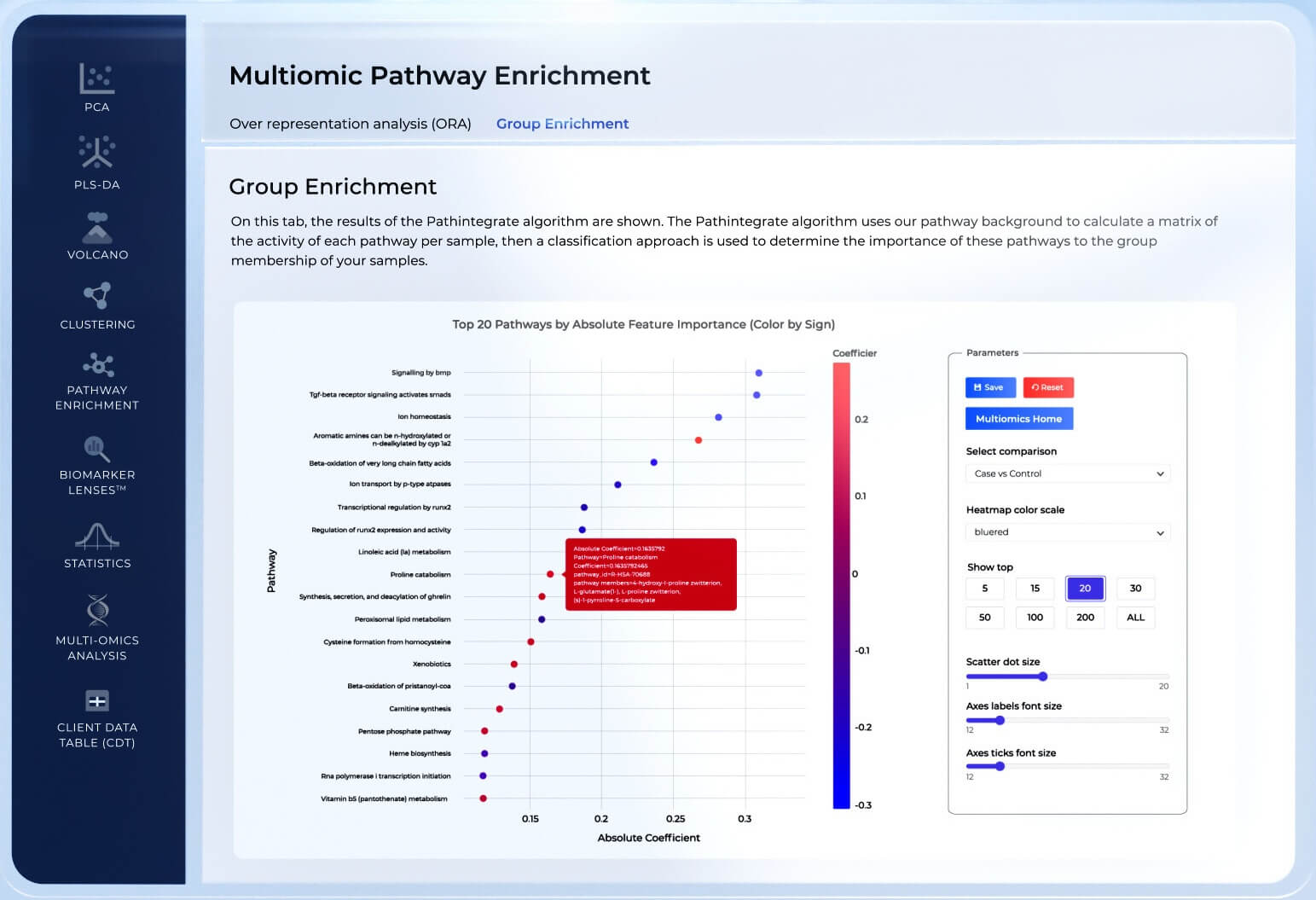
- Pathway Integration: Multiomic Pathway Analysis with REACTOME
- Generate Pathway Activity Scores: Apply Singular Value Decomposition (SVD) to calculate pathway-level metrics from multiomic data.
- Identify Key Pathways Driving Signal Variation: Using classification models to rank pathways based on their contribution to group differentiation.
- Improve Interpretability: Convert complex molecular measurements into pathway-level insights that are easier to analyze and communicate.
By linking molecular biomarkers to functional pathways, researchers can understand the broader biological context of their findings.
The Multiomics Tool provides customizable visualizations to support data exploration and interpretation:
- Multiomic Feature Importance Plots: Rank biomarkers based on their influence in predictive models.
- Latent Factor Projection Plots: Explore relationships between samples using dimensionality reduction techniques.
- Pathway Enrichment Dot Plots: Visualize the statistical significance of pathways in REACTOME-based enrichment analysis.
These interactive tools allow researchers to assess key findings and generate publication-ready figures quickly.
Multiomics Tool Overview
Despite the growing importance of multiomics research, combining genomic, transcriptomic, proteomic, and metabolomic data has remained challenging, until now.
Data integration can become time-consuming and costly, requiring investment and knowledge in multiple tools for statistical modelling and visualization. Metabolon’s multiomics software tools are designed to streamline investigators’ journeys from data generation to data insights in one unified solution, with accessible tools for all levels of multiomics literacy.
Multiomics within Metabolon’s Integrated Bioinformatics Platform
Metabolon’s Multiomics Tool, part of our Integrated Bioinformatics Platform (IBP), provides gold-standard bioinformatics software tools to make multiomics accessible. This tool allows researchers to upload, process, and analyze multiomics data and when combined with Metabolomics data offers the most complete understanding of the phenotype available.
With multiomic predictive modelling, latent factor analysis, and pathway enrichment using REACTOME, the Multiomics Tool enables users to efficiently explore relationships across different omics layers, identify key biomarkers, and rank pathway-level signals within their datasets.
Request a demo to explore how multiomics software integration can drive new discoveries.
Why Use Metabolon’s Multiomics Tool?
Metabolon’s new bioinformatics software functionality provides a comprehensive suite of web-based tools designed for multiomics research:
- Most Complete Out-of-the-Box Phenotypic Representation: Integrate multiple omics layers to provide a comprehensive biological view.
- Online Bioinformatics Tools for Biomarker Discovery: Access predictive modelling, latent factor analysis, and pathway enrichment in one platform.
- Flexible & Scalable Data Analysis: Customize experimental designs, feature selection methods, and identify predictive biomarkers using logistic regression, random forest, and latent factor models.
- Pathway Integration with REACTOME: Connect molecular data to curated pathway databases for functional interpretation.
Metabolon’s Multiomics Tool enables researchers to extract more value from their data and multiply the impact of their discoveries with a more complete and comprehensive representation of the phenotype.
Use Cases and Applications
The Multiomics Tool helps researchers uncover biologically meaningful insights by integrating genomic, transcriptomic, proteomic, and metabolomic data within a single analytical framework. By leveraging predictive modelling, latent factor analysis, and pathway enrichment, researchers can accelerate discoveries in key areas of biomarker research, drug development, and disease mechanisms.
- Biomarker Discovery: Identifying Key Molecular Signatures
Understanding biomarkers that differentiate between experimental groups, disease states, or treatment responses is central to translational research. The Multiomics Tool enables researchers to identify molecular signatures associated with disease progression, drug efficacy, or therapeutic response and integrate additional multiomics data to reduce the risk of drug failure due to unknown variables. - Drug Target Identification: Prioritizing Pathways and Molecules for Therapeutic Development
Researchers can prioritize potential drug targets by mapping molecular features to biological pathways and focusing on the most biologically relevant molecules. The Multiomics Tool supports the identification of key metabolic and signalling pathways that are strongly associated with disease mechanisms and the prioritization of high-confidence drug targets for further validation and preclinical development. - Drug Mechanism Analysis: Understanding Biological Impact of Therapeutics
Multiomics data can help uncover how therapeutic compounds interact with biological systems, providing a more complete picture of mechanisms of action and potential off-target effects. With the Multiomics Tool, researchers can investigate how different omics layers interact to produce drug-induced changes in biological pathways. They can then use pathway enrichment to assess whether a compound activates or inhibits key disease-related pathways. - Generating Greater Biological Insights
By characterizing multiomic differences at both the molecular and pathway levels, researchers can gain a deeper understanding of disease mechanisms and therapeutic responses. This approach supports more effective biomarker-driven study designs that link molecular data to clinical outcomes and enhanced drug discovery workflows, enabling researchers to move from data generation to actionable insights faster.
