
ON DEMAND WEBINAR

On Demand: Introducing Metabolon’s Integrated Bioinformatics Platform
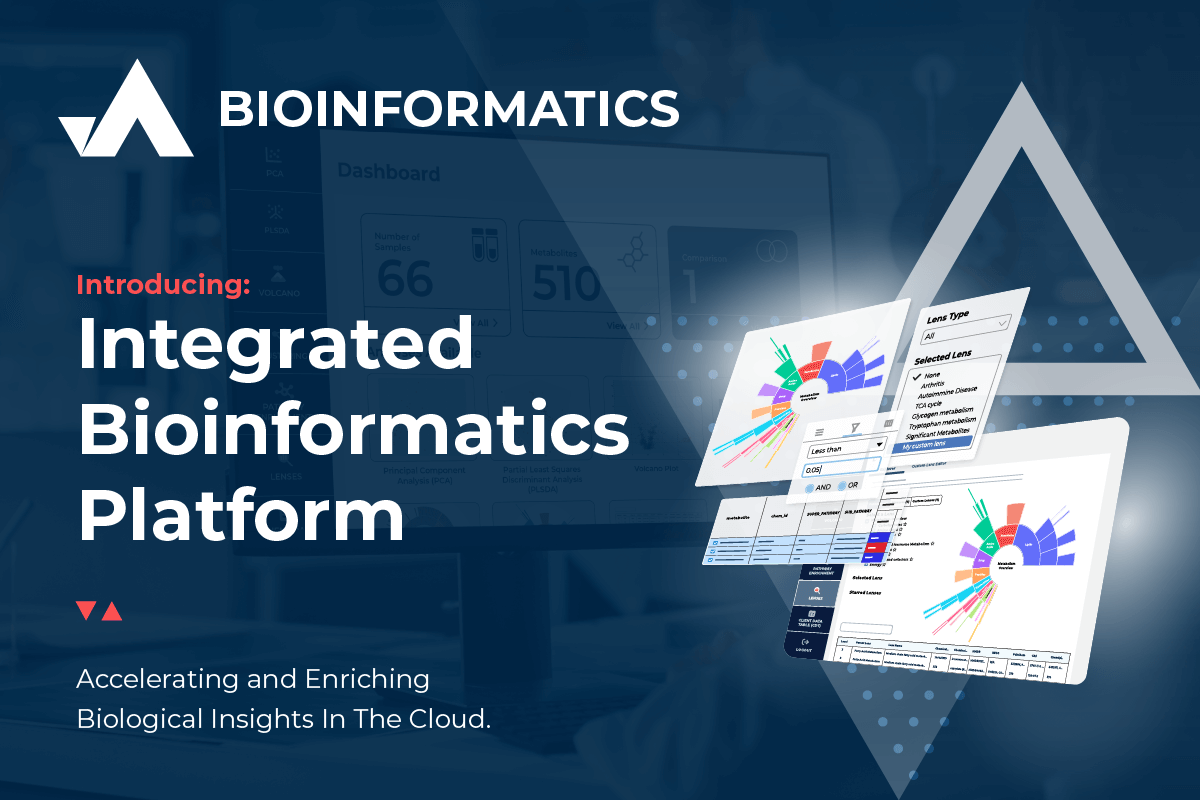
Integrated Bioinformatics Platform
Access to large volumes of high-quality biological data has changed the scope and potential for all life science research.

While data generation is becoming easier to attain, achieving data insights remains an industry-wide challenge. When the cost of failure can be billions of dollars in investment, and delays can impact the development of life-saving drugs by years, choosing a bioinformatics solution becomes a critical consideration within the design of your study.

Some standalone bioinformatics tools are available to support data analysis and visualization. While they can help to assist in transforming large amounts of data into biological insights, they are limited in features and/or require an advanced knowledge of coding languages to truly derive value from your time and effort.

So, how can scientists integrate their data with bioinformatics to achieve their research objectives quickly and confidently?

In this webinar, Heino Heyman, Ph.D. unveils Metabolon’s new Integrated Bioinformatics Platform and demonstrates the power and control it puts into every researcher’s hands.

In this webinar you will learn:

    • Go Deeper: Learn how Metabolon’s new Integrated Bioinformatics Platform can enrich your findings and isolate significant and associated analytes across a vast library of curated disease and analyte pathways.
    • Endless Visualization: Explore how you can conduct comparative and correlative analysis using an array of unique visualization tools, from PCA, PLSDA, and volcano plots to clustering, heatmaps, pathways, and many more.
    • Biomarker Lenses®: Apply advanced analytical filters and investigate your data faster with Biomarker Lenses®; use pre-validated disease lenses or customize your own lens to support bridging hypotheses across multiple projects.
    • Cloud Collaboration: Effortlessly collaborate with your peers anywhere in the world with bioinformatics in the cloud.
    • The future of bioinformatics: Learn how multiomics projects can benefit from the available features in the platform, today.

Metabolon’s new Integrated Bioinformatics Platform reduces the complexity of big data and accelerates time to insights. Join us and explore how Metabolon can elevate your research objectives, today.

Program

Presenter
Title/Abstract
Heino Heyman, Ph.D.
Introductions
Heino Heyman, Ph.D.
Introducing Metabolon’s Integrated Bioinformatics Platform – Overview, Features, Tools, and Benefits
Joey Gardner, Ph.D.
Demonstration - Biomarker Lenses® Overview
Demonstration - Pathway Analysis Overview
Heino Heyman, Ph.D.
Underpinning Our Bioinformatics Platform – Metabolon’s Technology and Analytical Services
Heino Heyman, Ph.D.
Software Resources
How to Request Demo Access
Closing Remarks

Speakers

K
L

Heino Heyman, Ph.D.

Global Metabolomics Applications Lead at Metabolon

LinkedIn: https://www.linkedin.com/in/heino-heyman

Dr. Heino M. Heyman is an industry-leading metabolomics expert, co-author of more than 40 publications, and consultative advisor to hundreds of metabolomics studies across the spectrum of life science research. Heino began his metabolomics journey in 2010, utilizing metabolomics to expedite the discovery of active constituents in natural products and to enhance the understanding of resilient crops. In 2015, he joined the Integrative Omics team at Pacific Northwest National Lab, WA, where he broadened the application of metabolomics across diverse sectors, including human, microbial, plant, and soil metabolomics. Following his postdoctoral studies, Heino joined the scientific instrument manufacturer and small molecule research organization, Bruker Scientific as a Metabolomics Applications Specialist, assisting in the promotion and demonstration of ion-mobility mass spectrometry instruments to advance metabolomics research outcomes. In 2020, he joined Metabolon, deepening his involvement in translational science informed by metabolomics. Since 2023, he has been leading a team of metabolomics experts as Global Metabolomics Applications Lead, supporting researchers and biochemists to achieve more actionable and translational insights from metabolomics data.

K
L

Joseph Gardner, Ph.D.

Senior Bioinformatician at Metabolon

LinkedIn: https://www.linkedin.com/in/microbesinsilico/

Dr. Joseph Gardner is an accomplished bioinformatics scientist specializing in metabolic modeling and multi-omics analysis. Joey began his career investigating the role of metabolism in promoting community dynamics of nitrogen an carbon fixing cyanobacteria. Using this knowledge, he transitioned into engineering soil microorganisms for application to industrial crops at Joyn Bio, a collaboration between Bayer and Ginkgo Bioworks. Subsequently, he moved towards human health, using multi-omics in pursuit of stratifying metabolically regulated rheumatoid arthritis patients. This has led him towards working with metabolomics as a key factor in multi-omic study design and he joined the Metabolon team in 2023 to help develop bioinformatics tools and drive research into the field.

WATCH WEBINAR

References

1. Zgoda-Pols, J.R., et al., Metabolomics analysis reveals elevation of 3-indoxyl sulfate in plasma and brain during chemically-induced acute kidney injury in mice: investigation of nicotinic acid receptor agonists. Toxicol Appl Pharmacol, 2011. 255(1): p. 48-56.

2. Bryant, J.A., et al., The impact of an oral purified microbiome therapeutic on the gastrointestinal microbiome. Nat Med, 2026. 32(1): p. 186-196

3. McGovern, B .H., et al., SER-109, an Investigational Microbiome Drugto Reduce Recurrence After Clostridioides difficile Infection: Lessons Learned From a Phase 2 Trial. Clin Infect Dis, 2021. 72(12): p. 2132-2140.

4. Feuerstadt, P., et al., SER-109, an Oral Microbiome Therapy for Recurrent Clostridioides difficile Infection. N Engl J Med, 2022. 386(3): p. 220-229.

5. Hu, Z., et al., Targeted metabolomics reveals novel diagnostic biomarkers for colorectal cancer. Mol Oncol, 2025. 19(6): p. 1737-1750.

6. Butler, F.M., et al., Vegetarian Dietary Patterns and Diet-Related Metabolites Are Associated With Kidney Function in the Adventist Health Study-2 Cohort. J Ren Nutr, 2025.

7. Stanford, J., et al., Metabolomic Profiling and Diet Quality Scoring in a Randomized Crossover Trial of Healthy and Typical Dietary Patterns. Mol Nutr Food Res, 2025 . 69(23): p. e70271.

8. O’Connor, L.E., et al., Metabolomic Profiling of an Ultraprocessed Dietary Pattern in a Domiciled Randomized Controlled Crossover Feeding Trial. J Nutr, 2023. 153(8): p. 2181-2192.

9. Fritsch, D.A., et al., Microbiome function underpins the efficacy of a fiber-supplemented dietary intervention in dogs with chronic large bowel diarrhea. BMC Vet Res, 2022. 18(1): p. 245.

10. Leal, L.N., et al., Preweaning nutrient supply improves lactation productivity and reduces the risk of culling in Holstein cows. J Dairy Sci, 2025. 108(6): p. 5875-5888.

11. Ahsin, M., et al., Soil and pasture health underlie improved beef nutrient density determined by untargeted metabolomics in Southern US grass finished beef systems. NPJ Sci Food, 2025. 9(1): p. 151.

12. Yin, W., et al., Plasma lipid profiling across species for the identification of optimal animal models of human dyslipidemia. J Lipid Res, 2012. 53(1): p. 51-65.

13. Porter, F .D., et al., Cholesterol oxidation products are sensitive and specific blood-based biomarkers for Niemann-Pick C1 disease. Sci Transl Med, 2010. 2(56): p. 56ra81.

14. Needham, B .D., et al., Plasma and Fecal Metabolite Profiles in Autism Spectrum Disorder. Biol Psychiatry, 2021. 89(5): p. 451-462

15. Li, C., et al., Estradiol and mTORC2 cooperate to enhance prostaglandin biosynthesis and tumorigenesis in TSC2-deficient LAM cells. J Exp Med, 2014. 211(1): p. 15-28.

16. Green, P.G., et al., Metabolic flexibility and reverse remodelling of the failing human heart. Eur Heart J, 2025. 46(25): p. 2422-2433.

17. Maekawa, H., et al., SGLT2 inhibition protects kidney function by SAM-dependent epigenetic repression of inflammatory genes under metabolic stress. J Clin Invest, 2025. 135(19).

18. Wu, D., et al., Integrated screens reveal that guanine nucleotide depletion, which is irreversible via targeting IMPDH2, inhibits pancreatic cancer and potentiates KRAS inhibition. Gut, 2026.

19. Schwerdtfeger, L.A., et al., Gut microbiota and metabolites are linked to disease progression in multiple sclerosis. Cell Rep Med, 2025. 6(4): p. 102055.

20. Wu, H., et al., Microbiome-metabolome dynamics associated with impaired glucose control and responses to lifestyle changes. Nat Med, 2025. 31(7): p. 2222-2231.

21. Jacobs, J.P., et al., Cognitive behavioral therapy for irritable bowel syndrome induces bidirectional alterations in the brain-gut-microbiome axis associated with gastrointestinal symptom improvement. Microbiome, 2021. 9(1): p. 236.

22. Pietzner, M., et al., Plasma metabolites to profile pathways in noncommunicable disease multimorbidity. Nat Med, 2021. 27(3): p. 471-479.

23. Faquih, T.O., et al., Robust Metabolomic Age Prediction Based on a Wide Selection of Metabolites. J Gerontol A Biol Sci Med Sci, 2025. 80(3).

24. Scherer, N., et al., Coupling metabolomics and exome sequencing reveals graded effects of rare damaging heterozygous variants on gene function and human traits. Nat Genet, 2025. 57(1): p. 193-205.

25. Holmes, Z.C., et al., Untargeted metabolomic analysis of human milk from healthy mothers reveals drivers of metabolite variability. Sci Rep, 2024. 14(1): p. 20827.

26. Titz, B., et al., Implications of Ocular Confounding Factors for Aqueous Humor Proteomic and Metabolomic Analyses in Retinal Diseases. Transl Vis Sci Technol, 2024. 13(6): p. 17.

27. Bloom, S.M., et al., Cysteine dependence of Lactobacillus iners is a potential therapeutic target for vaginal microbiota modulation. Nat Microbiol, 2022. 7(3): p. 434-450.

28. Leimer, E.M., et al., Lipid profile of human synovial fluid following intra-articular ankle fracture. J Orthop Res, 2017. 35(3): p. 657-666.