
Creatinine

Creatinine

Linear Formula

C4H7N30

Synonyms

n/a

Share this metabolite

What is Creatinine?

Creatinine is the end product of creatine and creatine phosphate metabolism. Creatine, a nitrogenous organic acid, and its conversion to creatine phosphate is critical as an energy source for muscle contraction. Creatinine is present in high concentrations in skeletal muscle and is continuously produced from the pool of creatine and creatine phosphate through non-enzymatic anhydration1. Since creatinine is continually produced, creatine pools must be replenished through the intake of essential amino acids.

Creatinine is a waste product that is eliminated through the kidneys, filtered from the blood, and released into the urine. Individuals with acute kidney injury or chronic kidney disease exhibit impairments in creatinine clearance and serum/urine creatinine is often used as a biomarker for kidney-related diseases. Urinary creatinine can also be used to test sample dilution, and biomarker: creatinine ratios can be applied to correct fluctuations in urine volume.
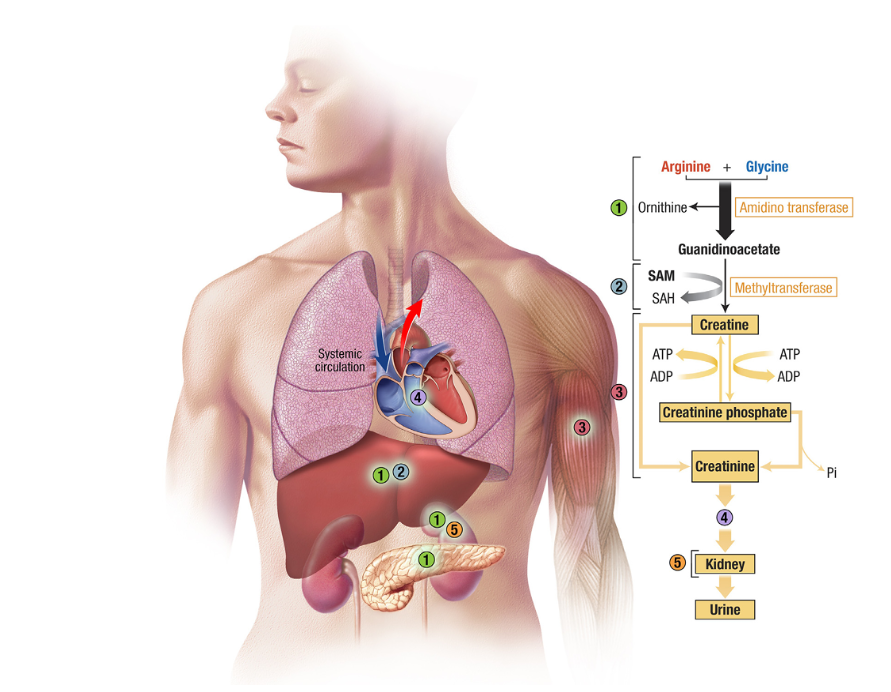
creatinine

(Figure from Kashani et al., 2019)

Creatinine and metabolic health

Obesity and metabolic health are strongly associated with the progression of chronic kidney disease. Research conducted using mouse models of type 1 diabetes has demonstrated that, in addition to profound impairments in glucose metabolism, these mice also exhibit elevated levels of serum creatinine2. Albumin, a protein produced in the liver, is also a marker for liver and kidney function and is often measured in conjunction with creatinine. Expressed as a ratio of albumin:creatinine, microalbuminuria (i.e., low albumin:high creatinine) is a measure that can track type 1 diabetes progression3.

In humans, individuals with high BMI (BMI >40 kg/m2) show ~31% higher creatinine excretion compared to those with normal BMI4. While obesity has been identified as a risk factor for chronic kidney disease, some researchers have identified an “obesity paradox”5. Despite high creatinine levels, high BMI individuals who lose weight show increased survival rates, whereas individuals who gain weight with low serum creatinine levels exhibit decreased survival rates.

Considering this “paradox”, researchers have suggested that a higher BMI with more muscle mass (that then translates to increased creatine and creatinine) is associated with increased survival5.

Creatinine and gastrointestinal health

Recent research has revealed a link between gastrointestinal health, the gut microbiome, and creatinine. In an untargeted metabolomics study, scientists identified significant changes in microbiome diversity in association with chronic kidney disease. In addition to functional alterations in a number of gut microbiome metabolites, creatinine was identified as an important modulator of microbiome disruptions related to chronic kidney disease6.

Others have demonstrated that individuals with type 2 diabetes also exhibit changes in microbiome diversity that are associated with decreases in genes that code for creatinine degradation7.

Creatinine and drug development

While creatinine itself has not been utilized in drug development, it has found application in assaying dose requirements for renally eliminated pharmaceuticals8. Glomerular filtration rate (GFR) equations are based on serum creatinine levels and are often used for pediatric dose adjustments in drug labeling. Interestingly, GFR equations have been found to overestimate drug clearance, and investigations are underway to enhance the accuracy of GFR equations. 

References

  1. Kashani K, Rosner MH, and Ostermann, M. Creatinine: From physiology to clinical application. Eur J Intern Med 2020;72:9–14.
  2. Glastras SJ, Chen H, Teh R et al. Mouse Models of Diabetes, Obesity and Related Kidney Disease. PLoS One 2016;11(8):e0162131.
  3. Warram JH, Gearin G, Laffel L et al. (Effect of duration of type I diabetes on the prevalence of stages of diabetic nephropathy defined by urinary albumin/creatinine ratio. J Am Soc Nephrol 1996;7(6):930–937.
  4. Fotheringham J, Weatherley N, Kawar B et al. The body composition and excretory burden of lean, obese, and severely obese individuals has implications for the assessment of chronic kidney disease. Kidney Int 2014;86(6):1221–1228.
  5. Kalantar-Zadeh K, Streja E, Kovesdy CP et al. The obesity paradox and mortality associated with surrogates of body size and muscle mass in patients receiving hemodialysis. Mayo Clin Proc 2010;85(11):991–1001.
  6. Wang H, Ainiwaer A, Song Y et al. Perturbed gut microbiome and fecal and serum metabolomes are associated with chronic kidney disease severity. Microbiome 2023;11(1):3.
  7. Dash NR and Al Bataineh MT. Metagenomic Analysis of the Gut Microbiome Reveals Enrichment of Menaquinones (Vitamin K2) Pathway in Diabetes Mellitus. Diabetes Metab J 2021;45(1):77–85.
  8. Zhang Y, Sherwin CM, Gonzalez D et al. Creatinine-Based Renal Function Assessment in Pediatric Drug Development: An Analysis Using Clinical Data for Renally Eliminated Drugs. Clin Pharmacol Ther 2021;109(1):263–269.

References

1. Zgoda-Pols, J.R., et al., Metabolomics analysis reveals elevation of 3-indoxyl sulfate in plasma and brain during chemically-induced acute kidney injury in mice: investigation of nicotinic acid receptor agonists. Toxicol Appl Pharmacol, 2011. 255(1): p. 48-56.

2. Bryant, J.A., et al., The impact of an oral purified microbiome therapeutic on the gastrointestinal microbiome. Nat Med, 2026. 32(1): p. 186-196

3. McGovern, B .H., et al., SER-109, an Investigational Microbiome Drugto Reduce Recurrence After Clostridioides difficile Infection: Lessons Learned From a Phase 2 Trial. Clin Infect Dis, 2021. 72(12): p. 2132-2140.

4. Feuerstadt, P., et al., SER-109, an Oral Microbiome Therapy for Recurrent Clostridioides difficile Infection. N Engl J Med, 2022. 386(3): p. 220-229.

5. Hu, Z., et al., Targeted metabolomics reveals novel diagnostic biomarkers for colorectal cancer. Mol Oncol, 2025. 19(6): p. 1737-1750.

6. Butler, F.M., et al., Vegetarian Dietary Patterns and Diet-Related Metabolites Are Associated With Kidney Function in the Adventist Health Study-2 Cohort. J Ren Nutr, 2025.

7. Stanford, J., et al., Metabolomic Profiling and Diet Quality Scoring in a Randomized Crossover Trial of Healthy and Typical Dietary Patterns. Mol Nutr Food Res, 2025 . 69(23): p. e70271.

8. O’Connor, L.E., et al., Metabolomic Profiling of an Ultraprocessed Dietary Pattern in a Domiciled Randomized Controlled Crossover Feeding Trial. J Nutr, 2023. 153(8): p. 2181-2192.

9. Fritsch, D.A., et al., Microbiome function underpins the efficacy of a fiber-supplemented dietary intervention in dogs with chronic large bowel diarrhea. BMC Vet Res, 2022. 18(1): p. 245.

10. Leal, L.N., et al., Preweaning nutrient supply improves lactation productivity and reduces the risk of culling in Holstein cows. J Dairy Sci, 2025. 108(6): p. 5875-5888.

11. Ahsin, M., et al., Soil and pasture health underlie improved beef nutrient density determined by untargeted metabolomics in Southern US grass finished beef systems. NPJ Sci Food, 2025. 9(1): p. 151.

12. Yin, W., et al., Plasma lipid profiling across species for the identification of optimal animal models of human dyslipidemia. J Lipid Res, 2012. 53(1): p. 51-65.

13. Porter, F .D., et al., Cholesterol oxidation products are sensitive and specific blood-based biomarkers for Niemann-Pick C1 disease. Sci Transl Med, 2010. 2(56): p. 56ra81.

14. Needham, B .D., et al., Plasma and Fecal Metabolite Profiles in Autism Spectrum Disorder. Biol Psychiatry, 2021. 89(5): p. 451-462

15. Li, C., et al., Estradiol and mTORC2 cooperate to enhance prostaglandin biosynthesis and tumorigenesis in TSC2-deficient LAM cells. J Exp Med, 2014. 211(1): p. 15-28.

16. Green, P.G., et al., Metabolic flexibility and reverse remodelling of the failing human heart. Eur Heart J, 2025. 46(25): p. 2422-2433.

17. Maekawa, H., et al., SGLT2 inhibition protects kidney function by SAM-dependent epigenetic repression of inflammatory genes under metabolic stress. J Clin Invest, 2025. 135(19).

18. Wu, D., et al., Integrated screens reveal that guanine nucleotide depletion, which is irreversible via targeting IMPDH2, inhibits pancreatic cancer and potentiates KRAS inhibition. Gut, 2026.

19. Schwerdtfeger, L.A., et al., Gut microbiota and metabolites are linked to disease progression in multiple sclerosis. Cell Rep Med, 2025. 6(4): p. 102055.

20. Wu, H., et al., Microbiome-metabolome dynamics associated with impaired glucose control and responses to lifestyle changes. Nat Med, 2025. 31(7): p. 2222-2231.

21. Jacobs, J.P., et al., Cognitive behavioral therapy for irritable bowel syndrome induces bidirectional alterations in the brain-gut-microbiome axis associated with gastrointestinal symptom improvement. Microbiome, 2021. 9(1): p. 236.

22. Pietzner, M., et al., Plasma metabolites to profile pathways in noncommunicable disease multimorbidity. Nat Med, 2021. 27(3): p. 471-479.

23. Faquih, T.O., et al., Robust Metabolomic Age Prediction Based on a Wide Selection of Metabolites. J Gerontol A Biol Sci Med Sci, 2025. 80(3).

24. Scherer, N., et al., Coupling metabolomics and exome sequencing reveals graded effects of rare damaging heterozygous variants on gene function and human traits. Nat Genet, 2025. 57(1): p. 193-205.

25. Holmes, Z.C., et al., Untargeted metabolomic analysis of human milk from healthy mothers reveals drivers of metabolite variability. Sci Rep, 2024. 14(1): p. 20827.

26. Titz, B., et al., Implications of Ocular Confounding Factors for Aqueous Humor Proteomic and Metabolomic Analyses in Retinal Diseases. Transl Vis Sci Technol, 2024. 13(6): p. 17.

27. Bloom, S.M., et al., Cysteine dependence of Lactobacillus iners is a potential therapeutic target for vaginal microbiota modulation. Nat Microbiol, 2022. 7(3): p. 434-450.

28. Leimer, E.M., et al., Lipid profile of human synovial fluid following intra-articular ankle fracture. J Orthop Res, 2017. 35(3): p. 657-666.