Guide to Metabolomics, 3rd Edition

This is the third edition of our Guide to Metabolomics, a comprehensive resource covering the biochemical foundations, analytical workflows, and biological applications of metabolomics across broad applications. This edition includes an expanded focus on alternative matrices and translational science, reflecting the growing role of metabolomics in bridging discovery research and clinical application.

Chapter guide

By the time you complete this series, you’ll have a deep understanding of metabolomics and how you can start implementing it in your own research. Each chapter in this series focuses on a specific topic, delivering everything you need to know about metabolomics in manageable bite-sized chunks.

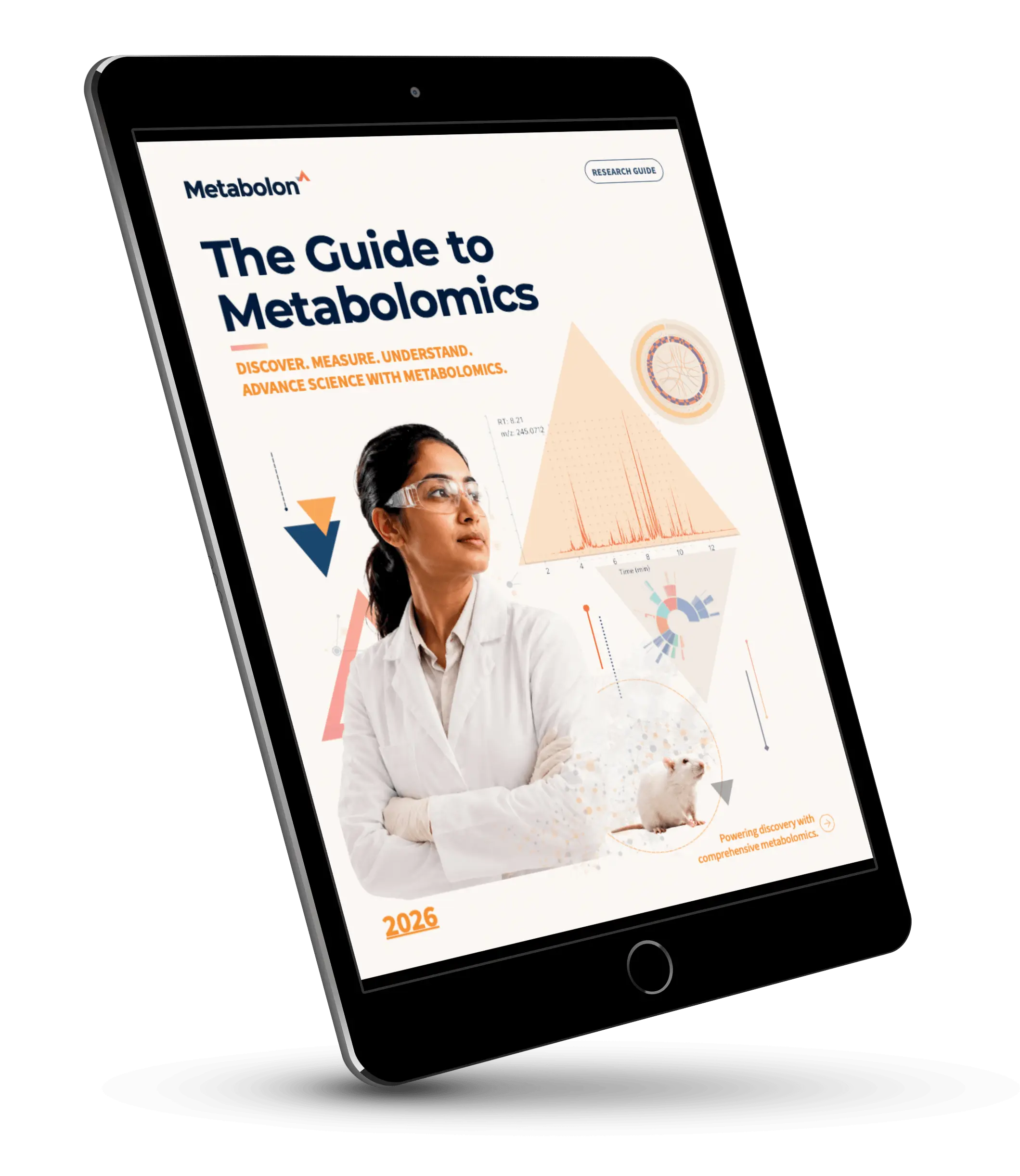
Metabolomics Guide ebook cover

Download the complete PDF guide

Download this comprehensive guide developed to teach you the ins and outs of one of the most powerful omics tools in any scientist’s toolbox: metabolomics.

Download now

Why Metabolon?

Once you see the full value of metabolomics, the only remaining question is who does it best? While many laboratories have metabolite profiling or analytical chemistry capabilities, comprehensive metabolomics technologies are extremely rare. Accurate, unbiased metabolite identification across the entire metabolome introduces signal-to-noise challenges that very few labs are equipped to handle. Also, translating massive quantities of data into actionable information is slow, if not impossible, for most because proper interpretation takes two things that are in short supply: experience and a comprehensive database.

Only Metabolon has all four core metabolomics capabilities

R

Coverage

Ability to interrogate thousands of metabolites across diverse biochemical space, revealing new insights and opportunities

R

Comparability

Ability to integrate the data from different studies into the same dataset, in different geographies, among different patients over time

R

Competency

Ability to inform on proper study design, generate high‐quality data, derive biological insights, and make actionable recommendations

R

Capacity

Ability to process hundreds of thousands of samples quickly and cost‐efficiently to service rapidly growing demand

Partner with Metabolon to access:

R

A library of 5,400+ known metabolites, 2,000 in human plasma, all referenced in the context of biochemical pathways

  • That’s 5x the metabolites of the closest competitor
R

Unparalleled depth and breadth of experience analyzing and interpreting metabolomic data to find meaningful results

  • 10,000+ projects with hundreds of clients
  • 3,500+ publications covering 500 diseases, including numerous peer-reviewed journals such as Cell, Nature and Science
  • Nearly 40 PhDs in data science, molecular biology, and biochemistry

Using our robust platform and visualization tools, our experts are uniquely able to tell you more about your molecule and develop assay panels to help you zero in on the results you need.

Contact Us

Talk with an expert

Request a quote for our services, get more information on sample types and handling procedures, request a letter of support, or submit a question about how metabolomics can advance your research.

Corporate Headquarters

617 Davis Drive, Suite 100
Morrisville, NC 27560

Mailing Address:
P.O. Box 110407
Research Triangle Park, NC 27709

+1 (919) 572-1711

+1 (919) 572-1721

International Headquarters

Metabolon GmbH

Zeppelinstraße 3
85399 Hallbergmoos
Germany
+49 89 99017752

References

1. Zgoda-Pols, J.R., et al., Metabolomics analysis reveals elevation of 3-indoxyl sulfate in plasma and brain during chemically-induced acute kidney injury in mice: investigation of nicotinic acid receptor agonists. Toxicol Appl Pharmacol, 2011. 255(1): p. 48-56.

2. Bryant, J.A., et al., The impact of an oral purified microbiome therapeutic on the gastrointestinal microbiome. Nat Med, 2026. 32(1): p. 186-196

3. McGovern, B .H., et al., SER-109, an Investigational Microbiome Drugto Reduce Recurrence After Clostridioides difficile Infection: Lessons Learned From a Phase 2 Trial. Clin Infect Dis, 2021. 72(12): p. 2132-2140.

4. Feuerstadt, P., et al., SER-109, an Oral Microbiome Therapy for Recurrent Clostridioides difficile Infection. N Engl J Med, 2022. 386(3): p. 220-229.

5. Hu, Z., et al., Targeted metabolomics reveals novel diagnostic biomarkers for colorectal cancer. Mol Oncol, 2025. 19(6): p. 1737-1750.

6. Butler, F.M., et al., Vegetarian Dietary Patterns and Diet-Related Metabolites Are Associated With Kidney Function in the Adventist Health Study-2 Cohort. J Ren Nutr, 2025.

7. Stanford, J., et al., Metabolomic Profiling and Diet Quality Scoring in a Randomized Crossover Trial of Healthy and Typical Dietary Patterns. Mol Nutr Food Res, 2025 . 69(23): p. e70271.

8. O’Connor, L.E., et al., Metabolomic Profiling of an Ultraprocessed Dietary Pattern in a Domiciled Randomized Controlled Crossover Feeding Trial. J Nutr, 2023. 153(8): p. 2181-2192.

9. Fritsch, D.A., et al., Microbiome function underpins the efficacy of a fiber-supplemented dietary intervention in dogs with chronic large bowel diarrhea. BMC Vet Res, 2022. 18(1): p. 245.

10. Leal, L.N., et al., Preweaning nutrient supply improves lactation productivity and reduces the risk of culling in Holstein cows. J Dairy Sci, 2025. 108(6): p. 5875-5888.

11. Ahsin, M., et al., Soil and pasture health underlie improved beef nutrient density determined by untargeted metabolomics in Southern US grass finished beef systems. NPJ Sci Food, 2025. 9(1): p. 151.

12. Yin, W., et al., Plasma lipid profiling across species for the identification of optimal animal models of human dyslipidemia. J Lipid Res, 2012. 53(1): p. 51-65.

13. Porter, F .D., et al., Cholesterol oxidation products are sensitive and specific blood-based biomarkers for Niemann-Pick C1 disease. Sci Transl Med, 2010. 2(56): p. 56ra81.

14. Needham, B .D., et al., Plasma and Fecal Metabolite Profiles in Autism Spectrum Disorder. Biol Psychiatry, 2021. 89(5): p. 451-462

15. Li, C., et al., Estradiol and mTORC2 cooperate to enhance prostaglandin biosynthesis and tumorigenesis in TSC2-deficient LAM cells. J Exp Med, 2014. 211(1): p. 15-28.

16. Green, P.G., et al., Metabolic flexibility and reverse remodelling of the failing human heart. Eur Heart J, 2025. 46(25): p. 2422-2433.

17. Maekawa, H., et al., SGLT2 inhibition protects kidney function by SAM-dependent epigenetic repression of inflammatory genes under metabolic stress. J Clin Invest, 2025. 135(19).

18. Wu, D., et al., Integrated screens reveal that guanine nucleotide depletion, which is irreversible via targeting IMPDH2, inhibits pancreatic cancer and potentiates KRAS inhibition. Gut, 2026.

19. Schwerdtfeger, L.A., et al., Gut microbiota and metabolites are linked to disease progression in multiple sclerosis. Cell Rep Med, 2025. 6(4): p. 102055.

20. Wu, H., et al., Microbiome-metabolome dynamics associated with impaired glucose control and responses to lifestyle changes. Nat Med, 2025. 31(7): p. 2222-2231.

21. Jacobs, J.P., et al., Cognitive behavioral therapy for irritable bowel syndrome induces bidirectional alterations in the brain-gut-microbiome axis associated with gastrointestinal symptom improvement. Microbiome, 2021. 9(1): p. 236.

22. Pietzner, M., et al., Plasma metabolites to profile pathways in noncommunicable disease multimorbidity. Nat Med, 2021. 27(3): p. 471-479.

23. Faquih, T.O., et al., Robust Metabolomic Age Prediction Based on a Wide Selection of Metabolites. J Gerontol A Biol Sci Med Sci, 2025. 80(3).

24. Scherer, N., et al., Coupling metabolomics and exome sequencing reveals graded effects of rare damaging heterozygous variants on gene function and human traits. Nat Genet, 2025. 57(1): p. 193-205.

25. Holmes, Z.C., et al., Untargeted metabolomic analysis of human milk from healthy mothers reveals drivers of metabolite variability. Sci Rep, 2024. 14(1): p. 20827.

26. Titz, B., et al., Implications of Ocular Confounding Factors for Aqueous Humor Proteomic and Metabolomic Analyses in Retinal Diseases. Transl Vis Sci Technol, 2024. 13(6): p. 17.

27. Bloom, S.M., et al., Cysteine dependence of Lactobacillus iners is a potential therapeutic target for vaginal microbiota modulation. Nat Microbiol, 2022. 7(3): p. 434-450.

28. Leimer, E.M., et al., Lipid profile of human synovial fluid following intra-articular ankle fracture. J Orthop Res, 2017. 35(3): p. 657-666.