ON-DEMAND WEBINAR
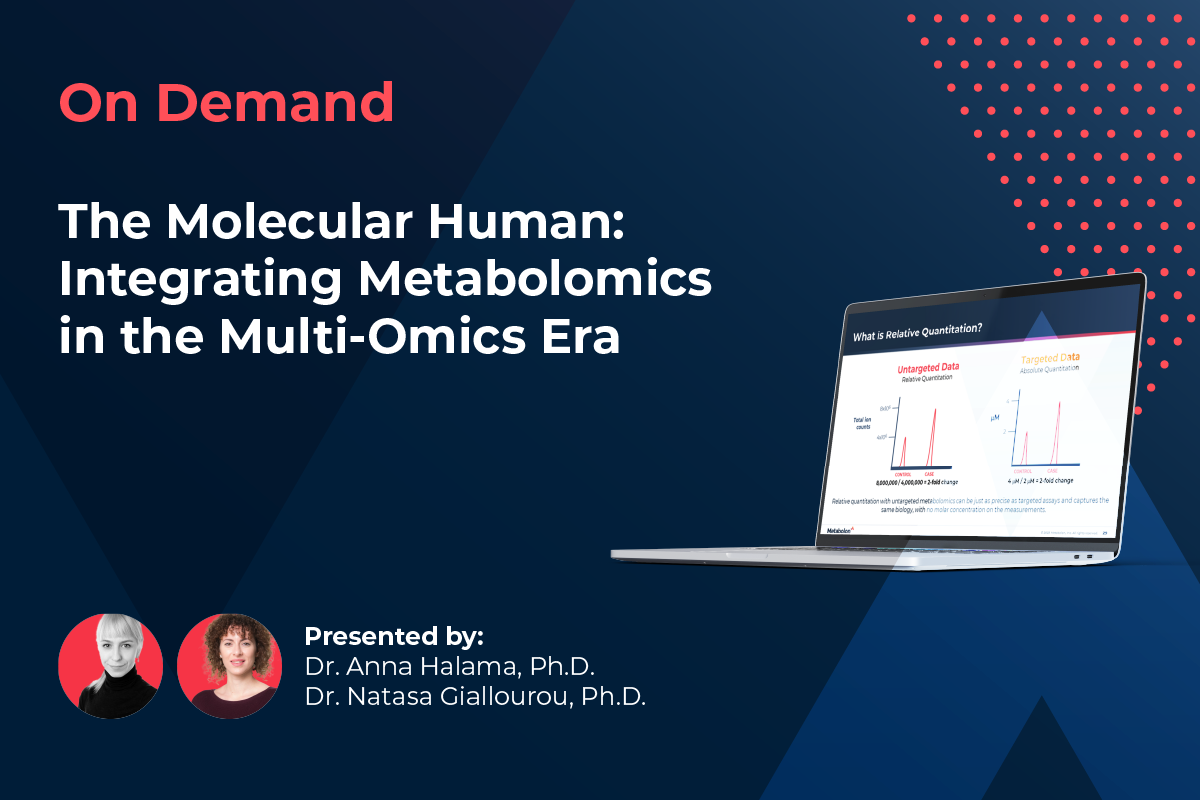
The Molecular Human—Integrating Metabolomics in the Multiomics Era
The multi-disciplined field of biochemistry is rapidly evolving: Life scientists, food scientists, and pharmaceutical scientists are all pursuing new answers to complex problems, and integrative omics (multiomics) with metabolomics is now critical to novel biological discovery.
Join Dr. Anna (Ania) Halama, Assistant Professor of Research in Physiology and Biophysics at Weill Cornell Medicine-Qatar, as she explores the relationship of different, integrated omics data to further understand human biology. Dr. Halama will demonstrate how longitudinal phenotyping can be used as foundational reference data when observing complex physiological processes, and how to best interpret multiomics data, using different technologies to derive actionable insights for new scientific discoveries and functional outcomes.
During this webinar, you will learn:
-
- How metabolomics can be used to assess medication usage in biobank studies with Qatar BioBank as an example
- How deep phenotyping can significantly advance our understanding of human health and disease
- Recommendations for integrating different technologies and data within a single study
- The functional power of phenotypic datasets
About Metabolomics
Metabolomics is an integral component of multiomics research. The detection, identification, and quantification of metabolites present in a biological system provides a functional snapshot—helpful when exploring health and disease and identifying predictive biomarkers for future conditions. In the context of multiomics, metabolomics plays a pivotal role by providing valuable insights into the downstream products of cellular processes. It offers a real-time snapshot of an organism’s metabolic state, revealing the end result of gene expression, protein activity, and environmental influences. By integrating metabolomics data with genomics, transcriptomics, proteomics, and other omics disciplines, researchers can unravel intricate relationships between genes, proteins, and metabolites, enabling a more holistic and systems-level understanding of complex biological phenomena, such as disease mechanisms, drug responses, and environmental interactions.
Dr. Anna Halama, Ph.D.
 Anna Halama received her Ph.D. from the Technical University of Munich (TUM) in Germany in 2013, where she obtained in-depth knowledge and skills in the field of metabolomics. She joined Weill Cornell Medicine Qatar (WCM-Q) in 2013 as a postdoctoral fellow in Prof. Karsten Suhre’s group and continued her career development at WCM-Q as a research associate, a position she held from 2016 to 2019. In this period, she conducted her own research in the field of metabolism and supported fellow scientists in the design of metabolomics-based experiments and analysis of metabolomics data.
Dr. Halama became an Assistant Professor of Research in Physiology and Biophysics at WCM-Q in April 2019. Her research focuses on metabolic deregulations in complex diseases, particularly cancer and diabetes. Dr. Halama is focused on the implementation of metabolomics along with other omics into the clinical pipeline. She is conducting research aiming to determine so-called “metabolic knobs” which could be used as targets for medical intervention.
Dr. Natasa Giallourou, Ph.D.
 Dr. Natasa Giallourou is a Field Metabolomics Scientist supporting Metabolon’s International Business activities. She provides scientific counsel for metabolomics applications in the biopharma and academic sectors. Natasa obtained her Ph.D. in Metabolomics from the University of Reading and holds an M.Sc. in Nutrition and Health from Wageningen University and a B.Sc. in Biology from the University of Leeds.
Prior to joining Metabolon, Natasa served as a Marie Skłodowska-Curie Postdoctoral Fellow at biobank.cy. Her research projects involved integrating metabolomic data with other omics data in population-based studies, with a focus on identifying biomarkers for complex diseases. She has also worked as a postdoctoral research associate at Imperial College London, where she specialized in utilizing metabolic phenotyping to address global health challenges, particularly in the field of public health nutrition.
Natasa sits on the Board of Directors of the International Metabolomics Society and is also an advisor to the Early-career Member’s Network for young metabolomics scientists.