ON DEMAND WEBINAR

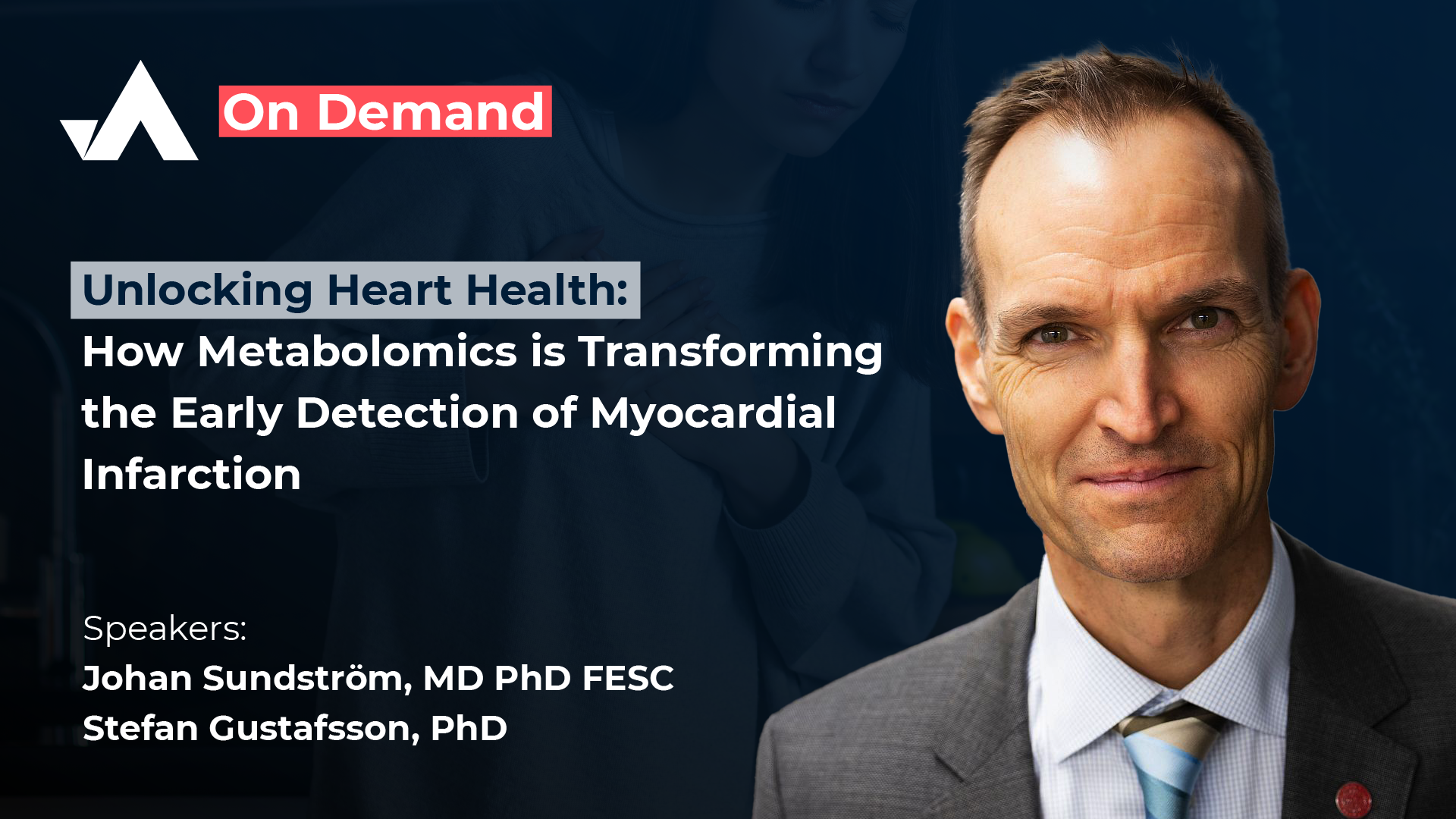
On Demand: Unlocking Heart Health: How Metabolomics is Transforming the Early Detection of Myocardial Infarction
Imminent myocardial infarction, commonly known as a heart attack, occurs when blood flow to a part of the heart muscle is severely reduced or completely blocked, often due to a blood clot forming in a coronary artery narrowed by atherosclerosis. This condition can manifest through symptoms such as chest pain, shortness of breath, and radiating discomfort in the arms, jaw, or back. Risk factors include high blood pressure, high cholesterol, smoking, diabetes, obesity, and a sedentary lifestyle. Prompt recognition and intervention are crucial, as a myocardial infarction can lead to significant heart damage or even death if not treated quickly. Timely medical attention can restore blood flow and minimize the risk of complications, emphasizing the importance of awareness and understanding of this critical health emergency.

Metabolomics, the comprehensive study of metabolites within biological systems, has emerged as a powerful tool in cardiovascular research, particularly in the context of imminent myocardial infarction. By analyzing metabolic profiles, researchers can identify specific biomarkers associated with heart disease, enabling earlier detection and improved risk assessment of impending heart attacks. This approach provides insights into the biochemical changes that precede myocardial infarction, such as alterations in lipid metabolism, energy production, and inflammatory pathways. Furthermore, metabolomics facilitates the understanding of individual responses to therapies, paving the way for personalized medicine in cardiovascular care. As researchers continue to explore the intricate connections between metabolism and heart health, metabolomics stands to significantly enhance early intervention strategies and therapeutic developments in the fight against cardiovascular diseases.

In this webinar, Johan Sundström, MD PhD FESC and Stefan Gustafsson, PhD discuss their latest publication that explores biomarkers of imminent myocardial infarction. Their multiomic research explored protein and metabolite biomarkers that were associated with risk of imminent myocardial infarction and created a prediction model that could be used for early identification.

You will learn:

  • About specific biomarkers associated with imminent myocardial infarction, enhancing early detection.
  • Understand the role of metabolites and proteins in assessing the risk of heart attacks.
  • Explore the prediction model developed for imminent myocardial infarction based on clinical and biomarker data.
  • Gain insights into how the findings can improve primary prevention strategies for cardiovascular diseases.
  • Understand how to design a successful cohort study

Program

Presenter
Title/Abstract
Dr. Natasa Giallourou, Ph.D.
Welcome and Introductions
Johan Sundström, MD Ph.D. FESC
Markers of imminent myocardial infarction: Rationale and design of a European case-cohort study
Dr. Natasa Giallourou, Ph.D.
Routine Solutions for Untargeted and Targeted Metabolomics
Stefan Gustafsson, Ph.D.
Markers of imminent myocardial infarction: Biomarker methods and results
Dr. Natasa Giallourou, Ph.D.
Questions & Answers

Speakers

K
L

”Johan

K
L

Stefan Gustafsson, Ph.D.

Bioinformatician at Uppsala University

Stefan Gustafsson, PhD is a Researcher at Uppsala University, Uppsala, Sweden. His work mainly focuses on cardiovascular disease, applying classical statistical methods well as machine learning methods using cohort studies, registry-based data, and electronic health records.

K
L

Dr. Natasa Giallourou, Ph.D.

Field Metabolomics Scientist at Metabolon

Dr. Natasa Giallourou is a Field Metabolomics Scientist supporting Metabolon’s International Business activities. She provides scientific counsel for metabolomics applications in the biopharma and academic sectors. Natasa obtained her Ph.D. in Metabolomics from the University of Reading and holds an M.Sc. in Nutrition and Health from Wageningen University and a B.Sc. in Biology from the University of Leeds.

Prior to joining Metabolon, Natasa served as a Marie Skłodowska-Curie Postdoctoral Fellow at biobank.cy. Her research projects involved integrating metabolomic data with other omics data in population-based studies, with a focus on identifying biomarkers for complex diseases. She has also worked as a postdoctoral research associate at Imperial College London, where she specialized in utilizing metabolic phenotyping to address global health challenges, particularly in the field of public health nutrition.

Natasa sits on the Board of Directors of the International Metabolomics Society and is also an advisor to the Early-career Member’s Network for young metabolomics scientists.
WATCH WEBINAR

References

1. Zgoda-Pols, J.R., et al., Metabolomics analysis reveals elevation of 3-indoxyl sulfate in plasma and brain during chemically-induced acute kidney injury in mice: investigation of nicotinic acid receptor agonists. Toxicol Appl Pharmacol, 2011. 255(1): p. 48-56.

2. Bryant, J.A., et al., The impact of an oral purified microbiome therapeutic on the gastrointestinal microbiome. Nat Med, 2026. 32(1): p. 186-196

3. McGovern, B .H., et al., SER-109, an Investigational Microbiome Drugto Reduce Recurrence After Clostridioides difficile Infection: Lessons Learned From a Phase 2 Trial. Clin Infect Dis, 2021. 72(12): p. 2132-2140.

4. Feuerstadt, P., et al., SER-109, an Oral Microbiome Therapy for Recurrent Clostridioides difficile Infection. N Engl J Med, 2022. 386(3): p. 220-229.

5. Hu, Z., et al., Targeted metabolomics reveals novel diagnostic biomarkers for colorectal cancer. Mol Oncol, 2025. 19(6): p. 1737-1750.

6. Butler, F.M., et al., Vegetarian Dietary Patterns and Diet-Related Metabolites Are Associated With Kidney Function in the Adventist Health Study-2 Cohort. J Ren Nutr, 2025.

7. Stanford, J., et al., Metabolomic Profiling and Diet Quality Scoring in a Randomized Crossover Trial of Healthy and Typical Dietary Patterns. Mol Nutr Food Res, 2025 . 69(23): p. e70271.

8. O’Connor, L.E., et al., Metabolomic Profiling of an Ultraprocessed Dietary Pattern in a Domiciled Randomized Controlled Crossover Feeding Trial. J Nutr, 2023. 153(8): p. 2181-2192.

9. Fritsch, D.A., et al., Microbiome function underpins the efficacy of a fiber-supplemented dietary intervention in dogs with chronic large bowel diarrhea. BMC Vet Res, 2022. 18(1): p. 245.

10. Leal, L.N., et al., Preweaning nutrient supply improves lactation productivity and reduces the risk of culling in Holstein cows. J Dairy Sci, 2025. 108(6): p. 5875-5888.

11. Ahsin, M., et al., Soil and pasture health underlie improved beef nutrient density determined by untargeted metabolomics in Southern US grass finished beef systems. NPJ Sci Food, 2025. 9(1): p. 151.

12. Yin, W., et al., Plasma lipid profiling across species for the identification of optimal animal models of human dyslipidemia. J Lipid Res, 2012. 53(1): p. 51-65.

13. Porter, F .D., et al., Cholesterol oxidation products are sensitive and specific blood-based biomarkers for Niemann-Pick C1 disease. Sci Transl Med, 2010. 2(56): p. 56ra81.

14. Needham, B .D., et al., Plasma and Fecal Metabolite Profiles in Autism Spectrum Disorder. Biol Psychiatry, 2021. 89(5): p. 451-462

15. Li, C., et al., Estradiol and mTORC2 cooperate to enhance prostaglandin biosynthesis and tumorigenesis in TSC2-deficient LAM cells. J Exp Med, 2014. 211(1): p. 15-28.

16. Green, P.G., et al., Metabolic flexibility and reverse remodelling of the failing human heart. Eur Heart J, 2025. 46(25): p. 2422-2433.

17. Maekawa, H., et al., SGLT2 inhibition protects kidney function by SAM-dependent epigenetic repression of inflammatory genes under metabolic stress. J Clin Invest, 2025. 135(19).

18. Wu, D., et al., Integrated screens reveal that guanine nucleotide depletion, which is irreversible via targeting IMPDH2, inhibits pancreatic cancer and potentiates KRAS inhibition. Gut, 2026.

19. Schwerdtfeger, L.A., et al., Gut microbiota and metabolites are linked to disease progression in multiple sclerosis. Cell Rep Med, 2025. 6(4): p. 102055.

20. Wu, H., et al., Microbiome-metabolome dynamics associated with impaired glucose control and responses to lifestyle changes. Nat Med, 2025. 31(7): p. 2222-2231.

21. Jacobs, J.P., et al., Cognitive behavioral therapy for irritable bowel syndrome induces bidirectional alterations in the brain-gut-microbiome axis associated with gastrointestinal symptom improvement. Microbiome, 2021. 9(1): p. 236.

22. Pietzner, M., et al., Plasma metabolites to profile pathways in noncommunicable disease multimorbidity. Nat Med, 2021. 27(3): p. 471-479.

23. Faquih, T.O., et al., Robust Metabolomic Age Prediction Based on a Wide Selection of Metabolites. J Gerontol A Biol Sci Med Sci, 2025. 80(3).

24. Scherer, N., et al., Coupling metabolomics and exome sequencing reveals graded effects of rare damaging heterozygous variants on gene function and human traits. Nat Genet, 2025. 57(1): p. 193-205.

25. Holmes, Z.C., et al., Untargeted metabolomic analysis of human milk from healthy mothers reveals drivers of metabolite variability. Sci Rep, 2024. 14(1): p. 20827.

26. Titz, B., et al., Implications of Ocular Confounding Factors for Aqueous Humor Proteomic and Metabolomic Analyses in Retinal Diseases. Transl Vis Sci Technol, 2024. 13(6): p. 17.

27. Bloom, S.M., et al., Cysteine dependence of Lactobacillus iners is a potential therapeutic target for vaginal microbiota modulation. Nat Microbiol, 2022. 7(3): p. 434-450.

28. Leimer, E.M., et al., Lipid profile of human synovial fluid following intra-articular ankle fracture. J Orthop Res, 2017. 35(3): p. 657-666.