
Company News
Metabolomics represents the ultimate biological endpoint. By identifying and quantifying metabolites within a biological sample, investigators uncover new frontiers of understanding – What role does this metabolite play in host biology, diseases, and disorders? Will its presence and concentration impact protein or gene behaviors, indicating it is a marker for wider systems biology? Can its detection be a predictor of good or bad biological outcomes leading to the development of new therapeutic interventions?
The power and utility of metabolomics data is transformative. Its use in multiomics research is critical to advancing life science discoveries, and Metabolon is at the forefront of metabolomics research.
To help researchers maximize their understanding of metabolomics, and the interplays of metabolomics with multiomics data, Metabolon is proud to announce a significant refresh of our website: https://metabolon.com
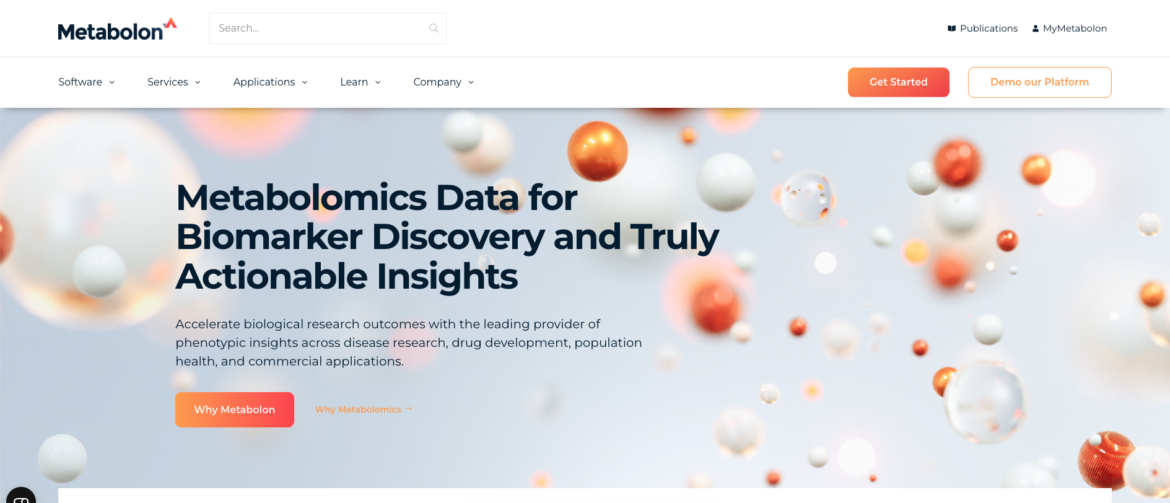
The site refresh is designed to make it faster and easier for visitors to find relevant information about metabolomics applications across all major research areas, as well as identifying which metabolomics services are most relevant to their research objectives.
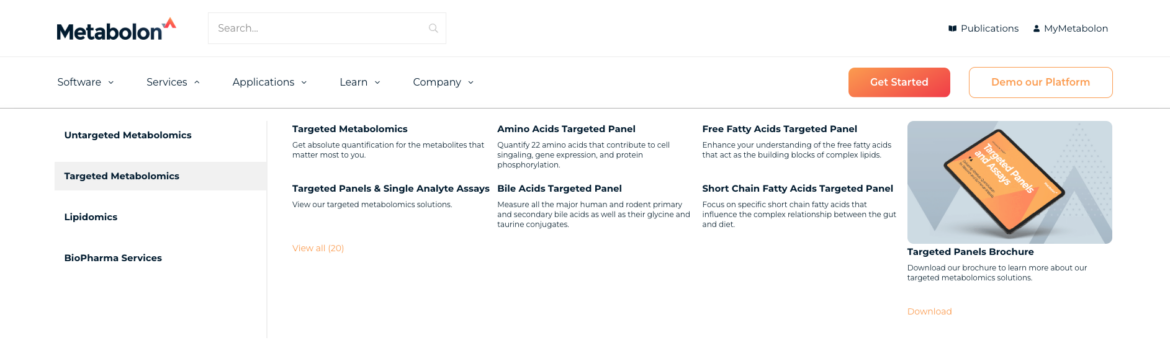
The new and improved menu helps quickly identify the best web page to learn more about Metabolon’s products and services, our contributions to different metabolomics applications, and company news and updates.
We have reduced the number of pages by more than 50%, making the most valuable information more accessible, with fewer clicks.
We have also included room for new, featured information to help inform visitors of the latest updates, content, and offers from Metabolon to stay informed.


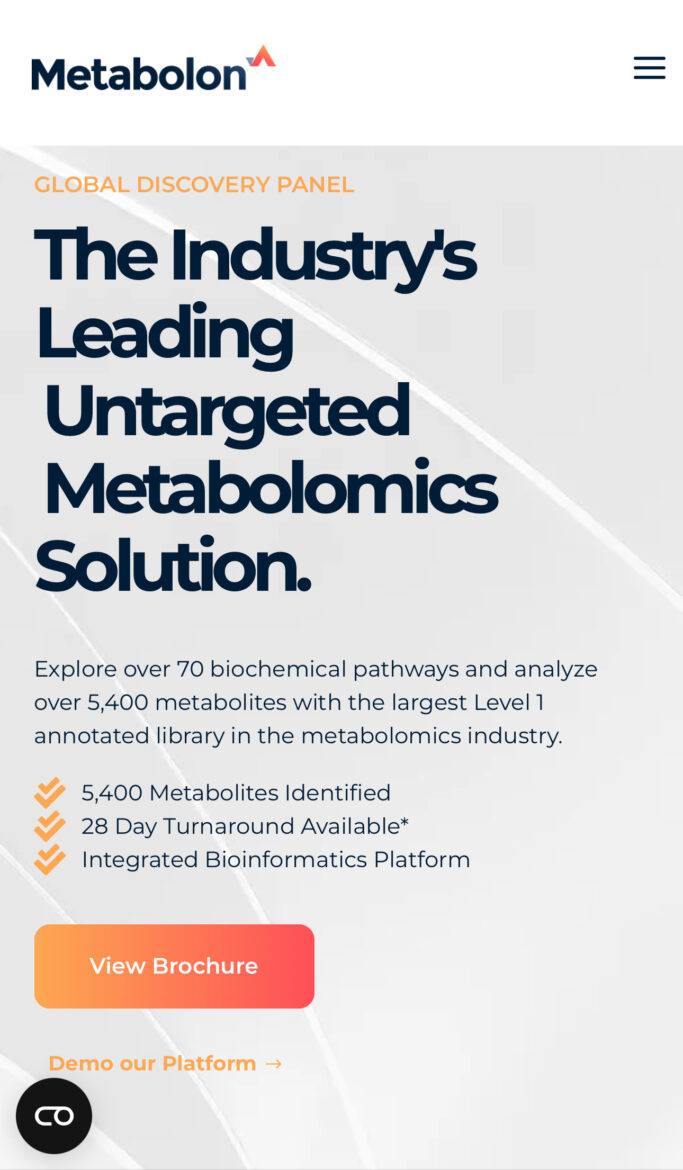
The website is fully mobile optimized and has a number of functional improvements to the User Experience (UX) and User Interface (UI). Users should be able to navigate between pages more easily , and all of the content and images are now better represented and readable across all screen resolutions.
The changes to metabolon.com are a part of our commitment to quality – we understand that metabolomics is a large field with many facets of learning, and by making our library of learning resources, publications, services, and case studies more readily available we hope to help everyone committed to uncovering new biological outcomes with metabolite data accelerate their path to novel insights.
Metabolomics, the large-scale study of all small molecules in a biological system, is the only omics technology that provides a complete current-state functional readout of a biological system. Metabolomics helps researchers see beyond individual genetic variation, capturing the combined impact of genetic and external factors, such as drugs, diet, lifestyle, and the microbiome, on human health. By measuring thousands of discrete chemical signals that form biological pathways in the body, metabolomics can reveal important biomarkers, enabling a better understanding of a drug’s mechanism of action, pharmacodynamics, and safety profile, as well as individual responses to therapy.
Metabolon, Inc. is the global leader in metabolomics, with a mission to deliver biochemical data and insights that expand and accelerate the impact of life sciences research and complement other ‘omics’ technologies. With 25 years of experience, 15,000+ client projects, 4,000+ scientific publication references, and ISO 9001:2015, CLIA, and CAP certifications, Metabolon has developed industry-leading scientific, technology, and bioinformatics techniques.
Metabolon’s Global Discovery Panel is powered by the world’s largest proprietary metabolomics reference library. Metabolon’s industry-leading data and translational science expertise help customers and partners address some of the most challenging and pressing questions in the life sciences, accelerating research and enhancing development success. The company offers scalable, customizable multiomics solutions, including metabolomics and lipidomics, that support customer needs from discovery through clinical trials and product life-cycle management.
For more information, please visit metabolon.com and follow us on LinkedIn and Twitter.
Sean Iverson
VP, Global Marketing
siverson@metabolon.com
Request a quote for our services, get more information on sample types and handling procedures, request a letter of support, or submit a question about how metabolomics can advance your research.
Corporate Headquarters
617 Davis Drive, Suite 100
Morrisville, NC 27560
Mailing Address
P.O. Box 110407
Research Triangle Park, NC 27709
Phone
+1 (919) 572-1711
Fax
+1 (919) 572-1721
International Headquarters
Metabolon GmbH
Zeppelinstraße 3
85399 Hallbergmoos
Germany