
Industry Research Areas
See how metabolomics can enhance our understanding of the dynamic relationship between diet, metabolism, and health.
Nutrition plays a crucial role in shaping our overall health and well-being, as the foods we consume provide the essential nutrients that fuel and repair our bodies. A balanced diet rich in vitamins, minerals, proteins, fats, and carbohydrates supports the proper functioning of organs, immune systems, and metabolic processes. Poor nutrition, on the other hand, can lead to various health issues, such as obesity, heart disease, diabetes, and weakened immunity. Additionally, the right nutrition can help prevent chronic illnesses, improve mental health, and promote longevity by reducing inflammation, improving cognitive function, and supporting energy levels.

Nutrimetabolomics is a growing field of research at the intersection of nutrition and metabolomics that focuses on the comprehensive analysis of small molecules in biological samples to understand how dietary components influence metabolism and health outcomes. By mapping the metabolic pathways affected by dietary intake, nutrimetabolomics can reveal and quantify the metabolic response of an individual to dietary interventions and gain insights into the underlying mechanisms of how nutrients affect health and disease.
Nutrimetabolomics holds promise for advancing our understanding of how diet impacts health at a molecular level, potentially revolutionizing our approaches to nutrition and wellness. Here, we showcase several examples of how metabolomics has helped advance our understanding of nutrition in human health and disease.
Fetal exposure to excess maternal glucose, amino acids, and lipids puts the offspring at an increased risk of metabolic diseases. Offspring of mothers who experience obesity and/or gestational diabetes mellitus (GDM) demonstrate sustained alterations in their metabolome, which tend to show variations between these two types of exposure.
To date, few studies have thoroughly examined these differences longitudinally. To address this gap in knowledge, Francis and colleagues analyzed the plasma metabolome at birth and at 6 years of age of offspring that experienced 1) maternal obesity, 2) gestational diabetes mellitus, or 3) both1. Linear mixed modeling and principal component analysis were used to identify metabolites associated with overnutrition and identify metabolic profile differences between groups. 52 metabolites were associated with fetal overnutrition, with sphingomyelin-mannose being more strongly associated with obesity compared to the other two groups.
Exposure to obesity + gestational diabetes was associated with higher skeletal muscle metabolism and CMPF, which has been linked to beta-cell dysfunction and subsequent diabetes. Overall, this hypothesis-generating study identified subtle differences in the metabolic footprint of offspring exposed to different types of overnutrition. This subtility suggests that obesity and gestational diabetes are not separate entities, but rather, different degrees of severity on a metabolic spectrum, which could be further investigated in future studies.
Preterm infants have minimal nutrient stores, which are essential for growth, as well as an underdeveloped gastrointestinal system that limits the uptake of nutrients. Total parenteral nutrition (TPN), which administers essential nutrients intravenously into the blood stream, is essential for preterm infant survival, but it carries potentially adverse effects such as hyperglycemia, electrolyte imbalance, and acid-base disturbances. The global impact of TPN on the infant metabolome is not well characterized, and having this knowledge could be useful for optimizing timing and dosing of feedings. Here, Guardado and colleagues performed untargeted metabolomics on urine samples collected between 23-30 days of life from 314 infants born before 29 weeks gestation2.
Principal component analysis showed a metabolic separation between infants on TPN compared to those who had transitioned to enteral feeds. Compared to TPN, enteral feeds were associated with higher concentrations of essential amino acids, lipids, and vitamins. A time course of metabolite concentrations related to the weaning off TPN and start of enteral feeds showed both rapid and delayed changes in concentrations of these biochemicals. Altogether, these findings confirm that enteral feeds are superior in supporting growth and development, support the current clinical practice of transitioning an infant to enteral feeds as soon as they are able, and provide a good example of how metabolomics can enhance our understanding of nutritional intervention.
In this study, Brachem and colleagues analyzed the plasma and urine metabolomes of 228 adolescent participants and diet-metabolome associations were determined using orthogonal projection to latent structures and random forests3.
A limited number of associations were found in urine and associations were not found in blood. The associations found were sex dependent. Hippurate or hippuric acid were associated with increased vegetable consumption in male urine. Indole-3-acetamide and N6-methyladenosine were negatively associated with egg consumption in males. Finally, vanillylmandelate was negatively associated with processed and other meat in female urine. These findings show that single metabolites can reflect habitual food intake to some degree, and future studies will be needed to more thoroughly characterize these pathways and their disparate association between sexes.
Nutritional intervention/medically tailored meals are one of the standards of care for several diseases including type 2 diabetes, cardiovascular disease, and hypertension. Recently, a ketogenic diet has been proposed as a novel therapeutic for delaying cognitive decline in Alzheimer’s disease (AD) owing to its ability to improve mitochondrial function, cerebral bioenergetics, and reduce oxidative stress. It is currently theorized that AD onset may begin with disruptions in the gut microbiome, leading to gastrointestinal inflammation and subsequent signal dysregulation between the gut-brain axis. To better characterize the relationship between the KD, gut microbiota, and cognitive status in AD patients, Dilmore and colleagues evaluated gut microbiota and metabolites related to cognitive status following a controlled KD intervention compared with a low-fat-diet intervention4.
Cognitively normal and mildly cognitively impaired pre-diabetic adults were placed on either a low-fat American Heart Association diet or KD for 6 weeks. After a 6-week washout period the groups switched to the alternate diet. Each participant’s microbiome and metabolome were analyzed using shotgun metagenomics and untargeted metabolomics on stool samples collected at 5 timepoints throughout the study. Microbial strains, foods, and metabolites related to both cognitive status and diet are shown in Figure 1.
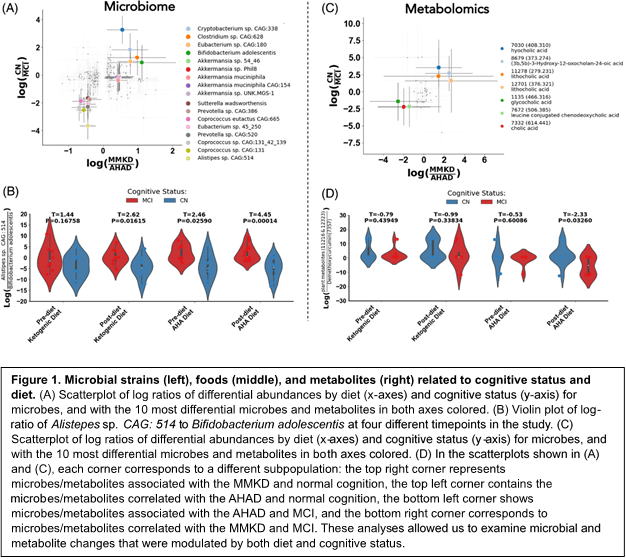
Figure 1. Microbial strains (left), foods (middle), and metabolites (right) related to cognitive status and diet. (A) Scatterplot of log ratios of differential abundances by diet (x-axes) and cognitive status (y-axis) for microbes, and with the 10 most differential microbes and metabolites in both axes colored. (B) Violin plot of log-ratio of Alistepes sp. CAG: 514 to Bifidobacterium adolescentis at four different timepoints in the study. (C) Scatterplot of log ratios of differential abundances by diet (x-axes) and cognitive status (y-axis) for microbes, and with the 10 most differential microbes and metabolites in both axes colored. (D) In the scatterplots shown in (A) and (C), each corner corresponds to a different subpopulation: the top right corner represents microbes/metabolites associated with the MMKD and normal cognition, the top left corner contains the microbes/metabolites correlated with the AHAD and normal cognition, the bottom left corner shows microbes/metabolites associated with the AHAD and MCI, and the bottom right corner corresponds to microbes/metabolites correlated with the MMKD and MCI. These analyses allowed us to examine microbial and metabolite changes that were modulated by both diet and cognitive status.
The ratio of Alistipes sp. CAG:514 to Bifidobacterium adolescentis was significantly different between mild cognitively impaired and cognitively normal individuals but only after consuming the low-fat American Heart Association diet. This finding was interesting because microbial strains that are similar to Alistipes sp. CAG:514 are known to produce GABA. When placed on the KD, individuals with mild cognitive impairment had lower levels of GABA-producing gut microbes and higher levels of GABA-regulating microbes. GABA has been shown to play a multifaceted role within the gut-brain axis. Within the gut it regulates microbial populations and signals through the GI tract to impact motility, inflammation, and may impact GABA levels in other organs including the brain. Overall, these results suggest that dietary intervention can alter the microbiome and downstream/signaling molecules, and that people with mild cognitive impairment respond differently than cognitively normal individuals to intervention impacting the microbiome.
"Metabolomics can discover and link biomarkers of food intacke from both whole diets and individual foods, to health outcomes."
Reisdorph, N. A., Hendricks, A. E., Tang, M., Doenges, K. A., Reisdorph, R. M., Tooker, B. C., Quinn, K., Borengasser, S. J., Frank, D. N., Campbell, W. W., & Krebs, N. F. An insight into farm animal skeletal muscle metabolism based on a metabolomics approach Nutrimetabolomics reveals food-specific compounds in urine of adults consuming a DASH-style diet 2020. Scientific Reports, 10(1), 1-10.. https://doi.org/10.1038/s41598-020-57979-8
Once you see the full value of metabolomics, the only remaining question is: who does it best? While many laboratories have metabolite profiling or analytical chemistry capabilities, comprehensive metabolomics technologies are extremely rare.
Accurate, unbiased metabolite identification across the entire metabolome introduces signal-to-noise challenges that very few labs are equipped to handle. Also, translating massive quantities of data into actionable information is slow, if not impossible, for most because proper interpretation takes two things that are in short supply: experience and a comprehensive database.
Using our robust platform and visualization tools, our experts are uniquely able to tell you more about your molecule and develop assay panels to help you zero in on the results you need.
Coverage
Ability to interrogate thousands of metabolites across diverse biochemical space, revealing new insights and opportunities
Comparability
Ability to integrate the data from different studies into the same dataset, in different geographies, among different patients over time
Competency
Ability to inform on proper study design, generate high‐quality data, derive biological insights, and make actionable recommendations
Capacity
Ability to process hundreds of thousands of samples quickly and cost‐efficiently to service rapidly growing demand
For over 20 years Metabolon has been helping scientists use, understand, and integrate metabolomics into their studies to drive discovery and innovation. To see how Metabolon’s industry-leading metabolomics platform and software, and scientific experts can help you take advantage of metabolomics in your studies, speak with one of our experts here.
Corporate Headquarters
617 Davis Drive, Suite 100
Morrisville, NC 27560
Mailing Address
P.O. Box 110407
Research Triangle Park, NC 27709
Phone
+1 (919) 572-1711
Fax
+1 (919) 572-1721
International Headquarters
Metabolon GmbH
Zeppelinstraße 3
85399 Hallbergmoos
Germany
1. Francis, E.C., et al., Metabolomic Profiles in Childhood and Adolescence Are Associated with Fetal Overnutrition. Metabolites, 2022. 12(3).
2. Guardado, M., et al., The Urinary Metabolomic Fingerprint in Extremely Preterm Infants on Total Parenteral Nutrition vs. Enteral Feeds. Metabolites, 2023. 13(9).
3. Brachem, C., Oluwagbemigun, K., Langenau, J., Weinhold, L., Alexy, U., Schmid, M., & Nöthlings, U. (2022). Exploring the Association between Habitual Food Intake and the Urine and Blood Metabolome in Adolescents and Young Adults: A Cohort Study. Molecular Nutrition & Food Research, 66(18), 2200023. https://doi.org/10.1002/mnfr.202200023
4. Dilmore, A.H., et al., Effects of a ketogenic and low-fat diet on the human metabolome, microbiome, and foodome in adults at risk for Alzheimer’s disease. Alzheimers Dement, 2023. 19(11): p. 4805-4816.