Chapter 5
Many studies have linked the gut microbiome to human disease, yet major challenges continue to limit its translation into improved prevention strategies and patient care. In inflammatory bowel disease (IBD), investigators struggle to distinguish microbial changes that drive intestinal inflammation from those that arise as a consequence of disease, treatment, diet, or other environmental exposures. The complexity and heterogeneity of the microbiome further complicate efforts to identify reproducible disease mechanisms, biomarkers, and therapeutic targets or to predict disease course and treatment response. Similar challenges hinder the use of precision nutrition to prevent metabolic disease. Individuals can respond very differently to the same foods or dietary interventions because nutritional responses are shaped by a complex interplay between the gut microbiome, host genetics, metabolism, and immune function. As a result, it remains difficult to determine why an intervention may benefit one person but not another and translate short-term biological changes into prolonged improvements in metabolic health.
Multiomics can help address these challenges by going beyond simply identifying which gut microbes are present to revealing what they are doing, which molecules they produce, how the host responds, and how these interconnected processes change over time or following intervention. This systems-level perspective can help distinguish causal disease mechanisms from downstream consequences, identify distinct patient subgroups, and uncover biomarkers and therapeutic targets. Multiomics can also link dietary exposures and microbiome activity to individual metabolic responses, enabling more accurate prediction of how specific food interventions may affect disease pathology and who would be likely to benefit from such interventions. In this final chapter, we present studies that demonstrate the utility of multiomics in tackling some of these challenges.
The difficulty of distinguishing correlation from causation when interpreting complex host-microbiome interactions and disease processes has been a longstanding limitation in biomedical research. In inflammatory bowel disease (IBD), many studies have reported associations with reduced microbial diversity, depletion of short-chain fatty acid-producing bacteria, and expansion of inflammatory taxa; however, it remains unclear whether these microbial shifts drive intestinal inflammation or are a consequence of it. This uncertainty limits the development of targeted microbiome-based therapies. Integrating microbial, functional, and metabolic data through multiomics approaches enables improved mechanistic understanding and supports identification of causal pathways underlying disease activity. The following study aimed to determine which bacterial species, microbial functions, and metabolites are associated with successful response to fecal microbiota transplantation (FMT) in patients with active ulcerative colitis (UC)36.
Metagenomic profiling was performed using shotgun sequencing and 16S rRNA sequencing on stool samples and colonic biopsies study participants. Untargeted metabolomics was conducted using liquid chromatography-mass spectrometry (LC-MS) on stool samples to characterize metabolic profiles. Differences in microbial community composition were assessed using Bray–Curtis dissimilarity and principal component analysis. Group-level comparisons (responders vs non-responders, FMT vs placebo, and longitudinal changes) were evaluated using permutational multivariate analysis of variance. Negative binomial generalized linear models were applied to identify bacterial taxa and metabolic pathways associated with remission or treatment failure, while linear discriminant analysis effect size was used to determine discriminatory microbial features, and linear mixed-effects models were used to assess longitudinal microbiome changes over time.
Patients receiving FMT exhibited substantial shifts in gut microbial composition compared with patients treated with placebo. These changes included increased microbial diversity, greater convergence of recipient microbiomes toward donor profiles, and a pronounced restructuring of bacterial community composition over time. Notably, these effects were most evident in individuals who achieved clinical remission, consistent with the notion that restoration of microbial diversity reflects improved gut ecosystem health in UC. Several bacterial taxa were significantly enriched in responders, including Eubacterium hallii, Roseburia inulinivorans, and Ruminococcus bromii, all of which are involved in short-chain fatty acid production, complex carbohydrate fermentation, and maintenance of intestinal barrier integrity. In contrast, nonresponders showed enrichment of taxa previously linked to intestinal inflammation and dysbiosis, such as Fusobacterium gonidiaformans, Sutterella wadsworthensis, and Escherichia species.
Untargeted fecal metabolomics further identified over 200 metabolites that differed between groups, with responders demonstrating increased levels of secondary bile acids, dehydrolithocholate, biotin-related metabolites, and fermentation products associated with anti-inflammatory signaling, epithelial health, and immune regulation. These findings converged on a strong association between remission and enhanced secondary bile acid metabolism, supported by parallel increases in bile acid-transforming bacteria and corresponding metabolite profiles. Conversely, treatment failure was characterized by elevated heme, lysine-related metabolites, and other signatures of inflammatory microbial metabolism, suggesting persistence of a pro-inflammatory metabolic environment despite FMT (Figure 13). Importantly, these microbial and metabolic signatures were consistently associated with clinical remission, endoscopic remission, and composite outcomes, supporting their robustness as biologically meaningful markers of therapeutic response.
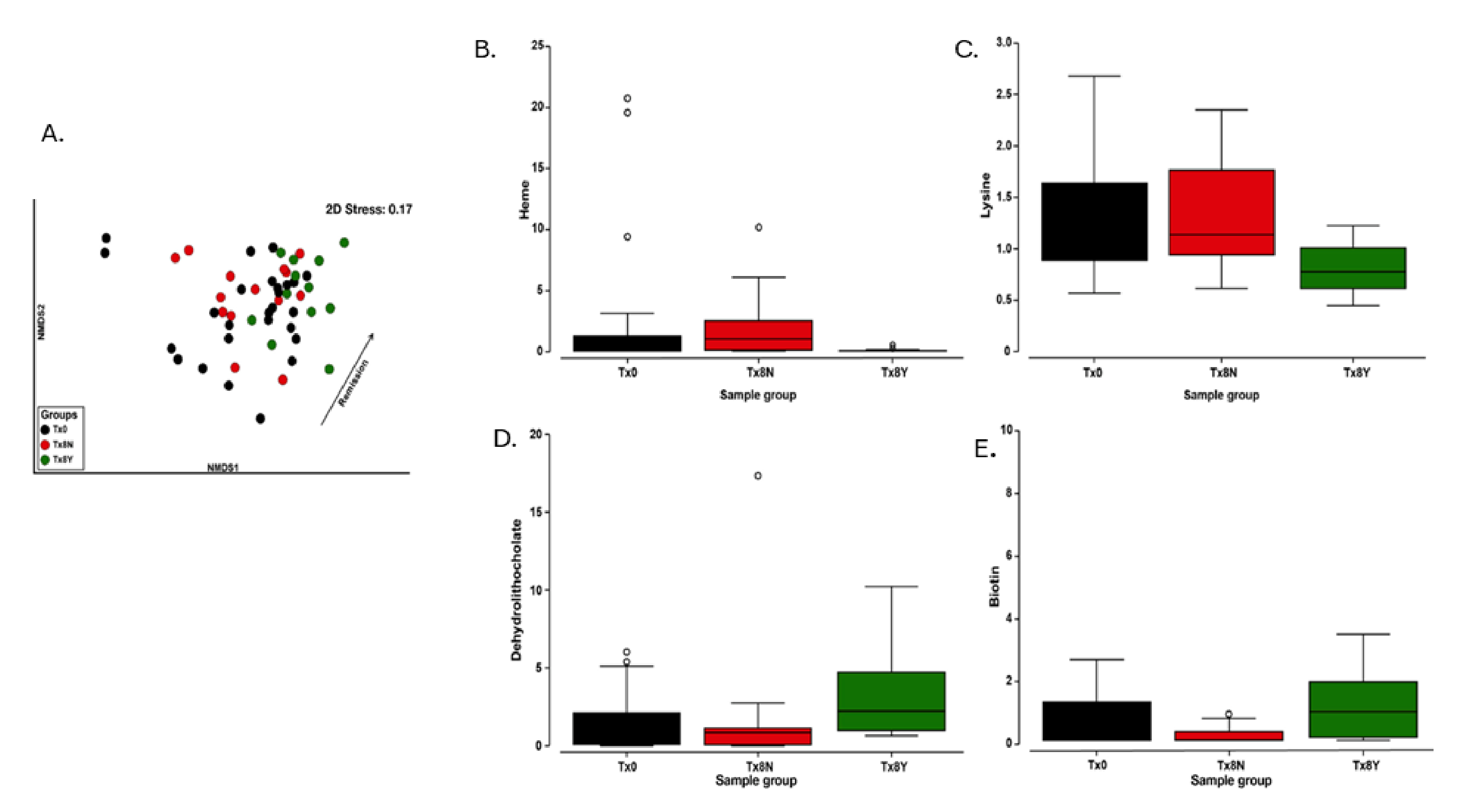
Figure 13. Metabolic profiles associated with primary outcome after FMT. (A) Nonmetric multidimensional scaling plot of the complete metabolic profiles after normalization of the metabolite levels across samples and runs. Baseline and week 8 FMT samples are shown, with week 8 samples divided according to primary outcome. Boxplots showing levels of (B) heme, (C) lysine, (D) dehydrolithocholate, and (E) biotin in patient stool samples at baseline and week 8 FMT. Tx0 = baseline sample, Tx8N = week 8 FMT without clinical remission, Tx8Y = weeks 8 FMT with clinical remission. Image licensed under CC BY 4.0.
In IBD care, predicting which patients will respond to a given therapy remains difficult, often leading to trial-and-error treatment approaches, persistent inflammation in nonresponders, and increased healthcare costs. This study identified microbial and metabolic signatures associated with successful response to FMT, providing a potential framework for patient stratification and more targeted therapy selection. Metabolomics played a key role by revealing functional metabolic changes associated with treatment response, particularly increased secondary bile acid and short-chain fatty acid metabolism. Together, these findings provide mechanistic insight that may support the development of metabolite-based therapeutics and next-generation microbiome interventions.
Understanding the biological mechanisms that link the gut microbiome to intestinal health remains a major focus of IBD research. However, cause-and-effect relationships between microbiome composition and disease activity are poorly understood, limiting both the ability to predict treatment responses and the translation of microbiome discoveries into effective therapies. Metabolomics can help address this gap by identifying microbiota-derived metabolites that function as mediators between microbial communities and host physiology, thereby providing insight into the mechanisms by which microbes influence intestinal inflammation and homeostasis. To advance this understanding, the following study aimed to identify metabolites derived from the microbiota that promote intestinal homeostasis and protect against IBD, with a particular focus on how alterations in microbial metabolism contribute to colitis37.
Targeted and untargeted metabolomic analyses were performed using liquid chromatography-mass spectrometry (LC-MS) on mouse colon tissue and serum, as well as human serum. Transcriptomic profiling was carried out using qualitative PCR in intestinal epithelial cells, organoids, and mouse colon tissue to evaluate gene expression changes. Functional microbiome studies included bacterial culture experiments and gnotobiotic mouse models, complemented by protein-level assessments using Western blotting and cytokine arrays. Statistical analyses involved t-tests for pairwise group comparisons and one-way ANOVA to assess differences in human serum metabolite profiles and histologic scores across groups.
Untargeted metabolomic profiling revealed a marked depletion of tryptophan-derived indole metabolites in dextran sodium sulfate (DSS)-induced colitis, including indole, indole-3-propionic acid (IPA), and indole-3-aldehyde (IAld), in both colon tissue and serum (Figure 14A, B). These changes indicated that intestinal inflammation is associated with a systemic loss of metabolites with known immunoregulatory functions derived from the microbiota. In human cohorts, circulating IPA levels were reduced by approximately 60% in patients with active ulcerative colitis compared with healthy controls, with partial restoration observed during remission, supporting clinical relevance of the murine findings.
Mechanistically, indole metabolites, particularly IPA, were shown to upregulate IL-10 receptor 1 (IL10R1) expression in intestinal epithelial cells, organoids, and mouse tissue, thereby enhancing responsiveness to anti-inflammatory IL-10 signaling. This effect was mediated through activation of the aryl hydrocarbon receptor (AhR), as pharmacologic blockade of AhR abolished IL10R1 induction. In vivo, colonization with indole-producing bacteria increased epithelial IL10R1 expression, while indole-deficient mutants failed to do so, confirming a microbiome-dependent mechanism. Functionally, IPA treatment improved epithelial barrier integrity (Figure 14C), reduced disease severity in DSS colitis, and decreased pro-inflammatory cytokines (IFN-γ, TNF-α, IL-1β), collectively demonstrating that microbial indole metabolites act as endogenous regulators of intestinal inflammation.
Disentangling whether microbial changes are causative drivers of disease or secondary consequences of inflammation remains a major hurdle in microbiome research, particularly when relying on taxonomic profiling alone. In this study, metabolomics was central in bridging this gap by identifying tryptophan-derived indole metabolites as functional mediators linking microbial activity to host immune signaling. This enabled the delineation of a causal pathway from microbial metabolism to AhR activation and IL10R1 upregulation, ultimately converging on reduced intestinal inflammation. By providing direct functional readouts of microbial activity, metabolomics helped move beyond association-based findings and strengthened the mechanistic and translational relevance of microbiome research.
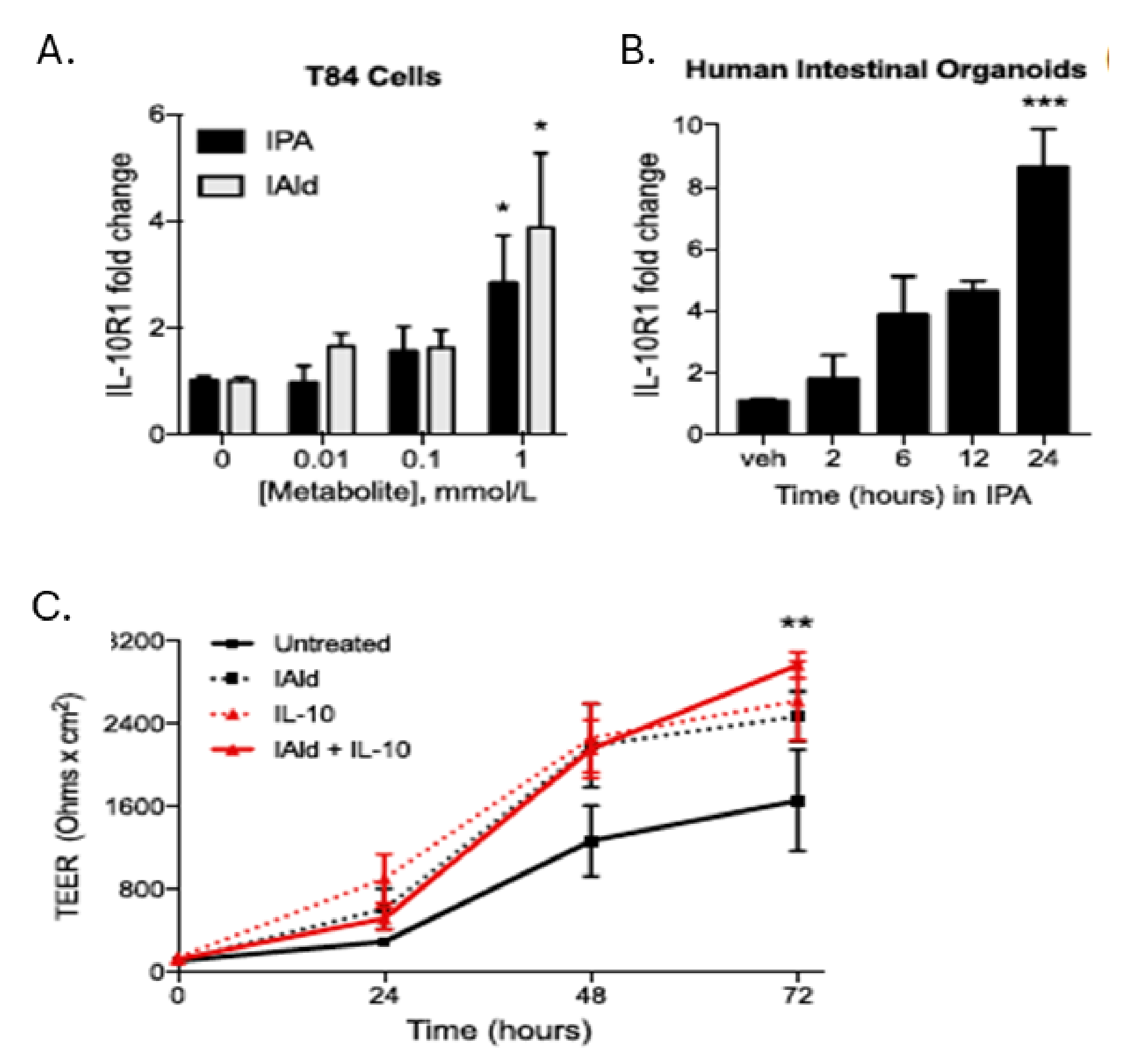
Figure 14. Indole metabolites were shown to improve intestinal barrier formation and induce IL-10 receptor 1 (IL-10R1) on epithelia. (A) Real-time quantitative PCR of IL-10R1 transcript levels in T84 cell treated with indole-3-proprionic acid (IPA) or indole-3-aldehyde (IAld) at varying concentrations for 6 hours. (B) Human intestinal organoids treated with IPA over 24 hours. (C) Transepithelial electrical resistance (i.e., measurement of barrier function) of IPA-treated T84 cells over 72 hours. Image licensed under CC BY 4.0.
A major limitation in translational biomedical research is the wide variability of biological signals and treatment effects that are demonstrated across individuals. In this context, microbiome findings frequently fail to replicate across geographic regions, ethnicities, age groups, and dietary patterns, largely due to the complexity of host-microbiome interactions. This limitation is especially important in precision nutrition studies, where the same diet may yield different results across a study cohort due to clinical covariates. Multiomics approaches provide a framework for overcoming this limitation by integrating microbial, metabolic, and host molecular data to better capture system-level interactions and reduce context-specific bias. In the following study, investigators aimed to reduce response heterogeneity while also evaluating a precision nutrition diet as a means to reverse type II diabetes (T2D). To this end, investigators examined how a postprandial glucose-targeting (PPT) diet, tailored to individual study participants based on their personal predicted glucose responses, and a standard Mediterranean (MED) diet influenced biological systems involved in the early stages of T2D38.
An integrated multiomics strategy was used to assess the molecular and microbial effects of two dietary interventions over a 6-month period. Gut microbial composition was characterized using shotgun metagenomic sequencing of stool and subgingival plaque samples, while serum metabolomics and proteomics were assessed using untargeted liquid chromatography-mass spectrometry (LC-MS) and Olink proximity extension assays, respectively. Changes in multiomics profiles from baseline to study completion were evaluated using Wilcoxon paired signed-rank tests, and mediation analyses were performed to determine whether microbiome alterations mediated relationships between diet and clinical outcomes. Machine learning models and Pearson correlation analyses were used to assess whether changes in microbiome composition could predict circulating metabolite changes, while the Shannon alpha diversity index was used to evaluate microbial diversity.
The PPT diet produced substantially broader biological changes than the MED diet across microbial, metabolic, and immune datasets (Figure 15). After six months, the PPT diet significantly altered 19 gut microbial species, 14 microbial pathways, 86 serum metabolites, and 4 cytokines, compared with 5 microbial species, 18 pathways, 27 metabolites, and 4 cytokines in the MED group. Participants receiving the PPT diet also demonstrated increased gut microbial richness and diversity, reduced human DNA shedding into stool samples, and increases in beneficial bacterial species, including multiple strains of Faecalibacterium prausnitzii, a butyrate-producing microbe associated with improved metabolic health and reduced inflammation. Both diets altered microbial pathways involved in amino acid biosynthesis, fermentation, sugar degradation, nitrate reduction, and thiamin biosynthesis, while metabolomic analyses revealed widespread changes in lipids, fatty acids, and amino acid metabolites, including increases in multiple butyrate-related compounds that are linked to improved glucose homeostasis and reduced inflammation.
One of the most important findings was that the gut microbiome appeared to function as a biological intermediary linking diet to metabolic outcomes. Mediation analyses demonstrated that specific bacterial species, including multiple strains of F. prausnitzii, mediated the effects of diet on HbA1c, glucose exposure, circulating metabolites, and cytokines. Predictive modeling further showed that changes induced by diet in gut microbiome composition explained approximately 12.25% of the variance in serum metabolite changes, providing quantitative evidence that microbial alterations influence host metabolism. Both diets also modified circulating immune markers, supporting coordinated effects on metabolic and immune pathways. Finally, the study found that the gut microbiome underwent larger shifts in species composition, whereas the oral microbiome exhibited greater genetic turnover at strain level, suggesting that these microbial ecosystems respond differently to dietary intervention.
High degree of inter-individual variability limits the effectiveness of dietary recommendations based on population averages and remains a major obstacle in precision nutrition. This study demonstrated that a personalized glucose-targeting diet produced greater improvements in glycemic control and broader molecular changes than a standard Mediterranean diet, supporting the use of individualized nutrition strategies. Metabolomics was instrumental in capturing diet-induced alterations in metabolic pathways, providing functional evidence that personalized dietary recommendations resulted in measurable biological effects. Together, these findings support the integration of continuous glucose monitoring, microbiome profiling, metabolomics, and machine learning into precision nutrition programs for metabolic disease prevention and management.
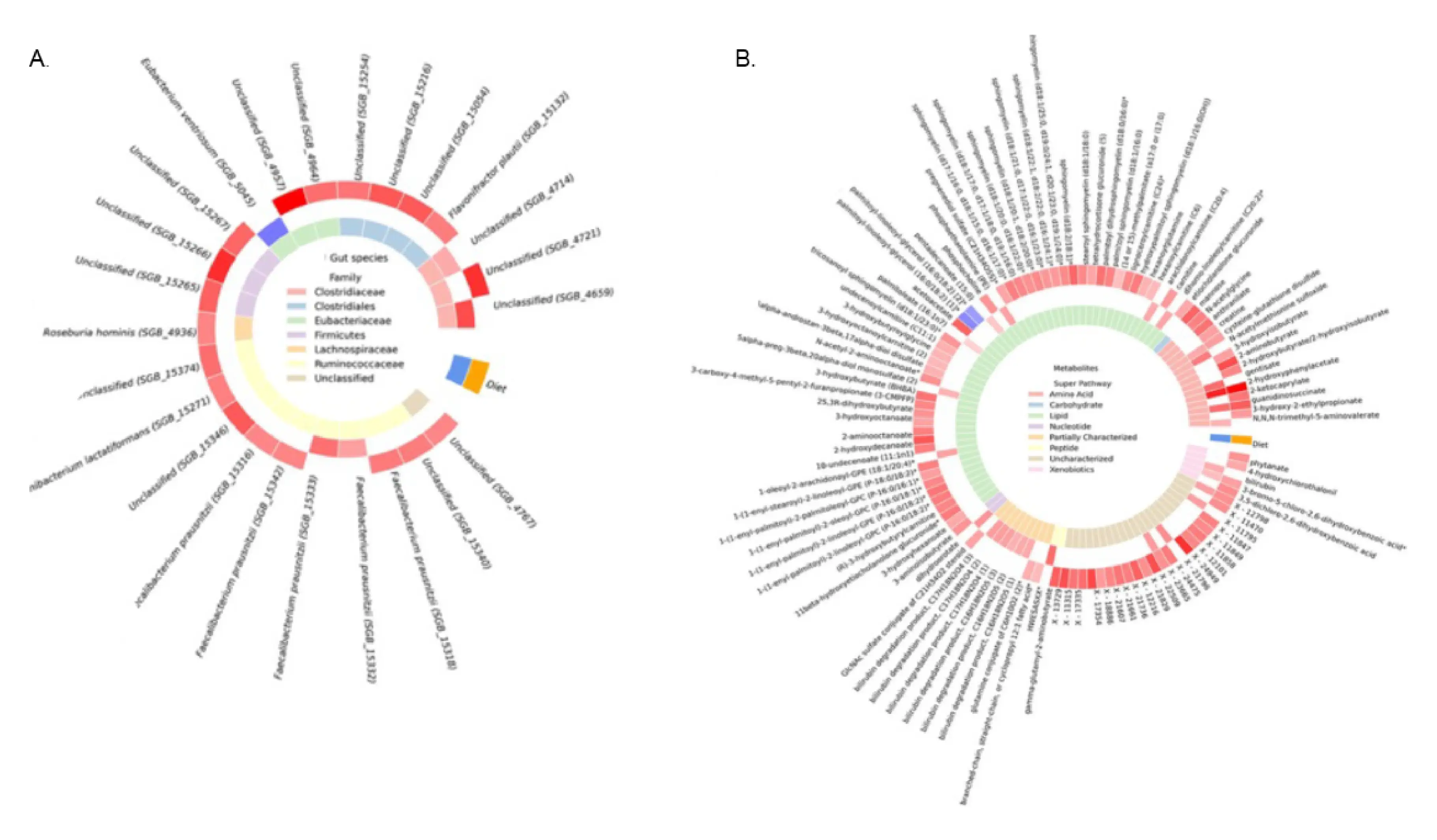
Figure 15. (A) Gut microbial species and (B) metabolites that significantly changed the PPT diet (outer ring) or in the MED diet (middle ring, blue), demonstrating that the PPT diet had a larger effect on the microbiome and metabolites than the MED diet. Image licensed under CC BY 4.0.
Once you see the full value of metabolomics, the only remaining question is: who does it best? While many laboratories have metabolite profiling or analytical chemistry capabilities, comprehensive metabolomics technologies are extremely rare.
Accurate, unbiased metabolite identification across the entire metabolome introduces signal-to-noise challenges that very few labs are equipped to handle. Also, translating massive quantities of data into actionable information is slow, if not impossible, for most because proper interpretation takes two things that are in short supply: experience and a comprehensive database.
Using our robust platform and visualization tools, our experts are uniquely able to tell you more about your molecule and develop assay panels to help you zero in on the results you need.
Coverage
Ability to interrogate thousands of metabolites across diverse biochemical space, revealing new insights and opportunities
Comparability
Ability to integrate the data from different studies into the same dataset, in different geographies, among different patients over time
Competency
Ability to inform on proper study design, generate high‐quality data, derive biological insights, and make actionable recommendations
Capacity
Ability to process hundreds of thousands of samples quickly and cost‐efficiently to service rapidly growing demand
Request a quote for our services, get more information on sample types and handling procedures, request a letter of support, or submit a question about how metabolomics can advance your research.
Corporate Headquarters
617 Davis Drive, Suite 100
Morrisville, NC 27560
Mailing Address
P.O. Box 110407
Research Triangle Park, NC 27709
Phone
+1 (919) 572-1711
Fax
+1 (919) 572-1721
International Headquarters
Metabolon GmbH
Zeppelinstraße 3
85399 Hallbergmoos
Germany