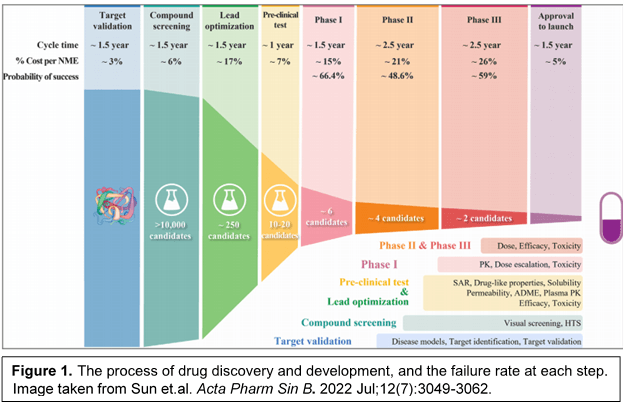
Despite modern assay technologies and data analysis tools drug discovery and development remains a lengthy, challenging, and costly process with a 90% failure rate1. Drug candidates typically fail in clinical trials because they lack clinical efficacy, provoke unmanageable toxicity, or have poor bioavailability1-3 (Figure 1).
Frequently, these issues remain undetected until late in the drug development pipeline because preclinical testing has limited ability to 1) characterize off-target effects that cause systemic toxicity, 2) identify erroneous selection of disease targets, 3) reveal comprehensive insight into the drug’s mechanisms of action, and 4) indicate heterogeneity in drug-target interaction between individuals4-8. Clinical trial failure rates could be improved if the functional readout of drug candidate properties, including target relevance, mechanism of action, and toxicity could be characterized better and earlier.
Figure 1. The process of drug discovery and development, and the failure rate at each step. Image taken from Sun et.al. Acta Pharm Sin B. 2022 Jul; 12(7):3049-3062.
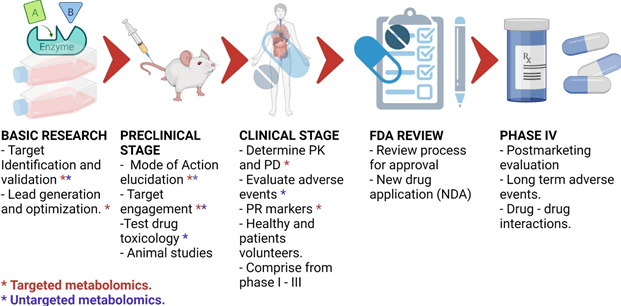
Figure 2. The drug development process and application of metabolomics analysis. The drug development process includes basic research to evaluation of a drug after its release to market. Each step includes unique goals to describe pharmacodynamics, pharmacokinetics, toxicology, clinical efficacy, and side effects. Given its high sensitivity and specificity, metabolomics has become an integral part of this process. Image taken from Alarcon-Barrera et.al. Drug Discov Today. 2022 Jun; 27(6):1763-73.
In recent years, metabolomics has grown to a place of prominence in drug discovery and development as investigators attempt to address these issues. The metabolic profile (i.e., the metabolome) is determined by the biological activity of cells, which reflects the genomic variation of the individual, and by environmental factors including diet and lifestyle. Alterations in metabolite levels are intricately tied to many diseases, which reveal insights into disease etiology, status, and therapeutic response9. By capturing the complex landscape of the metabolome and tracking changes in metabolite levels, metabolomics can reveal distinct molecular phenotypes that reflect the health status of an organism10, 11.
By revealing comprehensive phenotypic information global and targeted metabolomics can better characterize a drug candidate’s MoA, toxicity, pharmacokinetics, and evaluate adverse events associated with the drug (Figure 2)7, 12-14.
6-diazo-5-oxo-L-norleucine (DON) is a glutamine antagonist with promising anti-tumor activity, but it was pulled from clinical trials because of severe gastrointestinal (GI) toxicity. In this study, investigators attempted to optimize the drug to preferentially deliver it to tumors while being inactivated in GI tissues15.
Untargeted metabolomics was used to evaluate metabolic changes caused by the optimized compound, DRP-104. Metabolomics analysis showed that DRP-104, was preferentially bioactivated to DON in tumors (via serine) while simultaneously bio-inactivated to an inert metabolite in GI tissues (via carboxylesterases). This dual pathway activation/inactivation exposed tumors to 11-fold higher amounts of DON than GI tissues, effectively reducing systemic toxicity. Furthermore, DRP-104 demonstrated similar efficacy to DON against tumor growth while significantly reducing GI toxicity. Due to DRP-104 demonstrating differential metabolism in target compared to toxicity-prone tissue, the drug has been put back into clinical trials under the FDA Fast Track designation.
J147 is a novel drug candidate for Alzheimer’s disease (AD) that protects against neurodegeneration in transgenic AD animal models, prompting its advancement to human clinical trials. Ensuring the drug candidate is given in a sufficient dose to interact with the therapeutic target is an important challenge in clinical testing that requires finding biomarkers for target engagement.
The goal of this study was to determine whether specific plasma metabolites could indicate engagement of J147 with its molecular target, the alpha subunit of ATP synthase, in vivo16. Metabolomics analysis from three independent rodent studies showed that J147 consistently reduced free fatty acid levels in both plasma and liver. Changes in the liver were associated with AMP-activated protein kinase signaling activity, which was confirmed in HepG2 cells. Altogether, these findings identified a blood-based biomarker for ATP synthase modulation.
Although antihypertensive and lipid-lowering drugs are prescribed to millions of patients, their mechanisms of action are not fully understood. To gain new insight into this topic one research group conducted a metabolome-wide association analysis to generate new hypotheses about on- and off-target effects through metabolic variations associated with these drugs17.
Beta-blockers, angiotensin-converting enzyme (ACE) inhibitors, diuretics, statins, and fibrates were tested. Significant associations were found between beta-blockers and metabolite concentrations typical of drug side-effects, including increased serotonin and decreased free fatty acids. ACE inhibitors and statins associated with metabolites indicative of target engagement including reduced cholesterol and a product of the drug-inhibited ACE. Fibrates associated with metabolites indicative of their metabolic degradation, and diuretics showed considerable heterogeneity in metabolite changes that will require further study to fully characterize.
Altogether, this work provides a foundation for deeper understanding of the action and off-target effects of antihypertensive and lipid-lowering drugs.
Colorectal cancer (CC) is the third most prevalent malignancy in the United States for which novel targeted therapies are needed. CC cells contain high levels of cystathionine-beta-synthase (CBS). The product of CBS, hydrogen sulfide, promotes CC cell proliferation and tumor growth. Aminoooxyacetic acid (AOAA) is a CBS inhibitor that can regress CC, however its cellular uptake is limited. To improve uptake and in turn the anti-tumor efficacy of AOAA, Chao et.al. synthesized YD0171, a methyl ester derivative of AOAA18. The goal of this study was to evaluate the therapeutic efficacy of YD0171 and characterize its mechanism of action.
Metabolomics confirmed that YD0171 effectively inhibits CBS, as evidenced by alterations in transsulfuration pathway metabolites and reduced hydrogen sulfide, thus validating CBS as the therapeutic target. The analysis also showed that YD0171 disrupts critical metabolic pathways, such as the TCA cycle and glycolysis, which are essential for cancer cell bioenergetics. This provided a mechanistic basis for its antiproliferative effects. Metabolomics confirmed that YD0171 acts as a prodrug by converting to its active form, AOAA, within cells. This was evidenced by the similarity in metabolic effects between YD0171 and AOAA. The study demonstrated that YD0171 induces stronger metabolic disruptions than AOAA at lower doses, guiding its optimization for higher efficacy. Finally, metabolomics data indicated that YD0171 preferentially affects tumor metabolism while sparing normal tissues, which reduces the likelihood of systemic toxicity.
Altogether, metabolomics served as a comprehensive tool to guide the rational design, optimization, and validation of YD0171, ensuring its efficacy, safety, and selectivity as a targeted anticancer therapy. This approach exemplifies how metabolomics can accelerate drug development by linking biochemical changes to therapeutic outcomes.
Once you see the full value of metabolomics, the only remaining question is: who does it best? While many laboratories have metabolite profiling or analytical chemistry capabilities, comprehensive metabolomics technologies are extremely rare.
Accurate, unbiased metabolite identification across the entire metabolome introduces signal-to-noise challenges that very few labs are equipped to handle. Also, translating massive quantities of data into actionable information is slow, if not impossible, for most because proper interpretation takes two things that are in short supply: experience and a comprehensive database.
Using our robust platform and visualization tools, our experts are uniquely able to tell you more about your molecule and develop assay panels to help you zero in on the results you need.
Coverage
Ability to interrogate thousands of metabolites across diverse biochemical space, revealing new insights and opportunities
Comparability
Ability to integrate the data from different studies into the same dataset, in different geographies, among different patients over time
Competency
Ability to inform on proper study design, generate high‐quality data, derive biological insights, and make actionable recommendations
Capacity
Ability to process hundreds of thousands of samples quickly and cost‐efficiently to service rapidly growing demand
Request a quote for our services, get more information on sample types and handling procedures, request a letter of support, or submit a question about how metabolomics can advance your research.
Corporate Headquarters
617 Davis Drive, Suite 100
Morrisville, NC 27560
Mailing Address
P.O. Box 110407
Research Triangle Park, NC 27709
Phone
+1 (919) 572-1711
Fax
+1 (919) 572-1721
International Headquarters
Metabolon GmbH
Zeppelinstraße 3
85399 Hallbergmoos
Germany
1. Dowden, H. and J. Munro, Trends in clinical success rates and therapeutic focus. Nat Rev Drug Discov, 2019. 18(7): p. 495-496.
2. Harrison, R.K., Phase II and phase III failures: 2013-2015. Nat Rev Drug Discov, 2016. 15(12): p. 817-818.
3. Takebe, T., R. Imai, and S. Ono, The Current Status of Drug Discovery and Development as Originated in United States Academia: The Influence of Industrial and Academic Collaboration on Drug Discovery and Development. Clin Transl Sci, 2018. 11(6): p. 597-606.
4. Larsson, P., et al., Optimization of cell viability assays to improve replicability and reproducibility of cancer drug sensitivity screens. Sci Rep, 2020. 10(1): p. 5798.
5. Emmerich, C.H., et al., Improving target assessment in biomedical research: the GOT-IT recommendations. Nat Rev Drug Discov, 2021. 20(1): p. 64-81.
6. Davis, K.D., et al., Discovery and validation of biomarkers to aid the development of safe and effective pain therapeutics: Challenges and opportunities. Nat Rev Neurol, 2020. 16(7): p. 381-400.
7. Moffat, J.G., et al., Opportunities and challenges in phenotypic drug discovery: An industry perspective. Nat Rev Drug Discov, 2017. 16(8): p. 531-543.
8. Lin, A., et al., Off-target toxicity is a common mechanism of action of cancer drugs undergoing clinical trials. Sci Transl Med, 2019. 11(509).
9. Beger, R.D., et al., Metabolomics enables precision medicine: “A White Paper, Community Perspective”. Metabolomics, 2016. 12(10): p. 149.
10. Fiehn, O., Metabolomics – The link between genotypes and phenotypes. Plant Mol Biol, 2002. 48(1-2): p. 155-71.
11. Nicholson, J.K. and I.D. Wilson, Opinion: Understanding ‘global’ systems biology: Metabonomics and the continuum of metabolism. Nat Rev Drug Discov, 2003. 2(8): p. 668-76.
12. Luukkonen, P.K., et al., Hydroxysteroid 17-beta dehydrogenase 13 variant increases phospholipids and protects against fibrosis in nonalcoholic fatty liver disease. JCI Insight, 2020. 5(5).
13. Schenone, M., et al., Target identification and mechanism of action in chemical biology and drug discovery. Nat Chem Biol, 2013. 9(4): p. 232-40.
14. Fox, J.T. and K. Myung, Cell-based high-throughput screens for the discovery of chemotherapeutic agents. Oncotarget, 2012. 3(5): p. 581-5.
15. Rais, R., et al., Discovery of DRP-104, a tumor-targeted metabolic inhibitor prodrug. Sci Adv, 2022. 8(46): p. eabq5925.
16. Kepchia, D., et al., The Alzheimer’s disease drug candidate J147 decreases blood plasma fatty acid levels via modulation of AMPK/ACC1 signaling in the liver. Biomed Pharmacother, 2022. 147: p. 112648.
17. Altmaier, E., et al., Metabolomics approach reveals effects of antihypertensives and lipid-lowering drugs on the human metabolism. Eur J Epidemiol, 2014. 29(5): p. 325-36.
18. Chao, C., et al., Cystathionine-beta-synthase inhibition for colon cancer: Enhancement of the efficacy of aminooxyacetic acid via the prodrug approach. Mol Med, 2016. 22: p. 361-379.